Researchers find why nicotine in cigarettes may relieve anxiety in smokers
November 8, 2012 in Medical research
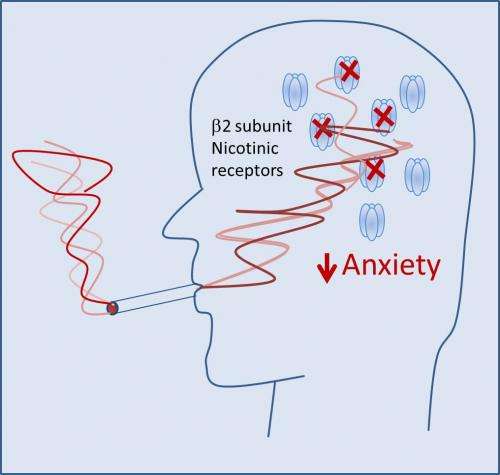
This image illustrates how nicotine in cigarette smoke may reduce anxiety by blocking the activity of the high affinity beta2 subunit containing nicotinic acetylcholine receptors. Credit: Image courtesy of Darlene Brunzell, Ph.D./VCU
Preclinical data suggests inactivation of a specific sub-class of nicotinic receptors may be an effective strategy to help smokers quit without feeling anxious, according to Virginia Commonwealth University researchers.
These findings could one day point researchers to the development of novel therapies to help smokers quit without feeling anxious.
Smokers use cigarettes for many reasons, but many report that they smoke to relieve anxiety, despite the health danger of cigarette smoking. Researchers are now working to understand the underlying neurochemical pathways that support smoking behavior.
In a study, published online this week in PLoS ONE, researchers observed that low doses of nicotine and a nicotinic receptor blocker had similar effects to reduce anxiety-like behavior in an animal model. They found that inactivation of beta2 subunit, a specific sub-class of nicotinic receptors that bind nicotine, appears to reduce anxiety. This is different from the mechanism that regulates nicotine reward and likely occurs in a separate brain area.
"This work is unique because it suggests that nicotine may be acting through inactivation, rather than activation, of the high affinity nicotinic receptors," said Darlene Brunzell, Ph.D., assistant professor in the Department of Pharmacology and Toxicology in the VCU School of Medicine.
"Nicotine acts like a key that unlocks nicotine receptors in the brain. Usually that key opens the receptor, but at other times nicotine is like a key that has gotten broken inside of the lock. Our findings suggest that low-dose nicotine may block a specific subtype of receptor from opening that is important for regulating anxiety behavior," she said, adding that anxiety is a major reason why people relapse to smoking.
Brunzell and colleagues are conducting ongoing studies that they hope will help to identify which brain areas regulate the anxiolytic effects of nicotine. Using genetic strategies, they are attempting to determine the specific molecular make-up of the nicotinic receptors that regulate anxiety.
According to Brunzell, from a therapeutic perspective it will be important to discover if blocking beta2 subunit containing nicotinic receptors relieves anxiety in smokers.
"Understanding what other subunits combine with beta2 to form the critical receptors that regulate anxiety could lead to selective therapeutics with fewer side effects," she said.
More information: www.plosone.org/ar… pone.0048665
Journal reference:
PLoS ONE
Provided by
Virginia Commonwealth University
-
Eliminating protein in specific brain cells blocks nicotine reward
Jul 26, 2011 |
not rated yet |
0
-
Children of women who smoked during pregnancy at increased risk of becoming smokers: study
Mar 21, 2011 |
not rated yet |
0
-
Your brain on nicotine: Nicotine receptors affect social behavior
Jun 30, 2011 |
not rated yet |
0
-
Do 'light' cigarettes deliver less nicotine to the brain than regular cigarettes?
Sep 28, 2008 |
not rated yet |
0
-
Why smokers are thinner? Nicotine triggered appetite suppression site identified in brain
Jun 09, 2011 |
not rated yet |
0
-
Motion perception revisited: High Phi effect challenges established motion perception assumptions
Apr 23, 2013 |
3 / 5 (2) |
2
-
Anything you can do I can do better: Neuromolecular foundations of the superiority illusion (Update)
Apr 02, 2013 |
4.5 / 5 (11) |
5
-
The visual system as economist: Neural resource allocation in visual adaptation
Mar 30, 2013 |
5 / 5 (2) |
9
-
Separate lives: Neuronal and organismal lifespans decoupled
Mar 27, 2013 |
4.9 / 5 (8) |
0
-
Sizing things up: The evolutionary neurobiology of scale invariance
Feb 28, 2013 |
4.8 / 5 (10) |
14
-
Why is zone 1 in liver more prone to ischemic injury?
May 23, 2013
-
How can there be villous adenoma in colon, if there are no villi there
May 22, 2013
-
How can there be a term called "intestinal metaplasia" of stomach
May 21, 2013
-
Pressure-volume curve: Elastic Recoil Pressure don't make sense
May 18, 2013
-
If you became brain-dead, would you want them to pull the plug?
May 17, 2013
-
MRI bill question
May 15, 2013
- More from Physics Forums - Medical Sciences
More news stories
Study reveals new mechanism for estrogen suppression of liver lipid synthesis
By discovering the new mechanism by which estrogen suppresses lipid synthesis in the liver, UC Irvine endocrinologists have revealed a potential new approach toward treating certain liver diseases.
Medical research
May 23, 2013 |
5 / 5 (1) |
0
|
MRI-based measurement helps predict vascular disease in the brain
Aortic arch pulse wave velocity, a measure of arterial stiffness, is a strong independent predictor of disease of the vessels that supply blood to the brain, according to a new study published in the June issue the journal ...
Medical research
May 23, 2013 |
not rated yet |
0
Antibiotics: A new understanding of sulfonamide nervous system side effects
Since the discovery of Prontosil in 1932, sulfonamide antibiotics have been used to combat a wide spectrum of bacterial infections, from acne to chlamydia and pneumonia. However, their side effects can include serious neurological ...
Medical research
May 23, 2013 |
not rated yet |
0
|
Scientists discover molecule triggers sensation of itch
Scientists at the National Institutes of Health report they have discovered in mouse studies that a small molecule released in the spinal cord triggers a process that is later experienced in the brain as ...
Medical research
May 23, 2013 |
5 / 5 (3) |
0
|
Discarded immune cells induce the relocation of stem cells
Spanish researchers have discovered that the daily clearance of neutrophils from the body stimulates the release of hematopoietic stem cells from the bone marrow into the bloodstream, according to a report published today ...
Medical research
May 23, 2013 |
5 / 5 (2) |
0
Engineered cytomegalovirus protects monkeys from HIV equivalent
(Medical Xpress)—A new study by researchers in the US has shown that an ancient virus can be modified to help in the fight against the simian immunodeficiency virus SIV, which is the equivalent in monkeys ...
Researchers identify first drug targets in childhood genetic tumor disorder
Two mutations central to the development of infantile myofibromatosis (IM)—a disorder characterized by multiple tumors involving the skin, bone, and soft tissue—may provide new therapeutic targets, according to researchers ...
Hormone levels may provide key to understanding psychological disorders in women
Women at a particular stage in their monthly menstrual cycle may be more vulnerable to some of the psychological side-effects associated with stressful experiences, according to a study from UCL.
Going live: Immune cell activation in multiple sclerosis
Biological processes are generally based on events at the molecular and cellular level. To understand what happens in the course of infections, diseases or normal bodily functions, scientists would need to ...
Help at hand for people with schizophrenia
How can healthy people who hear voices help schizophrenics? Finding the answer for this is at the centre of research conducted at the University of Bergen.
Alzheimer's disease, the soft target of the euthanasia debate
(Medical Xpress)—The way Alzheimer's disease is portrayed by advocacy groups and the media is having undue influence on the euthanasia debate, according to a Deakin University nursing ethics professor.