Pathway identified in human lymphoma points way to new blood cancer treatments
November 21, 2012 in Cancer

Pathway identified in human lymphoma points way to new blood cancer treatments

Enlarge

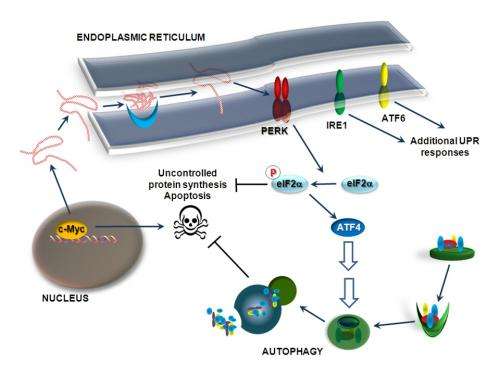
This image shows how the PERK-dependent arm of the UPR is thought to contribute to Myc-dependent tumorigenesis. Elevated levels of c-Myc increase the amount of synthesized proteins, including client proteins which enter the Endoplasmic reticulum (ER) to be folded by chaperones (top). An imbalance of client proteins vs. chaperones induces activation of the kinase PERK. PERK, in turn, phosphorylates the translation factor eIF2a which reduces the rates of protein synthesis. Also, phosphorylation of eIF2a increases the transcription factor ATF4 which activates the process of autophagy (bottom). Autophagy has been shown to prevent cell death. Therefore, the combined effects of PERK and eIF2a on protein synthesis and autophagy contribute to reduced cell death, thereby promoting tumor cell survival and lymphoma progression. Credit: Constantinos Koumenis, Ph.D., Perelman School of Medicine, University of Pennsylvania

A pathway called the "Unfolded Protein Response," or UPR, a cell's way of responding to unfolded and misfolded proteins, helps tumor cells escape programmed cell death during the development of lymphoma.

Research, led by Lori Hart, Ph.D., research associate and Constantinos Koumenis, Ph.D., associate professor,and research division director in the Department of , both from the Perelman School of Medicine, University of Pennsylvania, and Davide Ruggero, Ph.D., associate professor, Department of Urology, University of California, San Francisco, shows for the first time that the UPR is active in patients with human lymphomas and mice genetically bred to develop lymphomas. Importantly, when the UPR is inactivated, readily undergo cell death. Their findings appear online in the and will appear in the December 2012 issue.

"The general implications of our work are that components of this pathway may be attractive anti-tumor targets, especially in lymphomas," says Koumenis. "Indeed, an enzyme called PERK, a kinase that we found to play a central role in UPR, is already being targeted by several groups, in academia and pharmaceutical companies with specific inhibitors."

The cancer-causing gene c-Myc paradoxically activates both and death. When the cell becomes cancerous, c-Myc–induced death is bypassed, promoting . "A critical feature of c-Myc-overexpressing is an increased rate of protein synthesis that is essential for Myc's ability to cause cancer," says Tom Cunningham, Ph.D., a postdoctoral fellow in the Ruggero lab. "Myc use this aberrant production of proteins to block apoptosis and activate the UPR. These depend on Myc-induced increases in protein abundance to survive. Therefore, targeting downstream of Myc oncogenic activity may represent a promising new for ," adds Ruggero.

The accumulation of unfolded proteins in the endoplasmic reticulum, an inner cell component where newly made proteins are folded, initiates a stress program, the UPR, to support cell survival. Normally, UPR kicks in when there is an imbalance in the number of proteins that need to be folded and chaperones, specialized proteins that help fold them.

Analysis of mouse and human lymphomas demonstrated significantly higher levels of UPR activation compared with normal tissues. Using multiple genetic models, the two teams, in collaboration with additional labs in the US and Europe, demonstrated that Myc specifically activated one arm of the UPR, leading to increased cell survival by autophagy.

Autophagy is a survival pathway allowing a cell to recycle damaged proteins when it's under stress and reuse the damaged parts to fuel further growth. Cancer cells might be addicted to autophagy, since this innate response may be a critical means by which the cells survive the nutrient limitation and lack of oxygen commonly found within tumors.

Inhibition of one protein, PERK, in the UPR arm studied, significantly reduced Myc-induced autophagy and tumor formation. What's more, drug- or genetic-mediated inhibition of autophagy increased Myc-dependent cell death.

"Our findings establish a role for UPR as an enhancer of c-Myc–induced lymphomas and suggest that inhibiting UPR may be particularly effective against cancers characterized by c-Myc overexpression," says Koumenis. "In this context the UPR essentially acts as one of the cell's rheostats to counterbalance Myc's runaway cell replication nature and its pro-cell-death tendencies."

However, Koumenis indicates that further research is needed on the potential effects of PERK inhibition on normal tissues: "Although data from our lab and other groups suggest that PERK inhibition in tumors grown in animals is feasible, other studies suggest that PERK plays a critical role in the function of secretory tissues such as the pancreas. Carefully testing the effects of new PERK inhibitors in animal models of lymphoma and other malignancies in the next couple of years should address this question and could open the way for new clinical trials with such agents."

Journal reference: Journal of Clinical Investigation search and more info website

Provided by University of Pennsylvania School of Medicine search and more info website

not rated yet  

Rank not rated yet
Relevant PhysicsForums posts

More news stories

Research identifies a way to make cancer cells more responsive to chemotherapy

Breast cancer characterized as "triple negative" carries a poor prognosis, with limited treatment options. In some cases, chemotherapy doesn't kill the cancer cells the way it's supposed to. New research from Western University ...

Cancer created 10 hours ago | popularity 5 / 5 (3) | comments 0

Mayo Clinic genomic analysis lends insight to prostate cancer

Mayo Clinic researchers have used next generation genomic analysis to determine that some of the more aggressive prostate cancer tumors have similar genetic origins, which may help in predicting cancer progression. The findings ...

Cancer created 10 hours ago | popularity not rated yet | comments 0

When oxygen is short, EGFR prevents maturation of cancer-fighting miRNAs

Even while being dragged to its destruction inside a cell, a cancer-promoting growth factor receptor fires away, sending signals that thwart the development of tumor-suppressing microRNAs (miRNAs) before it's dissolved, researchers ...

Cancer created 11 hours ago | popularity not rated yet | comments 0 | with audio podcast

Improved chemo regimen for childhood leukemia may offer high survival, no added heart toxicity

Treating pediatric leukemia patients with a liposomal formulation of anthracycline-based chemotherapy at a more intense-than-standard dose during initial treatment may result in high survival rates without causing any added ...

Cancer created 15 hours ago | popularity not rated yet | comments 0

Protein preps cells to survive stress of cancer growth and chemotherapy

Scientists have uncovered a survival mechanism that occurs in breast cells that have just turned premalignant-cells on the cusp between normalcy and cancers-which may lead to new methods of stopping tumors.

Cancer created 16 hours ago | popularity not rated yet | comments 0 | with audio podcast


Controlling mood through the motions of mitochondria

(Medical Xpress)—Regulating the distribution of power in neurons is done by a system that makes the national electric grid look simple by comparison. Each neuron has several thousand mitochondria confined ...

Motion quotient: IQ predicted by ability to filter motion (w/ video)

A brief visual task can predict IQ, according to a new study. This surprisingly simple exercise measures the brain's unconscious ability to filter out visual movement. The study shows that individuals whose ...

Multiple research teams unable to confirm high-profile Alzheimer's study

Teams of highly respected Alzheimer's researchers failed to replicate what appeared to be breakthrough results for the treatment of this brain disease when they were published last year in the journal Science.

Scientists discover molecule triggers sensation of itch

Scientists at the National Institutes of Health report they have discovered in mouse studies that a small molecule released in the spinal cord triggers a process that is later experienced in the brain as ...

Researchers find common childhood asthma unconnected to allergens or inflammation

Little is known about why asthma develops, how it constricts the airway or why response to treatments varies between patients. Now, a team of researchers at Weill Cornell Medical College, Columbia University Medical Center ...

Diabetes' genetic underpinnings can vary based on ethnic background, studies say

Ethnic background plays a surprisingly large role in how diabetes develops on a cellular level, according to two new studies led by researchers at the Stanford University School of Medicine.