What is the psychology behind our desire to wait in line for the latest and greatest?
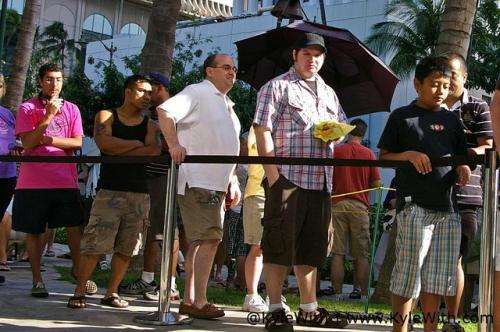
(Medical Xpress)—As the Black Friday sales start earlier and the smartphones play hard to get, a Kansas State University professor says psychology can explain why consumers wait in line for the latest sales, gadgets and experiences.
Different people wait in long lines for different reasons, said Laura Brannon, a professor of psychology who also researches consumer psychology. A line of people can represent a wide variety of personalities and motivations for waiting—or camping—in line.
"People who are very motivated to have scarce items tend to have a high need to be unique," Brannon said. "On the other hand, people who are motivated by social proof tend to want to fit in with everyone else. You might see a bunch of people waiting in line, but different things might be going through all their minds. It's a little more complicated than it might first appear."
From Harry Potter midnight shows to smartphones and video games, waiting in line for the latest product or experience is not a new phenomenon. Brannon traces the most famous waiting incident back to the mid-1980s, when the Cabbage Patch Kids doll frenzy occurred. Parents promised the dolls to their children, but the demand greatly exceeded availability, she said. Although the dolls were fairly inexpensive, people still paid hundreds of dollars to obtain them.
People lined up a few weeks ago for the release of the latest smartphone, and the lines will happen again with the arrival of Black Friday on Nov. 23. Although Brannon said there might be good deals on Black Friday, there is also a lot of clever marketing involved because marketers are aware of social influence practices on the consumer.
"I think the quality of the deals offered will obviously vary by store," Brannon said. "Many stores have a few very good deals to get consumers into the store, hoping that they'll buy other things as well."
Brannon said that at least two social influence principles explain consumers' willingness to wait in line for products or experiences: the scarcity principle and the social proof principle.
The scarcity principle is similar to playing hard to get in the dating arena. The principle states that people naturally want things that are rare or difficult to obtain, Brannon said. In reality, many things—such as diamonds—are naturally rare and are actually valuable. Marketers understand this effect on other products, too.
"Marketers create a demand by imposing an artificial scarcity on an opportunity," Brannon said. "Research shows that people tend to react against limits on opportunities and reassert their freedom to have and do what they want."
Even though people could wait an extra week for a new smartphone or a few extra days to see a movie, the scarcity principle motivates people to buy the smartphone or see the movie because they are difficult to obtain.
The social proof principle is the concept that if other people are doing something, we use that as evidence that it must be good, Brannon said. Advertisers emphasize when their products are the best-selling or leading brand. It is usually the case that the reason a product or experience is very popular is because people realize it is of good quality or value.
"Once the lines form, there's a tendency to assume that's a cue to the value of the experience or opportunity, and people want to join in," Brannon said.
With the social proof principle, there also is an element of normative influence, which is when people want to fit in with what other people are doing, Brannon said. For instance, if five people stand on a busy street corner and look up in the air, most passersby will stop and look up as well because they'll assume there's something to see. The same concept applies when people wait in line.
"Solidarity might be one part of it," Brannon said. "For some people it might be more about the information that others' behavior provides, and for others it might be wanting to fit in. But for most people it is probably a combination of these two."
Similarly, people's willingness to wait in line also involves how the waiting is framed. People might complain about waiting in line for two hours for something required, while they are less likely to complain about waiting overnight for the latest gadget that they want.
"When someone is waiting at the DMV, they're waiting to do something they have to do," Brannon said. "When they're waiting to get an iPhone, they're waiting for something they want. The waiting makes the first one a negative experience more negative, but the waiting can increase the excitement and anticipation of the second experience."
Brannon also conducts full-cycle social psychological research, which means that she conducts basic research studying the processes of persuasion and compliance and extends this research to applied areas. She also researches social marketing, which is a relatively recent trend in which researchers apply tried-and-true marketing and social influence techniques to the improvement of social problems.


