Researchers quantify how many years of life are gained by being physically active
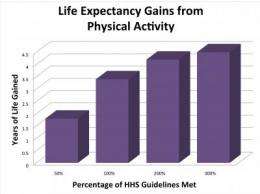
This bar graph displays the years of life gained when participants in a study by the National Cancer Institute met various percentages of physical activity guidelines recommended by the US Department of Health and Human Services. Credit: National Cancer Institute
In a new study from Brigham and Women's Hospital, in collaboration with the National Cancer Institute, researchers have quantified how many years of life are gained by being physically active at different levels, among all individuals as well as among various groups with different body mass index.
We all know that exercise is good for you, but how good? While previous studies have shown the link between physical activity and a lower risk of premature mortality, the number of years of life expectancy gained among persons with different activity levels has been unclear—until now. In a new study from Brigham and Women's Hospital (BWH), in collaboration with the National Cancer Institute, researchers have quantified how many years of life are gained by being physically active at different levels, among all individuals as well as among various groups with different body mass index (BMI).
The study will be published on November 6, 2012 in PLOS Medicine.
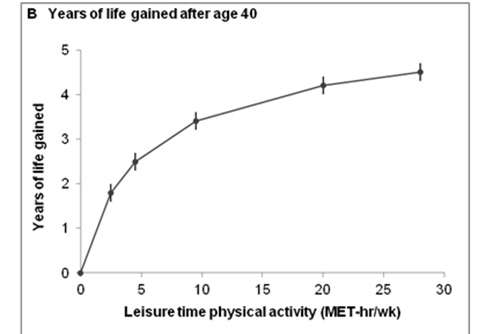
Researchers from Brigham and Women’s Hospital have quantified how many years of life are gained, by being physically active at different levels, among all individuals as well as among various groups with different body mass index (BMI). Credit: Courtesy of BWH
"We found that adding low amounts of physical activity to one's daily routine, such as 75 minutes of brisk walking per week, was associated with increased longevity: a gain of 1.8 years of life expectancy after age 40, compared with doing no such activity," explained I-Min Lee, MD, associate epidemiologist in the Department of Preventive Medicine at BWH and senior author on this study. "Physical activity above this minimal level was associated with additional gains in longevity. For example, walking briskly for at least 450 minutes a week was associated with a gain of 4.5 years. Further, physical activity was associated with greater longevity among persons in all BMI groups: those normal weight, overweight, and obese."In pooled data from six prospective cohort studies, the researchers examined associations of leisure-time physical activity of a moderate to vigorous intensity with mortality. They analyzed data from more than 650,000 subjects and followed subjects for an average of ten years- analyzing over 82,000 deaths. The large sample size allowed them to estimate years of life gained after the age of 40 among persons with different levels of physical activity and BMI.
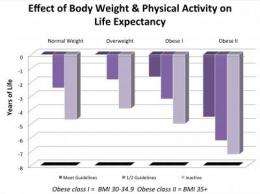
This bar graph displays years of life loss at various body weights and levels of activity. A study by the National Cancer Institute found that physical activity increased life expectancy, regardless of body weight. Credit: National Cancer Institute
The findings show that physical activity was associated with longer life expectancies across a range of activity levels and BMI groups. Participation in a low level of leisure time physical activity of moderate to vigorous intensity, comparable to up to 75 min of brisk walking per week, was associated with a 19 percent reduced risk of mortality compared to no such activity.Assuming a causal relationship, which is not specifically demonstrated in this research, this level of activity would confer a 1.8 year gain in life expectancy after age 40, compared with no activity. For those who did the equivalent to 150 min of brisk walking per week—the basic amount of physical activity currently recommended by the federal government—the gain in life expectancy was 3.4 years. These benefits were seen in both men and women, and among white and black participants. Importantly, they were also observed among persons who were normal weight, overweight, and obese. Participants faring best were those who were both normal weight and active: among normal weight persons who were active at the level recommended by the federal government, researchers observed a gain in life expectancy of 7.2 years, compared to those with a BMI of 35 or more who did no leisure time physical activity (a 5 ft 5 in tall person with BMI of 35 weighs 210 lb).
"Our findings reinforce prevailing public health messages promoting both a physically active lifestyle and a normal body weight," explained Dr. Steven C. Moore, PhD, research fellow at the National Cancer Institute (NCI) and lead author of this study. This findings may also help convince currently inactive persons that even being modestly active is ''worth it'' for greater longevity, even if it may not result in weight control.
More information: Moore SC, et al. Leisure Time Physical Activity of Moderate to Vigorous Intensity and Mortality: A Large Pooled Cohort Analysis. PLoS Medicine. November 6, 2012. doi: 10.1371/journal.pmed.1001335
Journal reference:
PLoS Medicine
Provided by
Brigham and Women's Hospital
-
60 minutes of exercise per day needed for middle-aged women to maintain weight
Mar 23, 2010 |
not rated yet |
0
-
Physical activity more likely to prevent breast cancer in certain groups
May 13, 2008 |
not rated yet |
0
-
15 minutes of physical activity per day reduces risk of death by 14 percent, increases life expectancy by 3 years
Aug 15, 2011 |
not rated yet |
0
-
Early mortality risk reduced up to 40 percent through increased physical activity and sports
Oct 20, 2011 |
not rated yet |
0
-
Physical activity after bariatric surgery improves weight loss, quality of life
Nov 17, 2008 |
not rated yet |
0
-
Motion perception revisited: High Phi effect challenges established motion perception assumptions
Apr 23, 2013 |
3 / 5 (2) |
2
-
Anything you can do I can do better: Neuromolecular foundations of the superiority illusion (Update)
Apr 02, 2013 |
4.5 / 5 (11) |
5
-
The visual system as economist: Neural resource allocation in visual adaptation
Mar 30, 2013 |
5 / 5 (2) |
9
-
Separate lives: Neuronal and organismal lifespans decoupled
Mar 27, 2013 |
4.9 / 5 (8) |
0
-
Sizing things up: The evolutionary neurobiology of scale invariance
Feb 28, 2013 |
4.8 / 5 (10) |
14
-
Classical and Quantum Mechanics via Lie algebras
Apr 15, 2011
- More from Physics Forums - Independent Research
More news stories
Life expectancy gap widens between those with mental illness and general population
The gap between life expectancy in patients with a mental illness and the general population has widened since 1985 and efforts to reduce this gap should focus on improving physical health, suggest researchers in a paper ...
Health
8 hours ago |
not rated yet |
0
Failure to use linked health records may lead to biased disease estimates
Failure to use linked electronic health records may lead to biased estimates of heart attack incidence and outcome, warn researchers in a paper published in BMJ today.
Health
8 hours ago |
5 / 5 (1) |
0
Dietary advice on added sugar is damaging our health, warns heart expert
Dietary advice on added sugar is damaging our health, warns a cardiologist in BMJ today. Dr. Aseem Malhotra believes that "not only has this advice been manipulated by the food industry for profit but it is actually a risk ...
Health
8 hours ago |
5 / 5 (4) |
0
CDC presents recent trends in health behaviors of US adults
(HealthDay)—In 2008 to 2010, the prevalence of key health behaviors among U.S. adults varied, with about one in five adults current smokers and 62.1 percent overweight or obese, according to a report presented ...
Health
10 hours ago |
5 / 5 (1) |
0
Americans still making unhealthy choices, CDC reports
(HealthDay)—The overall health of Americans isn't improving much, with about six in 10 people either overweight or obese and large numbers engaging in unhealthy behaviors like smoking, heavy drinking or ...
Health
10 hours ago |
not rated yet |
0
If you can remember it, you can remember it wrong
(Medical Xpress)—Native peoples in regions where cameras are uncommon sometimes react with caution when their picture is taken. The fear that something must have been stolen from them to create the photo ...
B vitamins could delay dementia
(Medical Xpress)—Despite spending billions of dollars on research and development, drug companies have been unable to come up with effective treatments for dementia and Alzheimer's Disease (AD). Now, A. ...
Insight into the dazzling impact of insulin in cells
Australian scientists have charted the path of insulin action in cells in precise detail like never before. This provides a comprehensive blueprint for understanding what goes wrong in diabetes.
New sleeping pill poised to hit US markets
An experimental sleeping pill from US drug company Merck is effective at helping people fall and stay asleep, according to reviewers at the US Food and Drug Administration, which could soon approve the new drug.
Reducing caloric intake delays nerve cell loss
Activating an enzyme known to play a role in the anti-aging benefits of calorie restriction delays the loss of brain cells and preserves cognitive function in mice, according to a study published in the May ...
Antidepressant reduces stress-induced heart condition
A drug commonly used to treat depression and anxiety may improve a stress-related heart condition in people with stable coronary heart disease, according to researchers at Duke Medicine.
