Robots being used as classroom buddies for children with autism
November 9, 2012 in Autism spectrum disorders
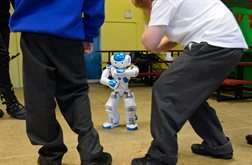
(Medical Xpress)—Robots are being used as classroom buddies for children with autism in a groundbreaking initiative that aims to improve social interaction and communication.
Max and Ben, two knee-high humanoid robots that can dance to "Thriller", play games and emulate Tai Chi, are to be showcased by researchers at the University of Birmingham as part of the ESRC festival of Social Sciences.
The Aldebaran robots, which have been trialled by pupils at Topcliffe Primary School in Castle Vale, Birmingham since March, are the latest in a range of innovative technologies that will be on display at the school tomorrow (Thurs 8th November).
The event is about using technologies to help children with autism. Children, teachers and researchers will demonstrate the latest technologies and share their experiences of using them in the classroom.
Dr Karen Guldberg, from the University of Birmingham's School of Education, said: "We have been looking at how technology can support pupils with autism to communicate more effectively.
"Pupils and teachers are experimenting with the robots and other technologies in a developmental way and they are showing significant benefits for the classroom. The robots have been modelling good behaviour and acting as buddies."
Research shows that children with autism often find computers and technology safe, motivating and engaging, particularly in the areas of social interaction and communication.
Ian Lowe, headteacher at Topcliffe Primary, said: "The robots have been brilliant at supporting autistic children with their learning. You can program them to teach language, play games and model behaviour. We have even used them in assemblies. In the future we are looking to see if they can be used to support learning not just at school but at home as well."
Provided by
University of Birmingham
-
Digital worlds can help autistic children to develop social skills
Oct 21, 2011 |
not rated yet |
0
-
Robots to help children to form relationships
May 29, 2007 |
not rated yet |
0
-
Using robots to help children with autism
Sep 28, 2012 |
not rated yet |
0
-
Augmented play helps autism
Feb 23, 2012 |
not rated yet |
0
-
Robots attend nursery school
Jun 23, 2005 |
not rated yet |
0
-
Motion perception revisited: High Phi effect challenges established motion perception assumptions
Apr 23, 2013 |
3 / 5 (2) |
2
-
Anything you can do I can do better: Neuromolecular foundations of the superiority illusion (Update)
Apr 02, 2013 |
4.5 / 5 (11) |
5
-
The visual system as economist: Neural resource allocation in visual adaptation
Mar 30, 2013 |
5 / 5 (2) |
9
-
Separate lives: Neuronal and organismal lifespans decoupled
Mar 27, 2013 |
4.9 / 5 (8) |
0
-
Sizing things up: The evolutionary neurobiology of scale invariance
Feb 28, 2013 |
4.8 / 5 (10) |
14
-
Does a charged particle rotate when traveling through a static Bf?
31 minutes ago
-
Find a link between physics and assignment problems
1 hour ago
-
Light as a source of electricity
1 hour ago
-
A question about the energy stored in a capacitor.
1 hour ago
-
Electric field-Charge inside a metallic shell
4 hours ago
-
Change in momentum when a body is thrown up and falls back down.
10 hours ago
- More from Physics Forums - Classical Physics
More news stories
Researcher helps give children with autism the chance to communicate
Research by Victoria University PhD education graduand Larah van der Meer highlights the importance of understanding the communication preferences of children with developmental disabilities such as autism.
Autism spectrum disorders
May 14, 2013 |
3.3 / 5 (3) |
1
Developers dive in to create a wealth of autism apps
At times, Andy Shih still finds himself overwhelmed by the groundswell of interest in autism applications he's seen in the three years since Apple Inc. released the first iPad.
Autism spectrum disorders
May 09, 2013 |
2 / 5 (1) |
0
Enhanced motion perception in autism may point to an underlying cause of the disorder
Children with autism see simple movement twice as quickly as other children their age, and this hypersensitivity to motion may provide clues to a fundamental cause of the developmental disorder, according ...
Autism spectrum disorders
May 08, 2013 |
not rated yet |
0
|
Autism scientists seek more brains to aid research
(AP)—Autism scientists are seeking more brain samples for research.
Autism spectrum disorders
May 02, 2013 |
5 / 5 (1) |
0
Drug shows some benefit for kids with autism
(HealthDay)—An experimental drug for autism did not improve levels of lethargy and social withdrawal in children who took it, but it did show some other benefits, a new study finds.
Autism spectrum disorders
May 02, 2013 |
4 / 5 (1) |
0
Researchers identify a potential new risk for sleep apnea: Asthma
Researchers at the University of Wisconsin have identified a potential new risk factor for obstructive sleep apnea: asthma. Using data from the National Institutes of Health (Heart, Lung, and Blood Institute)-funded Wisconsin ...
Ginger compounds may be effective in treating asthma symptoms
Gourmands and foodies everywhere have long recognized ginger as a great way to add a little peppery zing to both sweet and savory dishes; now, a study from researchers at Columbia University shows purified components of the ...
Study finds that sleep apnea and Alzheimer's are linked
A new study looking at sleep-disordered breathing (SDB) and markers for Alzheimer's disease (AD) risk in cerebrospinal fluid (CSF) and neuroimaging adds to the growing body of research linking the two.
Computational tool translates complex data into simplified 2-dimensional images
In their quest to learn more about the variability of cells between and within tissues, biomedical scientists have devised tools capable of simultaneously measuring dozens of characteristics of individual ...
New theory on genesis of osteoarthritis comes with successful therapy in mice
Scientists at Johns Hopkins have turned their view of osteoarthritis (OA) inside out. Literally. Instead of seeing the painful degenerative disease as a problem primarily of the cartilage that cushions joints, ...
'Gap' for HIV vaccine efforts after latest setback
The hunt for an HIV vaccine has gobbled up $8 billion in the past decade, and the failure of the most recent efficacy trial has delivered yet another setback to 26 years of efforts.