Skin cells reveal DNA's genetic mosaic

Credit: Michael Helfenbein
(Medical Xpress)—The prevailing wisdom has been that every cell in the body contains identical DNA. However, a new study of stem cells derived from the skin has found that genetic variations are widespread in the body's tissues, a finding with profound implications for genetic screening, according to Yale School of Medicine researchers.
Published in the Nov. 18 issue of Nature, the study paves the way for assessing the extent of gene variation, and for better understanding human development and disease.
"We found that humans are made up of a mosaic of cells with different genomes," said lead author Dr. Flora Vaccarino, the Harris Professor of Child Psychiatry at the Yale Child Study Center. "We saw that 30 percent of skin cells harbor copy number variations (CNV), which are segments of DNA that are deleted or duplicated. Previously it was assumed that these variations only occurred in cases of disease, such as cancer. The mosaic that we've seen in the skin could also be found in the blood, in the brain, and in other parts of the human body."
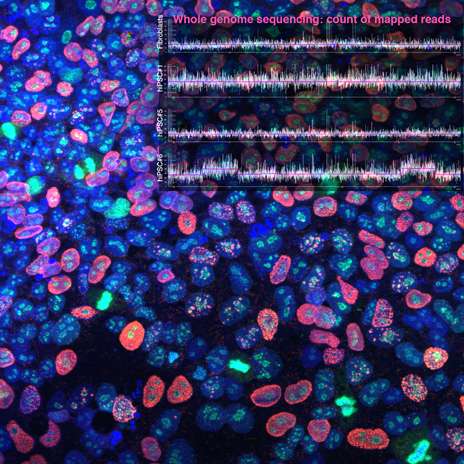
iPS cells stained for proteins expressed during the cell cycle. Credit: Vaccarino lab
The longstanding belief has been that our cells have the same DNA sequence and this blueprint governs the body's functions. The Yale team's research challenges this dogma. Some scientists have hypothesized that during development, when DNA is copied from mother to daughter cells, there could be deletions, duplications and changes in the sequence of the DNA, and an entire group of genes could be affected. This premise has been incredibly difficult to test, but Vaccarino and colleagues have done so in this new study.The team used whole genome sequencing to study induced pluripotent stem cells lines (iPS), which are stem cells developed from a mature-differentiated cell. The team grew cells taken from the inner upper arms of two families. The team spent two years characterizing these iPS cell lines and comparing them to the original skin cells.
While observing that the genome of iPS cells closely resembles the genome of skin cells from which they originated, the team could identify several deletions or duplications involving thousands of base pairs of DNA. The team then performed additional experiments to understand the origin of those differences, and showed that at least half of them pre-existed in small fractions of skin cells. These differences were revealed in iPS cells because each iPS line is derived from one, or very few, skin cells. Vaccarino said these iPS lines could act as a magnifying glass to see the mosaic of genomic differences in the body's cells.
"In the skin, this mosaicism is extensive and at least 30 percent of skin cells harbor different deletion or duplication of DNA, each found in a small percentage of cells," said Vaccarino. "The observation of somatic mosaicism has far-reaching consequences for genetic analyses, which currently use only blood samples. When we look at the blood DNA, it's not exactly reflecting the DNA of other tissues such as the brain. There could be mutations that we're missing."
"These findings are shaping our future studies, and we're doing more studies of the developing brains of animals and humans to see if this variation exists there as well," Vaccarino added.
More information: The study was funded by NIH/NIMH, the Simons Foundation, and the State of Connecticut.
Journal reference:
Nature
Provided by
Yale University
-
Researchers develop safer way to make induced pluripotent stem cells
Feb 01, 2011 |
not rated yet |
0
-
Mature B cells reprogrammed to stem-cell-like state
Apr 17, 2008 |
not rated yet |
0
-
New study gives insight into subtle genomic differences among our own cells
Nov 18, 2012 |
not rated yet |
0
-
Improved adult-derived human stem cells have fewer genetic changes than expected
May 01, 2012 |
not rated yet |
0
-
Stem cell first: Creating induced pluripotent stem cells
Aug 23, 2010 |
not rated yet |
0
-
Motion perception revisited: High Phi effect challenges established motion perception assumptions
Apr 23, 2013 |
3 / 5 (2) |
2
-
Anything you can do I can do better: Neuromolecular foundations of the superiority illusion (Update)
Apr 02, 2013 |
4.5 / 5 (11) |
5
-
The visual system as economist: Neural resource allocation in visual adaptation
Mar 30, 2013 |
5 / 5 (2) |
9
-
Separate lives: Neuronal and organismal lifespans decoupled
Mar 27, 2013 |
4.9 / 5 (8) |
0
-
Sizing things up: The evolutionary neurobiology of scale invariance
Feb 28, 2013 |
4.8 / 5 (10) |
14
-
Classical and Quantum Mechanics via Lie algebras
Apr 15, 2011
- More from Physics Forums - Independent Research
More news stories
Researchers complete largest genetic sequencing study of human disease
Researchers from Queen Mary, University of London have led the largest sequencing study of human disease to date, investigating the genetic basis of six autoimmune diseases.
Genetics
May 22, 2013 |
4.5 / 5 (4) |
0
|
Researchers develop model for better testing, targeting of malignant peripheral nerve sheath tumors
University of Minnesota Medical School researchers from the Masonic Cancer Center, University of Minnesota, in partnership with the University's Brain Tumor Program, have developed a new mouse model of malignant peripheral ...
Genetics
May 20, 2013 |
5 / 5 (1) |
0
|
Researchers identify new circadian clock component
Northwestern University scientists have shown a gene involved in neurodegenerative disease also plays a critical role in the proper function of the circadian clock.
Genetics
May 16, 2013 |
3 / 5 (1) |
1
|
Returning genetic incidental findings without patient consent violates basic rights, experts say
Informed consent is the backbone of patient care. Genetic testing has long required patient consent and patients have had a "right not to know" the results. However, as 21st century medicine now begins to use the tools of ...
Genetics
May 16, 2013 |
5 / 5 (1) |
3
|
Ethicists provide framework supporting new recommendations on reporting incidental findings in gene sequencing
In a paper published in Science Express, a group of experts led by bioethicists in the Center for Medical Ethics and Health Policy at Baylor College of Medicine provide a framework for the new American College of Medical Geneti ...
Genetics
May 16, 2013 |
not rated yet |
0
When oxygen is short, EGFR prevents maturation of cancer-fighting miRNAs
Even while being dragged to its destruction inside a cell, a cancer-promoting growth factor receptor fires away, sending signals that thwart the development of tumor-suppressing microRNAs (miRNAs) before it's dissolved, researchers ...
Flu vaccine also linked to narcolepsy in adults, study reports
Finnish researchers unveiled new data Thursday to link the Pandemrix flu vaccine to a higher risk of the sleeping disorder narcolepsy in adults.
Heart healthy lifestyle may cut kidney disease patients' risk of kidney failure
Maintaining a heart healthy lifestyle may also help protect chronic kidney disease patients from developing kidney failure and dying prematurely, according to a study appearing in an upcoming issue of the Journal of the Am ...
J&J expects 10-plus new drug applications by 2017
(AP)—Johnson & Johnson is developing what could eventually be game-changing treatments for depression and pain, and it's aiming to apply for approval of more than 10 new medicines by 2017, executives said Thursday during ...
Farm bill: Senate rejects GMO labeling amendment
The Senate has overwhelmingly rejected an amendment allowing states to require labeling of genetically modified foods.
Diabetes' genetic underpinnings can vary based on ethnic background, studies say
Ethnic background plays a surprisingly large role in how diabetes develops on a cellular level, according to two new studies led by researchers at the Stanford University School of Medicine.