UCLA performs first 'breathing lung' transplant in US
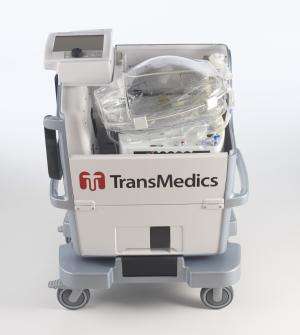
UCLA performed the first double lung transplant in the US using the experimental TransMedics Organ Care System, which keeps donor lungs functioning and "breathing" in a near-physiologic state outside the body during transport. Credit: TransMedics
First there was the "heart in a box," a revolutionary experimental technology that allows donor hearts to be delivered to transplant recipients warm and beating rather than frozen in an ice cooler.
Now that same technology is being used to deliver "breathing lungs."
The lung transplant team at Ronald Reagan UCLA Medical successfully performed the nation's first "breathing lung" transplant in mid-November. The patient, a 57-year-old who suffered from pulmonary fibrosis—a disease in which the air sacs of the lungs are gradually replaced by scar tissue—received two new lungs and is recuperating from the seven-hour surgery.
The groundbreaking transplant involved an experimental organ-preservation device known as the Organ Care System (OCS), which keeps donor lungs functioning and "breathing" in a near-physiologic state outside the body during transport. The current standard involves transporting donor lungs in a non-functioning, non-breathing state inside an icebox.
This video is not supported by your browser at this time.
With the OCS, the lungs are removed from a donor's body and are placed in a high-tech OCS box, where they are immediately revived to a warm, breathing state and perfused with oxygen and a special solution supplemented with packed red-blood cells. The device also features monitors that display how the lungs are functioning during transport."Organs were never meant to be frozen on ice," said Dr. Abbas Ardehali, a professor of cardiothoracic surgery and director of the heart and lung transplantation program at Ronald Reagan UCLA Medical Center. "Lungs are very sensitive and can easily be damaged during the donation process. The cold storage method does not allow for reconditioning of the lungs before transplantation, but this promising 'breathing lung' technology enables us to potentially improve the function of the donor lungs before they are placed in the recipient."
UCLA is currently leading the U.S. arm of the international, multicenter phase 2 clinical INSPIRE study of the OCS, developed by medical device company TransMedics; Ardehali is the principal investigator for UCLA. The purpose of the trial is to compare donor lungs transported using the OCS technology with the standard icebox method. The INSPIRE trial is also underway at lung transplant centers in Europe, Australia and Canada and will enroll a total of 264 randomized patients.
According to Ardehali, in addition to potentially improving donor-lung function, the technology could help transplant teams better assess donor lungs, since the organs can be tested in the device, over a longer period of time.
In addition, it could help expand the donor pool by allowing donor lungs to be safely transported across longer distances.
"For patients with end-stage lung disease, lung transplantation can dramatically improve the patient's symptoms and offer relief from severe shortness of breath," said Dr. David Ross, professor of medicine and medical director of UCLA's lung and heart-lung transplantation program and UCLA's pulmonary arterial hypertension and thromboendarterectomy program. "The 'breathing lung' technology could potentially make the transplantation process even better and improve the outcomes for patients suffering from lung disease."
The "breathing lung" device follows on the heels of TransMedics' "heart in a box" technology, which delivers donor hearts in a similar manner. The multi-center national study of the heart technology, also led by UCLA, is ongoing.
Results of a preliminary OCS lung study conducted in Europe were published in the Oct. 10 edition of the journal Lancet. The findings showed good lung transplantation outcomes following preservation using the OCS system. Read the Lancet study.
Journal reference:
The Lancet
Provided by
University of California, Los Angeles
-
'Beating heart' technology could revolutionize field of heart transplantation
Dec 06, 2010 |
not rated yet |
0
-
Patient's lifesaving donor heart arrives 'warm and beating' inside experimental device
Aug 30, 2011 |
not rated yet |
0
-
Portable lung perfusion device could revolutionise transplant procedures
Oct 09, 2012 |
not rated yet |
0
-
Many more lungs suitable for transplantation
Jun 30, 2011 |
not rated yet |
0
-
New use of artificial lung device pioneered at University of Kentucky
Aug 04, 2011 |
not rated yet |
0
-
Motion perception revisited: High Phi effect challenges established motion perception assumptions
Apr 23, 2013 |
3 / 5 (2) |
2
-
Anything you can do I can do better: Neuromolecular foundations of the superiority illusion (Update)
Apr 02, 2013 |
4.5 / 5 (11) |
5
-
The visual system as economist: Neural resource allocation in visual adaptation
Mar 30, 2013 |
5 / 5 (2) |
9
-
Separate lives: Neuronal and organismal lifespans decoupled
Mar 27, 2013 |
4.9 / 5 (8) |
0
-
Sizing things up: The evolutionary neurobiology of scale invariance
Feb 28, 2013 |
4.8 / 5 (10) |
14
-
Question in reflection and transmission at oblique incidence.
2 hours ago
-
Is this plasma (picture in thread)
2 hours ago
-
Basic physics understanding. Could someone explain?
4 hours ago
-
Change in flux of a transformer
4 hours ago
-
Electric field between parallel plate capacitor
5 hours ago
-
Why angle of projectile has 2 solutions?
6 hours ago
- More from Physics Forums - Classical Physics
More news stories
Researchers rewrite obsolete blood-ordering rules
Johns Hopkins researchers have developed new guidelines—the first in more than 35 years—to govern the amount of blood ordered for surgical patients. The recommendations, based on a lengthy study of blood use at The Johns ...
Surgery
May 22, 2013 |
4 / 5 (1) |
0
Indian medics reconstruct baby's swollen head
Indian doctors said Wednesday they have successfully carried out a first round of reconstructive surgery on the skull of a baby suffering from a rare disorder that caused her head to nearly double in size.
Surgery
May 22, 2013 |
not rated yet |
0
Polish man gets quick face transplant after injury (Update)
A 33-year-old Polish man received a face transplant just three weeks after being disfigured in a workplace accident, in what his doctors said Wednesday is the fastest time frame to date for such an operation. ...
Surgery
May 22, 2013 |
not rated yet |
0
Sexual function in older adults with thoracolumbar-pelvic instrumentation
Surgeons investigated sexual function in 62 patients, 50 years and older, who had received extensive spinal–pelvic instrumentation for spinal deformity at the University of Virginia Health Center. Based on their results, ...
Surgery
May 21, 2013 |
not rated yet |
0
Challenges encountered in surgical management of spine trauma in morbidly obese patients
Physicians at Monash University and The Alfred Hospital in Melbourne, Australia describe the logistic, medical, and societal challenges faced in treating spine trauma in morbidly obese patients. Based on a case series of ...
Surgery
May 21, 2013 |
not rated yet |
0
Researchers identify first drug targets in childhood genetic tumor disorder
Two mutations central to the development of infantile myofibromatosis (IM)—a disorder characterized by multiple tumors involving the skin, bone, and soft tissue—may provide new therapeutic targets, according to researchers ...
Engineered cytomegalovirus protects monkeys from HIV equivalent
(Medical Xpress)—A new study by researchers in the US has shown that an ancient virus can be modified to help in the fight against the simian immunodeficiency virus SIV, which is the equivalent in monkeys ...
Hormone levels may provide key to understanding psychological disorders in women
Women at a particular stage in their monthly menstrual cycle may be more vulnerable to some of the psychological side-effects associated with stressful experiences, according to a study from UCL.
Going live: Immune cell activation in multiple sclerosis
Biological processes are generally based on events at the molecular and cellular level. To understand what happens in the course of infections, diseases or normal bodily functions, scientists would need to ...
Driving and hands-free talking lead to spike in errors, study shows
Talking on a hands-free device while behind the wheel can lead to a sharp increase in errors that could imperil other drivers on the road, according to new research from the University of Alberta.
Pollen count apps for smartphones are nothing to sneeze at
Kate O'Reilly's spring allergy survival kit includes the usual stuff - nasal sprays, allergy pills and a box of tissues. This season, she's added a new weapon to her line of defense: an app on her smartphone.