Unique treatment proposed for children's developmental coordination disorder
November 26, 2012 in Psychology & Psychiatry
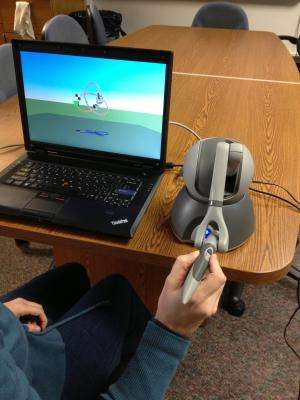
This device enables children with DCD to improve their fine motor skills by tracing a virtual three-dimensional path. Credit: Indiana University
An Indiana University study in the Journal of Child Neurology proposes an innovative treatment for developmental coordination disorder, a potentially debilitating neurological disorder in which the development of a child's fine or gross motor skills, or both, is impaired.
DCD strikes about one in 20 children, predominantly boys, and frequently occurs alongside ADHD, autism spectrum disorders and other better known conditions. Like ADHD, DCD has broad academic, social and emotional impact. It can severely affect reading, spelling and handwriting abilities; and insofar as children with DCD both struggle with and avoid physical activity, it can also lead to problems with self-esteem, obesity and injury.
Severity of the disorder varies, and as the researchers explain, it is sometimes called the "hidden disorder" because of the way those with milder cases develop coping strategies that conceal the disorder, such as using computers to avoid handwriting tasks, and wearing shirts without buttons, or shoes without laces. But children with DCD have been generally thought unable to learn or improve their motor skills.
"The results of this study were remarkable," said lead author Geoffrey Bingham, professor in the Department of Psychological and Brain Sciences in the College of Arts and Sciences. "After training the children over a five- to six-week period, one day a week for 20 minutes at a time, the differences between children with DCD and typically developing children were all but obliterated."
Key to the training was a unique technology: a three-dimensional virtual reality device, the PHANTOM Omni from Sensable Technologies, developed for the visualization of knots by topologists, who study geometric forms in space. Holding a stylus attached to a robot, participants in the study developed their fine motor skills by playing a game in which they traced a three-dimensional virtual path in the air, visually represented on a computer screen. Forces such as magnetic attraction and friction can be applied to the path and adjusted so participants could actually feel a surface that changed as the parameters were altered.
The study compared the progress of a group of eight 7- to 8-year-olds with DCD to a group of eight 7- to 8-year-old typically developing children in a three-dimensional tracing game. The task was to push a brightly colored fish along a visible path on a computer screen from the starting location to the finish point while racing a competitor fish.
The training started with the highest level of magnetic attraction, slowest competitor and shortest path. The goal of the training was to allow the children to progress at their own pace through the different combinations and levels of attraction, paths and competitors.
THE CHILDREN'S 'CATCH-22'
As Bingham's collaborator Winona Snapp-Childs, a post-doctoral fellow in the Department of Psychological and Brain Sciences, explains, the particular challenge facing children with DCD is a "Catch-22" situation. Children must first be able to approximate a movement by actively generating it themselves before they can improve it through practice and repetition. But because children with DCD have been unable to produce this initial movement, they have been unable to improve their skills.
The technology provided the tool needed to overcome this impasse. It gave both the support needed to produce the movement, as well as the flexibility to let children actively generate the movement themselves. It allowed the children to do what they otherwise could not do: produce the requisite initial movements that could then be practiced to yield quantitative improvements.
The researchers say the technology could potentially be widely accessible: It can be used without a therapist and is portable enough to be put in clinics, classrooms or the home. It can also be adjusted to suit the needs of children across the spectrum of DCD severity.
More information: The study, "A Sensorimotor Approach to the Training of Manual Actions in Children With Developmental Coordination Disorder," is appearing on the Journal of Child Neurology Online First.
Provided by
Indiana University
-
Clumsy kids who don't 'grow out of it'
Apr 04, 2011 |
not rated yet |
0
-
Weight and children with developmental coordination disorder
Jun 28, 2010 |
not rated yet |
0
-
New research on developmental co-ordination disorder
Nov 23, 2010 |
not rated yet |
0
-
Child coordination disorder ups risk of mental health issues
Mar 27, 2012 |
not rated yet |
0
-
Diagnosing developmental coordination disorder
Feb 09, 2012 |
not rated yet |
0
-
Motion perception revisited: High Phi effect challenges established motion perception assumptions
Apr 23, 2013 |
3 / 5 (2) |
2
-
Anything you can do I can do better: Neuromolecular foundations of the superiority illusion (Update)
Apr 02, 2013 |
4.5 / 5 (11) |
5
-
The visual system as economist: Neural resource allocation in visual adaptation
Mar 30, 2013 |
5 / 5 (2) |
9
-
Separate lives: Neuronal and organismal lifespans decoupled
Mar 27, 2013 |
4.9 / 5 (8) |
0
-
Sizing things up: The evolutionary neurobiology of scale invariance
Feb 28, 2013 |
4.8 / 5 (10) |
14
-
Pressure-volume curve: Elastic Recoil Pressure don't make sense
May 18, 2013
-
If you became brain-dead, would you want them to pull the plug?
May 17, 2013
-
MRI bill question
May 15, 2013
-
Ratio of Hydrogen of Oxygen in Dessicated Animal Protein
May 13, 2013
-
Alcohol and acetaminophen
May 13, 2013
-
Marie Curie's leukemia
May 13, 2013
- More from Physics Forums - Medical Sciences
More news stories
Ketamine shows significant therapeutic benefit in people with treatment-resistant depression
Patients with treatment-resistant major depression saw dramatic improvement in their illness after treatment with ketamine, an anesthetic, according to the largest ketamine clinical trial to-date led by researchers from the ...
Psychology & Psychiatry
6 hours ago |
4.5 / 5 (2) |
0
|
US psychiatry gets makeover in new manual
The latest makeover to a massive psychiatric tome honored by some, reviled by others and even called the "Bible" of mental disorders is being released Saturday with a host of new changes.
Psychology & Psychiatry
18 hours ago |
not rated yet |
0
Study reviews readmissions in inpatient psychiatric facilities
(HealthDay)—Most Medicare beneficiaries treated in inpatient psychiatric facilities (IPFs) exhibit characteristics associated with hospital readmission, according to a report prepared for the National Association ...
Psychology & Psychiatry
May 17, 2013 |
not rated yet |
0
Skydiving is never plane sailing
Skydivers show the same level of physical stress before every jump whether a first-timer or experienced jumper, say Northumbria researchers.
Psychology & Psychiatry
May 17, 2013 |
not rated yet |
0
|
Kids, especially boys, perceive sadness of depressed parents
Children of depressed parents pick up on their parents' sadness—whether mom or dad realizes their mood or not.
Psychology & Psychiatry
May 17, 2013 |
4.5 / 5 (2) |
1
|
Consuming coffee linked to lower risk of detrimental liver disease, study finds
Regular consumption of coffee is associated with a reduced risk of primary sclerosing cholangitis (PSC), an autoimmune liver disease, Mayo Clinic research shows. The findings were being presented at the Digestive Disease ...
Research examines new methods for managing digestive health
Research presented at Digestive Disease Week (DDW) explores new methods for managing digestive health through diet and lifestyle.
New smartphone application improves colonoscopy preparation
The use of a smartphone application significantly improves patients' preparation for a colonoscopy, according to new research presented today at Digestive Disease Week (DDW). The preparation process, which begins days in ...
New research identifies practice changes to improve value and quality of GI procedures
There are significant cost and risk factors associated with two procedures commonly used to diagnose or treat gastrointestinal problems, according to research presented at Digestive Disease Week (DDW).
New research identifies risks, interventions for children's GI health
An increasing number of U.S. children are experiencing gastrointestinal issues that require interventions to resolve, according to research presented at Digestive Disease Week (DDW).
New case of SARS-like virus in Saudi: ministry
A new case of the deadly coronavirus has been detected in Saudi Arabia where 15 people have already died after contracting it, the health ministry announced on Saturday on its Internet website.