New Alzheimer's drug studies offer patients hope (Update)
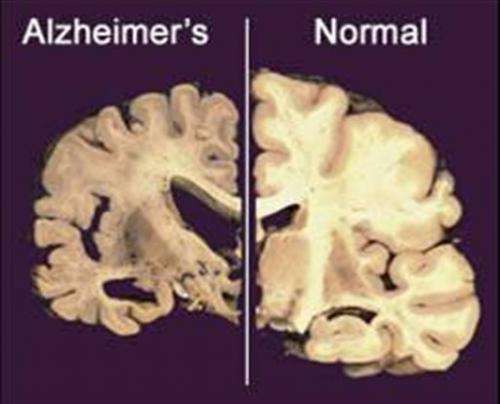
For Alzheimer's patients and their families, desperate for an effective treatment for the epidemic disease, there's hope from new studies starting up and insights from recent ones that didn't quite pan out.
If the new studies succeed, a medicine that slows or even stops progression of the brain-destroying disease might be ready in three to five years, said Dr. William H. Thies, chief medical officer of the Alzheimer's Association. The group assists patients and caregivers, lobbies for more research and helps fund studies.
"The number of smart people working on this problem means to me we'll begin to manage it better in the very near future," Thies said. "It may be as short as three years away."
That's only if government and other sources provide tens of millions of dollars for additional research and more patients join clinical studies.
After decades of stumbles and dozens of promising experimental drugs failing, scientists think they're now on the right track. They're targeting what they believe are the mechanisms to arrest a disease that steadily steals patients' personality and ability to remember, think and care for themselves.
A vaccine is in mid-stage testing, and drugmakers shy about funding expensive treatment tests could start as many as 30 studies once they're more confident that their approach is sound, Thies said. Early next year, the first study to try to prevent Alzheimer's begins—in people a decade away from symptoms but who have a genetic mutation that causes early onset Alzheimer's. It will include three drugs that each attack the country's No. 6 killer in a different way.
And in May, the Obama administration unveiled an ambitious national plan to fund new research, better train those caring for Alzheimer's patients.
The number of Alzheimer's patients in the U.S. is expected to jump from the current 5.4 million to 16 million by 2050. Costs for care, mostly borne by taxpayers, could skyrocket from roughly $200 billion this year to $1.1 trillion in 2050. The few treatments available only ease symptoms temporarily.
On Monday, drugmaker Merck & Co. announced it's just begun the first combined mid- and late-stage study of a BACE inhibitor. That's a new type of drug designed to slow mental and functional decline by limiting production of amyloid beta, the protein that's the main ingredient in brain-damaging amyloid plaques considered the most likely cause of Alzheimer's.
After safety testing of the drug MK-8931 in about 200 patients, the 78-week study, known by the acronym EPOCH, will quickly expand to as many as 1,700 patients. That phase will test the daily pill at three different doses, compared with a dummy pill.
Combining study phases should shave some time from the years-long, and often billion-dollar, research process. If MK-8931 works, EPOCH would give Merck one of the two major patient studies needed to win approval from government regulators, said Darryle D. Schoepp, Merck's head of neuroscience research. Merck also has some backup compounds and plans other studies, including some on patients very early in the disease, Schoepp told The Associated Press in an exclusive interview.
In earlier research MK-8931 blocked formation of almost all the toxic amyloid plaques, he said.
"No one's ever done that before," Schoepp said. "If (amyloid) plaques are the cause, the medicine will work."
Merck's MK-8931 and some other experimental drugs aim to turn off the Alzheimer's "faucet" by blocking production of amyloid beta. Other experimental drugs instead aim to bail out the sink while the faucet's still running, either by removing clumps of amyloid plaque from the brain or by binding to bits of amyloid beta protein and clearing them from the brain before they clump into plaques.
Researchers were frustrated this year by failures of two drugs that targeted amyloid beta—bapineuzumab from Pfizer Inc. and Johnson & Johnson, and solanezumab from Eli Lilly and Co. Both drugs are injected because their large molecules can't pass through the digestive tract into blood vessels. Their size might have limited how much medicine could get inside brain cells.
However, solanezumab showed signs that attacking beta amyloid beta was effective. While it didn't help most patients in the study, it slowed mental decline by about a third in patients with mild forms of the disease—a first for that approach.
That's added to researchers' growing belief that patients must be treated early on, before Alzheimer's has destroyed much of their brains.
The big prevention study to start early next year, called DIAN TU, is meant to help find a way to do that, by testing drugs on people with a family history and genes that make them likely to develop Alzheimer's in their 50s, rather than after 65.
—One part will test the Roche Group's biologic antibody drug gantenerumab, which removes amyloid beta plaques from the brain. It's already in late-stage testing in patients who don't have symptoms but have abnormally high levels of amyloid beta in spinal fluid.
—Another part will test Lilly's solanezumab, which binds to smaller bits of amyloid beta and clears them from the brain before they clump into plaques.
—The third study drug could be Lilly's BACE inhibitor, now in midstage testing in Alzheimer's patients. The company expects by mid-2013 to complete work needed to determine whether the drug is right for the prevention study.
Meanwhile, two late-stage patient studies started this fall with a drug called LMTX developed by TauRx Pharmaceuticals Ltd. It targets tangles in the brain with an abnormal version of a protein called tau.
Thies, of the Alzheimer's Association, thinks the disease likely is caused by a combination of those tau tangles and amyloid beta plaques.
The key issue for all these drugs will be what side effects they cause, because patients would take them for many years.
Patients and families are anxious for a drug that slows or stops Alzheimer's.
"When you're faced with a diagnosis that tells you your brain is being eaten up," said patient Ron Grant, "and you start seeing who you were no longer being who you are, and the only thing you can expect is being worse, in this day that's totally unacceptable."
The Oklahoma City prison chaplain was diagnosed with Alzheimer's in 2007 at age 55 and had to stop work barely a year later. He's helped found a support group for early onset Alzheimer's patients, participated in a clinical trial and takes the drugs Namenda and Razadyne, which he thinks have limited his symptoms.
But PET scans of his brain show the disease is progressing. The former avid reader can no longer follow a book's plot or remember where he left off.
The federal government doesn't spend enough on Alzheimer's, said Grant, who helps lobby Congress for more funding.
"The biggest thing standing between us and a treatment for this disease is money," he said.
Copyright 2012 The Associated Press. All rights reserved. This material may not be published, broadcast, rewritten or redistributed.


