Cancer cells co-opt immune response to escape destruction
December 18, 2012 in Cancer

Cancer cells co-opt immune response to escape destruction

Enlarge

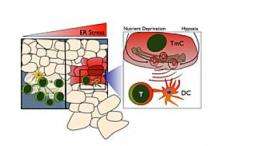
The cartoon represents the consequences of tumor ER stress on components of the adaptive anti-tumor immune response. Under ideal circumstances (left panel), tumor cells and their antigens are picked up by immune cells such as dendritic cells (DC), which in turn instruct T cells (T) to proliferate and eliminate the tumor cells. A different scenario (center panel and right insert) occurs in the growing tumor where tumor micro-environmental factors such as nutrient deprivation or hypoxia create ER stress in tumor cells (TmC). These stressors induce an unfolded protein response (UPR) in tumor cells, which is then transmitted to nearby DC and brainwashes them. Affected dendritic cells no longer coordinate T cells, and impaired T cells no longer proliferate. This inappropriate T cell education hinders the effect of the body’s anti-tumor immune response and allows for unrestrained tumor growth. Credit: UC San Diego School of Medicine

Researchers at the University of California, San Diego School of Medicine report that tumor cells use stress signals to subvert responding immune cells, exploiting them to actually boost conditions beneficial to cancer growth.

The findings are published in the December 18 online issue of the journal .

Lead author Navin R. Mahadevan, a graduate student in the Laboratory of Immunology at the UC San Diego Moores , and colleagues found that tumor cells manipulate a fundamental called unfolded protein response (UPR). In all cells, UPR is used to maintain homeostasis, or equilibrium, in the (ER) – the cell's protein-making factory. When, for a variety of reasons, a cell is subjected to overwork, ER stress occurs and a compensatory UPR is triggered.

"The goal is to understand how ER stress is transmitted and how this is amplified by receiver cells to attack vulnerable aspects of the immune system," said principal investigator Maurizio Zanetti, MD, who heads the Laboratory of Immunology and is director of Tumor Immunology at the Center for Immunity, Infection and Inflammation at UC San Diego.

"These findings suggest that the tumor UPR should be a target of therapy, not only for its intrinsic function in promoting tumor adaption and survival, but now for its external role in subverting the anti-tumor immune response."

When a UPR response is triggered, one of two things can happen. Either UPR restores homeostasis by slowing and synthesizing chaperone molecules to ease the burden on the endoplasmic reticulum or it decides can't be restored and the cell is better off dying. The latter is called apoptosis, or programmed cell death.

In research published last year, Zanetti and colleagues found that the UPR is transmissible: It can travel from one cell to another. In normal cells, ER stress is transient with the UPR usually restoring normal function. But cancer cells thrive in an environment in which low oxygen and scarce nutrients, such as glucose, induce continuous ER stress. For them, a sustained ER stress response "offers a survival advantage by promoting cancer cell adaptation, continued growth, and inflammation that is more damaging than healing," Zanetti said.

In the latest study, the scientists found that the transmissible ER stress response (TERS), which emanates from tumor cells experiencing ER stress, alters in such a way that they no longer function to help fight off cancer. Normally dendritic cells – the sentinels and information couriers of the immune system – train T cells (the immune system's enforcers) to specifically kill foreign entities. In the case of cancer, however, T cells are unable to properly eliminate tumor cells – confounding efforts to develop more effective cancer treatments. The new findings implicate TERS as cancer's siren call. It brainwashes dendritic cells so that they ineffectively communicate with T cells, reducing anti-tumor immunity while increasing tumor growth.

"This is one of the hot topics of contemporary immunology," said Mahadevan. "Our paper shows that TERS – and by inference ER stress in tumor cells – has the ability to negatively affect the sanctuary of the immune response."

Zanetti said the research further elucidates the fundamental processes that use – or abuse – to manipulate their local microenvironment to promote their survival and growth. And it points to an area of drug development the pharmaceutical industry will likely focus on over the next decade.

Targeting the UPR, he said, may also help improve efficacy of long-sought cancer vaccines which have thus far been hampered by the ability of to subvert the immune response, perhaps through mechanisms like TERS.

Journal reference: PLoS ONE search and more info website

Provided by University of California - San Diego search and more info website

4.7 /5 (3 votes)  

Rank 4.7 /5 (3 votes)
Relevant PhysicsForums posts

More news stories

Small increase in cancer risk following CT scans in childhood and adolescence

Study leader, Professor John Mathews from the University of Melbourne said this small increase in cancer risk must be weighed against the undoubted benefits from CT scans in diagnosing and monitoring disease.

Cancer created 2 hours ago | popularity not rated yet | comments 0

Cancer survivors need more support to stop smoking and drinking

Cancer survivors are no more likely to stop smoking, cut down on alcohol, or exercise more often than the general population, according to new research published in the British Journal of Cancer today (Wednesday)

Cancer created 4 hours ago | popularity not rated yet | comments 0

Beta-blockers may boost chemo effect in childhood cancer

Beta-blockers, normally used for high blood pressure, could enhance the effectiveness of chemotherapies in treating neuroblastoma, a type of children's cancer, according to a new study published in the British Jo ...

Cancer created 4 hours ago | popularity not rated yet | comments 0

Japan hospital tests powerful breast cancer therapy

A Japanese cancer specialist said Wednesday she has started the world's first clinical trial of a powerful, non-surgical, short-term radiation therapy for breast cancer.

Cancer created 4 hours ago | popularity 5 / 5 (1) | comments 0

Small cancer risk following CT scans in childhood and adolescence confirmed

The gap between life expectancy in patients with a mental illness and the general population has widened since 1985 and efforts to reduce this gap should focus on improving physical health, suggest researchers in a paper ...

Cancer created 17 hours ago | popularity not rated yet | comments 0


Scientists uncover molecular roots of cocaine addiction in the brain

Researchers at Johns Hopkins have unraveled the molecular foundations of cocaine's effects on the brain, and identified a compound that blocks cravings for the drug in cocaine-addicted mice. The compound, already proven safe ...

Taming suspect gene reverses schizophrenia-like abnormalities in mice

Scientists have reversed behavioral and brain abnormalities in adult mice that resemble some features of schizophrenia by restoring normal expression to a suspect gene that is over-expressed in humans with ...

Costs to treat stroke in America may double by 2030

Costs to treat stroke are projected to more than double and the number of people having strokes may increase 20 percent by 2030, according to the American Heart Association/American Stroke Association.

Acne treatment: Natural substance-based formula is more effective than artificial compounds

University of Granada scientists have patented a new treatment for acne that is based on completely natural substances and is much more effective than artificial formulas because it does not create resistance ...

Study finds new pneumococcal vaccine appears to be as safe as previously used vaccine

The new 13-valent pneumococcal conjugate vaccine (PCV13) appears to be as safe as the previous version used prior to 2010, the 7-valent pneumococcal conjugate vaccine (PCV7), according to a Kaiser Permanente study published ...

Study says empathy plays a key role in moral judgments

Is it permissible to harm one to save many? Those who tend to say "yes" when faced with this classic dilemma are likely to be deficient in a specific kind of empathy, according to a report published in the scientific journal ...