9/11 cancer study won't settle debate over risks
December 18, 2012 by Lindsey Tanner in Cancer
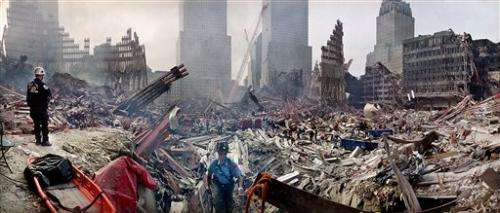
In this Monday, Sept. 24, 2001 file photo, rescue workers examine the site of the Sept. 11, 2001 World Trade Center terrorist attacks in New York. The most comprehensive study of potential World Trade Center-related cancers raises more questions than it answers and won't end a debate over whether the attacks were really a cause. (AP Photo/Ted S. Warren, Pool, File)
The most comprehensive study of potential World Trade Center-related cancers raises more questions than it answers and won't end a debate over whether the attacks were really a cause.
The study suggests possible links with prostate, thyroid and a type of blood cancer among rescue and recovery workers exposed to toxic debris from the terrorist attacks. But there were few total cancers and even the study leaders say the results "should be interpreted with caution."
The study involved nearly 56,000 people enrolled in a registry set up to monitor health effects from those exposed to the aftermath of the trade center attacks. Most participants volunteered for enrollment, which could skew the results if people who already had symptoms were more likely to enroll than healthier people.
Cancers diagnosed through 2008 were included in the study, but that's just seven years after the 2001 attacks, and cancer often takes longer to develop. People diagnosed with cancer before the attacks were excluded from the study.
Cancer rates were compared with those in the general New York state population. But the researchers had no data on whether people in the study had risk factors for getting cancer, including a strong family history, or if they had existing cancer that wasn't detected until after the disaster. Participants are being monitored for health issues and may have gotten more cancer screening than other people, which also could skew the results.
The increased risks were seen only in rescue and recovery workers, who likely had more direct, sustained contact with potential cancer-causing substances in the dust, smoke and debris from the attacks. But cancers weren't more common in workers who had the most exposure—a finding that would seem to contradict the theory that contact was the cause.
The study comes just a few months after the federal government added dozens of types of cancer to a list of illnesses related to the trade center attacks that will be covered by a program to pay for health coverage.
The study results "won't settle the question because it's still too early," said Dr. Thomas Farley, New York City's health commissioner. "People are very, very interested in this topic and we thought it was important to get the data out that we have even though it is early."
Marijo Russell O'Grady, dean of students at Pace University's New York City campus, was at her office near the trade center during the attacks. She also lives nearby, and said she worries about how exposure to choking dust, ash and an "overwhelming burnt plastic smell" might affect her family, including her then 1 1/2 year-old son. They are all enrolled in the health registry.
Cancer is her greatest concern and it's "always present in the back of my mind," she said.
Researchers from the city's health department led the study, which was partly paid for by the National Institute for Occupational Safety and Health. NIOSH spokesman Fred Blosser said the agency welcomes the results and that longer follow-up is needed to examine risks for cancers with that take a long time to develop.
The study appears in Wednesday's Journal of the American Medical Association.
Earlier research from the same registry linked the attacks with respiratory problems including asthma and symptoms of post-traumatic stress.
The new study involved a broader array of people, including firefighters and other emergency workers, along with residents and employees of workplaces near ground zero, Farley said.
In the new study, possible links were mainly seen with cancers diagnosed in 2007 and 2008 in rescue and recovery workers. These included 67 cases of prostate cancer, 13 thyroid cancer cases, and seven cases of multiple myeloma—all at rates higher than in the New York state population.
Donald Berry, a biostatistics professor at the University of Texas MD Anderson Cancer Center in Houston, said the study has too many limitations to draw any definitive conclusions.
"There's no evidence that 9/11 caused any of these cancers," Berry said.
He pointed out that no increased risks were found for lung cancer—a cancer that might seem plausible after breathing lots of toxic dust and smoke.
Copyright 2012 The Associated Press. All rights reserved. This material may not be published, broadcast, rewritten or redistributed.
-
World Trade Center rescue, recovery workers have had increased incidence of certain types of cancer
Dec 18, 2012 |
not rated yet |
0
-
World Trade Center-exposed NYC firefighters face increased cancer risk
Sep 02, 2011 |
not rated yet |
0
-
9/11 WTC health program adds 50 types of cancer
Sep 10, 2012 |
not rated yet |
0
-
Home damage following Sept. 11 attacks linked with higher levels of respiratory illness
May 22, 2012 |
not rated yet |
0
-
Survey finds elevated rates of new asthma among WTC rescue and recovery workers
Aug 27, 2007 |
not rated yet |
0
-
Motion perception revisited: High Phi effect challenges established motion perception assumptions
Apr 23, 2013 |
3 / 5 (2) |
2
-
Anything you can do I can do better: Neuromolecular foundations of the superiority illusion (Update)
Apr 02, 2013 |
4.5 / 5 (11) |
5
-
The visual system as economist: Neural resource allocation in visual adaptation
Mar 30, 2013 |
5 / 5 (2) |
9
-
Separate lives: Neuronal and organismal lifespans decoupled
Mar 27, 2013 |
4.9 / 5 (8) |
0
-
Sizing things up: The evolutionary neurobiology of scale invariance
Feb 28, 2013 |
4.8 / 5 (10) |
14
-
Pressure-volume curve: Elastic Recoil Pressure don't make sense
May 18, 2013
-
If you became brain-dead, would you want them to pull the plug?
May 17, 2013
-
MRI bill question
May 15, 2013
-
Ratio of Hydrogen of Oxygen in Dessicated Animal Protein
May 13, 2013
-
Alcohol and acetaminophen
May 13, 2013
-
Marie Curie's leukemia
May 13, 2013
- More from Physics Forums - Medical Sciences
More news stories
New smartphone application improves colonoscopy preparation
The use of a smartphone application significantly improves patients' preparation for a colonoscopy, according to new research presented today at Digestive Disease Week (DDW). The preparation process, which begins days in ...
Cancer
16 hours ago |
not rated yet |
0
Research examines new methods for managing digestive health
Research presented at Digestive Disease Week (DDW) explores new methods for managing digestive health through diet and lifestyle.
Cancer
16 hours ago |
not rated yet |
1
New colonoscope provides ground-breaking view of colon
A ground-breaking advance in colonoscopy technology signals the future of colorectal care, according to research presented today at Digestive Disease Week(DDW). Additional research focuses on optimizing the minimal withdrawal ...
Cancer
May 18, 2013 |
5 / 5 (2) |
0
ASCO: combo antibody therapy effective for melanoma
(HealthDay)—Concurrent use of two immune checkpoint antibodies—ipilimumab and nivolumab—may be effective for the treatment of advanced melanoma, according to a proof-of-principal study presented in ...
Cancer
May 17, 2013 |
not rated yet |
0
Risk factors ID'd for poor cutaneous cell CA outcomes
(HealthDay)—The risks of metastasis and death associated with cutaneous squamous cell carcinoma (CSCC) are low, but significant, and risk factors for poor outcome include tumor diameter, invasion beyond ...
Cancer
May 17, 2013 |
not rated yet |
0
|
Researchers identify a potential new risk for sleep apnea: Asthma
Researchers at the University of Wisconsin have identified a potential new risk factor for obstructive sleep apnea: asthma. Using data from the National Institutes of Health (Heart, Lung, and Blood Institute)-funded Wisconsin ...
Study finds that sleep apnea and Alzheimer's are linked
A new study looking at sleep-disordered breathing (SDB) and markers for Alzheimer's disease (AD) risk in cerebrospinal fluid (CSF) and neuroimaging adds to the growing body of research linking the two.
Computational tool translates complex data into simplified 2-dimensional images
In their quest to learn more about the variability of cells between and within tissues, biomedical scientists have devised tools capable of simultaneously measuring dozens of characteristics of individual ...
New theory on genesis of osteoarthritis comes with successful therapy in mice
Scientists at Johns Hopkins have turned their view of osteoarthritis (OA) inside out. Literally. Instead of seeing the painful degenerative disease as a problem primarily of the cartilage that cushions joints, ...
Ginger compounds may be effective in treating asthma symptoms
Gourmands and foodies everywhere have long recognized ginger as a great way to add a little peppery zing to both sweet and savory dishes; now, a study from researchers at Columbia University shows purified components of the ...
'Gap' for HIV vaccine efforts after latest setback
The hunt for an HIV vaccine has gobbled up $8 billion in the past decade, and the failure of the most recent efficacy trial has delivered yet another setback to 26 years of efforts.