The end of a dogma: Bipolar cells generate action potentials
December 19, 2012 in Medical research
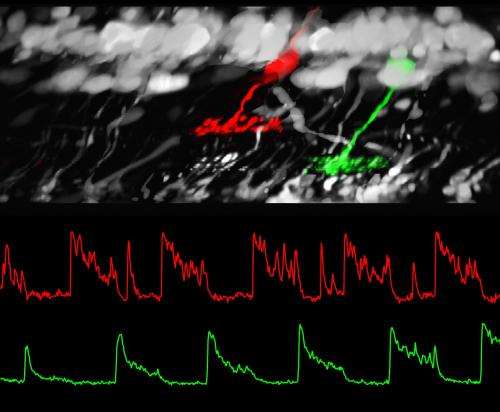
Some bipolar cells in the mouse retina generate digital action potentials (in red) while others use only graded potentials for information propagation (green). Credit: Baden, 2012
To make information transmission to the brain reliable, the retina first has to "digitize" the image. Until now, it was widely believed that this step takes place in the retinal ganglion cells, the output neurons of the retina. Scientists in the lab of Thomas Euler at the University of Tübingen, the Werner Reichardt Centre for Integrative Neuroscience and the Bernstein Center Tübingen were now able to show that already bipolar cells can generate "digital" signals. At least three types of mouse BC showed clear evidence of fast and stereotypic action potentials, so called "spikes". These results show that the retina is by no means as well understood as is commonly believed.
The retina in our eyes is not just a sheet of light sensors that – like a camera chip – faithfully transmits patterns of light to the brain. Rather, it performs complex computations, extracting several features from the visual stimuli, e.g., whether the light intensity at a certain place increases or decreases, in which direction a light source moves or whether there is an edge in the image. To transmit this information reliably across the optic nerve - acting as a kind of a cable - to the brain, the retina reformats it into a succession of stereotypic action potentials – it "digitizes" it. Classical textbook knowledge holds that this digital code – similar to the one employed by computers – is applied only in the retina's ganglion cells, which send the information to the brain. Almost all other cells in the retina were believed to employ graded, analogue signals. But the Tübingen scientists could now show that, in mammals, already the bipolar cells, which are situated right after the photoreceptors within the retinal network, are able to work in a "digital mode" as well.
Using a new experimental technique, Tom Baden and colleagues recorded signals in the synaptic terminals of bipolar cells in the mouse retina. Based on the responses of these cells to simple light stimuli, they were able to separate the neurons into eight different response types. These types closely resembled those expected from physiological and anatomical studies. But surprisingly, the responses of the fastest cell types looked quite different than expected: they were fast, stereotypic and occurred in an all-or-nothing instead of a graded fashion. All these are typical features of action potentials. Such "digital" signals had occasionally been observed in bipolar cells before, but these were believed to be rare exceptional cases. Studies from the past two years on the fish retina had already cast doubt on the long-held belief that BCs do not spike. The new data from Tübingen clearly show that these "digital" signals are systematically generated in certain types of mammalian bipolar cells. Action potentials allow for much faster and temporally more precise signal transmission than graded potentials, thus offering advantages in certain situations. The results from Tübingen call a widely held dogma of neuroscience into question - and open up many new questions.
More information: Baden T., Berens P., Bethge M., Euler T. Spikes in Mammalian Bipolar Cells Support Temporal Layering of the Inner Retina. Current Biology: Dec 13, 2012.
Journal reference:
Current Biology
Provided by
Universitaet Tübingen
-
Algae may be the solution to blindness
Apr 15, 2011 |
not rated yet |
0
-
From eye to brain: Researchers map functional connections between retinal neurons at single-cell resolution
Oct 06, 2010 |
not rated yet |
0
-
Nerve cells live double lives
Oct 06, 2009 |
not rated yet |
0
-
Transcriptional barcoding of retinal cells identifies disease target cells
Jan 23, 2012 |
not rated yet |
0
-
Hi-res detector used by researchers to map neural circuits of the retina
Oct 12, 2010 |
not rated yet |
0
-
Motion perception revisited: High Phi effect challenges established motion perception assumptions
Apr 23, 2013 |
3 / 5 (2) |
2
-
Anything you can do I can do better: Neuromolecular foundations of the superiority illusion (Update)
Apr 02, 2013 |
4.5 / 5 (11) |
5
-
The visual system as economist: Neural resource allocation in visual adaptation
Mar 30, 2013 |
5 / 5 (2) |
9
-
Separate lives: Neuronal and organismal lifespans decoupled
Mar 27, 2013 |
4.9 / 5 (8) |
0
-
Sizing things up: The evolutionary neurobiology of scale invariance
Feb 28, 2013 |
4.8 / 5 (10) |
14
-
How can there be a term called "intestinal metaplasia" of stomach
1 hour ago
-
Pressure-volume curve: Elastic Recoil Pressure don't make sense
May 18, 2013
-
If you became brain-dead, would you want them to pull the plug?
May 17, 2013
-
MRI bill question
May 15, 2013
-
Ratio of Hydrogen of Oxygen in Dessicated Animal Protein
May 13, 2013
-
Alcohol and acetaminophen
May 13, 2013
- More from Physics Forums - Medical Sciences
More news stories
Study suggests new source of kidneys for transplant
Nearly 20 percent of kidneys that are recovered from deceased donors in the U.S. are refused for transplant due to factors ranging from scarring in small blood vessels of the kidney's filtering units to the organ going too ...
Medical research
16 hours ago |
5 / 5 (2) |
0
|
Discovery of circadian clock in mice hair reveals period of time when damage from radiotherapy can be quickly repaired
Discovering that mouse hair has a circadian clock - a 24-hour cycle of growth followed by restorative repair - researchers suspect that hair loss in humans from toxic cancer radiotherapy and chemotherapy ...
Medical research
16 hours ago |
5 / 5 (2) |
1
|
Do salamanders hold the solution to regeneration?
Salamanders' immune systems are key to their remarkable ability to regrow limbs, and could also underpin their ability to regenerate spinal cords, brain tissue and even parts of their hearts, scientists have ...
Medical research
17 hours ago |
4.9 / 5 (7) |
3
|
New study finds blind people have the potential to use their 'inner bat' to locate objects
New research from the University of Southampton has shown that blind and visually impaired people have the potential to use echolocation, similar to that used by bats and dolphins, to determine the location of an object.
Medical research
20 hours ago |
not rated yet |
1
|
Germ-fighting vaccine system makes great strides in delivery
A novel vaccine study from South Dakota State University (SDSU) will headline the groundbreaking research that will be unveiled at the American Association of Pharmaceutical Scientists' (AAPS) National Biotechnology Conference ...
Medical research
20 hours ago |
not rated yet |
0
Sugar injections for knee arthritis may ease pain
(HealthDay)—Injections of a sugar solution appear to help relieve knee pain and stiffness related to osteoarthritis, a new study suggests.
Anti-CD47 antibody may offer new route to successful cancer vaccination
(Medical Xpress)—Scientists at the School of Medicine have shown that their previously identified therapeutic approach to fight cancer via immune cells called macrophages also prompts the disease-fighting killer T cells ...
Evaluating a new way to open clogged arteries
Over the past few decades, scientists have developed many devices that can reopen clogged arteries, including angioplasty balloons and metallic stents. While generally effective, each of these treatments ...
Losing weight may ease chronic heartburn
(HealthDay)—Obese and overweight men and women who suffer from heartburn often report relief when they lose weight, a new study shows.
Primary care docs should play role in kids' dental health, experts say
(HealthDay)—When it comes to the care of your children's teeth, dentists aren't the only experts who can help.
Study identifies superior hypertension treatment, efficacy between sexes
(Medical Xpress)—In a recent subgroup analysis of the largest blood pressure treatment trial in history, University of Alabama at Birmingham (UAB) researchers found that women and men react the same to ...