To revert breast cancer cells, give them the squeeze
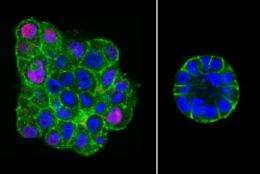
Shown are fluorescence images of uncompressed (left) and compressed (right) colonies of malignant breast epithelial cells. Compressed colonies are smaller and more organized. Credit: Images courtesy of Fletcher Lab
Researchers at the University of California, Berkeley, and the Lawrence Berkeley National Laboratory have put the squeeze—literally—on malignant mammary cells to guide them back into a normal growth pattern.
The findings, to be presented Monday, Dec. 17, at the annual meeting of the American Society for Cell Biology in San Francisco, show for the first time that mechanical forces alone can revert and stop the out-of-control growth of cancer cells. This change happens even though the genetic mutations responsible for malignancy remain, setting up a nature-versus-nurture battle in determining a cell's fate.
"We are showing that tissue organization is sensitive to mechanical inputs from the environment at the beginning stages of growth and development," said principal investigator Daniel Fletcher, professor of bioengineering at UC Berkeley and faculty scientist at the Berkeley Lab. "An early signal, in the form of compression, appears to get these malignant cells back on the right track."
Throughout a woman's life, breast tissue grows, shrinks and shifts in a highly organized way in response to changes in her reproductive cycle. For instance, when forming acini, the berry-shaped structures that secrete milk during lactation, healthy breast cells will rotate as they form an organized structure. And, importantly, the cells stop growing when they are supposed to.
One of the early hallmarks of breast cancer is the breakdown of this normal growth pattern. Not only do cancer cells continue to grow irregularly when they shouldn't, recent studies have shown that they do not rotate coherently when forming acini.
While the traditional view of cancer development focuses on the genetic mutations within the cell, Mina Bissell, Distinguished Scientist at the Berkeley Lab, conducted pioneering experiments that showed that a malignant cell is not doomed to become a tumor, but that its fate is dependent on its interaction with the surrounding microenvironment. Her experiments showed that manipulation of this environment, through the introduction of biochemical inhibitors, could tame mutated mammary cells into behaving normally.
The latest work from Fletcher's lab, in collaboration with Bissell's lab, takes a major step forward by introducing the concept of mechanical rather than chemical influences on cancer cell growth. Gautham Venugopalan, a member of Fletcher's lab, conducted the new experiments as part of his recently completed Ph.D. dissertation at UC Berkeley.
"People have known for centuries that physical force can influence our bodies," said Venugopalan. "When we lift weights, our muscles get bigger. The force of gravity is essential to keeping our bones strong. Here we show that physical force can play a role in the growth—and reversion—of cancer cells."
Venugopalan and collaborators grew malignant breast epithelial cells in a gelatin-like substance that had been injected into flexible silicone chambers. The flexible chambers allowed the researchers to apply a compressive force in the first stages of cell development.
Over time, the compressed malignant cells grew into more organized, healthy-looking acini that resembled normal structures, compared with malignant cells that were not compressed. The researchers used time-lapse microscopy over several days to show that early compression also induced coherent rotation in the malignant cells, a characteristic feature of normal development.
Notably, those cells stopped growing once the breast tissue structure was formed, even though the compressive force had been removed.
"Malignant cells have not completely forgotten how to be healthy; they just need the right cues to guide them back into a healthy growth pattern," said Venugopalan.
Researchers further added a drug that blocked E-cadherin, a protein that helps cells adhere to their neighbors. When they did this, the malignant cells returned to their disorganized, cancerous appearance, negating the effects of compression and demonstrating the importance of cell-to-cell communication in organized structure formation.
It should be noted that the researchers are not proposing the development of compression bras as a treatment for breast cancer. "Compression, in and of itself, is not likely to be a therapy," said Fletcher. "But this does give us new clues to track down the molecules and structures that could eventually be targeted for therapies."
More information: "Externally applied forces can phenotypically revert malignant breast epithelial structures," Monday, Dec. 17, 2012, 2−3:30 pm, Session: Tumor Microenvironment, presentation: 1673, poster: B1444, Exhibit Halls A-C
Provided by
University of California - Berkeley
-
Researchers discover critical rotational motion in cells
Jan 26, 2012 |
not rated yet |
0
-
New class of proteins allows breast cancer cells to evade tyrosine kinase inhibitors
Aug 13, 2012 |
not rated yet |
0
-
Scientists find that normal breast cells help kill cancer cells
Apr 13, 2011 |
not rated yet |
0
-
New cell imaging can identify cancer cells
Mar 13, 2006 |
not rated yet |
0
-
Malignant stem cells may explain why some breast cancers develop and recur
Aug 16, 2011 |
not rated yet |
0
-
Motion perception revisited: High Phi effect challenges established motion perception assumptions
Apr 23, 2013 |
3 / 5 (2) |
2
-
Anything you can do I can do better: Neuromolecular foundations of the superiority illusion (Update)
Apr 02, 2013 |
4.5 / 5 (11) |
5
-
The visual system as economist: Neural resource allocation in visual adaptation
Mar 30, 2013 |
5 / 5 (2) |
9
-
Separate lives: Neuronal and organismal lifespans decoupled
Mar 27, 2013 |
4.9 / 5 (8) |
0
-
Sizing things up: The evolutionary neurobiology of scale invariance
Feb 28, 2013 |
4.8 / 5 (10) |
14
-
Why is zone 1 in liver more prone to ischemic injury?
May 23, 2013
-
How can there be villous adenoma in colon, if there are no villi there
May 22, 2013
-
How can there be a term called "intestinal metaplasia" of stomach
May 21, 2013
-
Pressure-volume curve: Elastic Recoil Pressure don't make sense
May 18, 2013
-
If you became brain-dead, would you want them to pull the plug?
May 17, 2013
-
MRI bill question
May 15, 2013
- More from Physics Forums - Medical Sciences
More news stories
New fluorescent tools for cancer diagnosis
In recent years, microRNAs (miRNAs) and other non-coding RNAs are small molecules that help control the expression of specific proteins. In recent years they have emerged as disease biomarkers. miRNA profiles have been used ...
Cancer
23 hours ago |
not rated yet |
0
Modulating the immune system to combat metastatic cancer
Cancer cells spread and grow by avoiding detection and destruction by the immune system. Stimulation of the immune system can help to eliminate cancer cells; however, there are many factors that cause the immune system to ...
Cancer
23 hours ago |
5 / 5 (1) |
0
Scientists put bowel cancer under the microscope
Researchers from London's Kingston University have begun a two-year study which could help prolong the lives of people with colorectal tumours.
Cancer
May 24, 2013 |
5 / 5 (1) |
0
Researcher identifies breast cancer fighting hormone
Transformative research from Western University has identified new hormones in the body which may suppress breast cancer and stimulate the regression of breast tumors.
Cancer
May 24, 2013 |
5 / 5 (2) |
0
Ground breaking cancer research finds immune system link
(Medical Xpress)—Curtin University researchers have found evidence that targeting specific cells in the body can reverse the effects of cancer on the immune system.
Cancer
May 24, 2013 |
5 / 5 (4) |
0
First drug to improve heart failure mortality in over a decade
Coenzyme Q10 decreases all cause mortality by half, according to the results of a multicentre randomised double blind trial presented today at Heart Failure 2013 congress. It is the first drug to improve heart failure mortality ...
Hormone levels may provide key to understanding psychological disorders in women
Women at a particular stage in their monthly menstrual cycle may be more vulnerable to some of the psychological side-effects associated with stressful experiences, according to a study from UCL.
Heart failure accelerates male 'menopause'
Heart failure accelerates the aging process and brings on early andropausal syndrome (AS), according to research presented today at the Heart Failure Congress 2013. AS, also referred to as male 'menopause', was four times ...
Researchers identify first drug targets in childhood genetic tumor disorder
Two mutations central to the development of infantile myofibromatosis (IM)—a disorder characterized by multiple tumors involving the skin, bone, and soft tissue—may provide new therapeutic targets, according to researchers ...
Feds fight morning-after pill age ruling in NY
(AP)—Department of Justice lawyers have again asked a federal appeals court in New York to delay lifting age restrictions and prescription requirements on an emergency contraceptive popularly known as the morning-after ...
Death highest in heart failure patients admitted in January, on Friday, and overnight
Mortality and length of stay are highest in heart failure patients admitted in January, on Friday, and overnight, according to research presented today at the Heart Failure Congress 2013. The analysis of nearly 1 million ...