Computer simulations of blood flow through mechanical heart valves could pave the way for more individualized prosthetic
December 19, 2012 in Cardiology
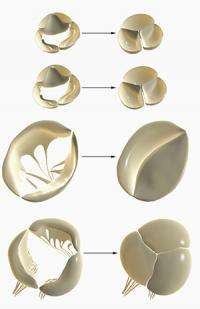
Four types of heart valves in open (left) and shut (right) positions. Diseased valves can be replaced with prosthetic ones but they can lead to complications. Credit: MedicalRF.com/Corbis
Every year, over 300,000 heart valve replacement operations are performed worldwide. Diseased valves are often replaced with mechanical heart valves (MHVs), which cannot yet be designed to suit each patient's specific needs. Complications such as blood clots can occur, which can require patients to take blood-thinning medication.
To investigate why such complications occur, Vinh-Tan Nguyen at A*STAR's Institute of High Performance Computing, Singapore, together with scientists at the National University of Singapore and institutions across the USA, have developed a new computer model to simulate the dynamics of blood flow through MHVs.
"The current practice for heart valve replacement in patients is a one-size-fits-all approach where a patient is implanted with the best-fit valve available on the market," explains Nguyen. "The valves are well designed for general physiological conditions, but may not be suitable for each individual's particular heart condition."
The researchers focused on the blood flow dynamics in a prosthetic valve known as a bileaflet MHV. This type of MHV contains two mobile leaflets, or gates, which are held in place by hinges. The leaflets open and close in response to blood flow pressures through the valve. Little is known about the effect that the hinged leaflets have on blood dynamics, although such designs are suspected of causing blood clots.
The computer model developed by Nguyen and his team simulates pressure flows through bileaflet MHVs by representing blood vessels as a computational mesh, where calculations are performed for individual blocks of the mesh. Their crucial advance was in enabling this mesh to move and evolve in response to the leaflet movements.
The researchers validated their computer model through laboratory experiments with a full 3D reproduction of the heart's circulation system. Particle imaging equipment allowed them to visualize the fluid dynamics under different scenarios including pulsatile flow, which follows the pattern of a typical cardiac cycle.
"We obtained good agreement between our computer simulations and the experiments in terms of the magnitude and velocity of blood flow through the leaflets," states Nguyen. The researchers also found that leaflet hinges might play a vital role in clotting, because individual hinges have different tolerances that can disrupt normal blood flow and cause stress in the vein walls.
This research is a first crucial step in understanding the impact of MHVs on blood flow. "Ultimately we hope to provide doctors with a tool to evaluate blood flow dynamics and other related aspects in patients with newly implanted valves," says Nguyen.
More information: Nguyen, V.-T., Kuan, Y. H., Chen, P.-Y., Ge, L., Sotiropoulos, F. et al. Experimentally validated hemodynamics simulations of mechanical heart valves in three dimensions. Cardiovascular Engineering and Technology 3, 88–100 (2012). rd.springer.com/ar… 9-011-0077-z
Provided by
Agency for Science, Technology and Research (A*STAR), Singapore
-
New design for mechanical heart valves
Nov 22, 2011 |
not rated yet |
0
-
Heart valves implanted without open-heart surgery
Jan 07, 2009 |
not rated yet |
0
-
Prosthetic vein valve designed to direct blood flow shows promising pre-clinical results
Sep 15, 2008 |
not rated yet |
0
-
Heart valve replacement without opening the chest gives new option for non-operable patients
Jun 24, 2011 |
not rated yet |
0
-
4 out of 106 heart replacement valves from pig hearts failed
Jun 29, 2009 |
not rated yet |
0
-
Motion perception revisited: High Phi effect challenges established motion perception assumptions
Apr 23, 2013 |
3 / 5 (2) |
2
-
Anything you can do I can do better: Neuromolecular foundations of the superiority illusion (Update)
Apr 02, 2013 |
4.5 / 5 (11) |
5
-
The visual system as economist: Neural resource allocation in visual adaptation
Mar 30, 2013 |
5 / 5 (2) |
9
-
Separate lives: Neuronal and organismal lifespans decoupled
Mar 27, 2013 |
4.9 / 5 (8) |
0
-
Sizing things up: The evolutionary neurobiology of scale invariance
Feb 28, 2013 |
4.8 / 5 (10) |
14
-
gravity is std. therefore can we rate a 'mass at height' by watts?
2 hours ago
-
Calculating on-axis elements of a solenoid
14 hours ago
-
latitude & longitude & air pressure
15 hours ago
-
Differences of Classical Mechanics when learned with Calc vs algebra?
18 hours ago
-
what is the distance traveled
22 hours ago
-
Image of a Convex Lens Cut in Half Horizontally
May 22, 2013
- More from Physics Forums - Classical Physics
More news stories
Second-generation TAVI device—Lotus Valve—shows good performance in REPRISE II
22 May 2013, Paris, France: The Lotus Valve, a second-generation transcatheter aortic valve implantation (TAVI) device, was successfully implanted in all of the first 60 patients in results from REPRISE II reported at EuroPCR ...
Cardiology
42 minutes ago |
not rated yet |
0
Costs to treat stroke in America may double by 2030
Costs to treat stroke are projected to more than double and the number of people having strokes may increase 20 percent by 2030, according to the American Heart Association/American Stroke Association.
Cardiology
23 hours ago |
not rated yet |
0
New blood-thinner measures may cut medication errors
Blood thinners are the preferred treatment option to prevent heart attacks, blood clots and stroke, but they are not without risk, and not just because of their side effects. These high-risk drugs, known as anticoagulants, ...
Cardiology
May 22, 2013 |
not rated yet |
0
Registry questions superiority of bivalirudin over heparin
Results from a large observational study reported at EuroPCR 2013 today question whether bivalirudin is superior to heparin in the absence of GPIIb/IIIa blockade, showing similar 30-day mortality in patients with non-ST segment ...
Cardiology
May 22, 2013 |
5 / 5 (1) |
0
Study shows low rate of late lumen loss with bioresorbable DESolve device
The DESolve bioresorbable coronary scaffold system achieves good efficacy and safety with low rates of late lumen loss and major coronary adverse events at six months, show first results from the pivotal DESolve Nx trial ...
Cardiology
May 22, 2013 |
not rated yet |
0
Researchers suggest boosting body's natural flu killers
A known difficulty in fighting influenza (flu) is the ability of the flu viruses to mutate and thus evade various medications that were previously found to be effective. Researchers at the Hebrew University of Jerusalem have ...
Anxious men fare worse during job interviews, study finds
Nervous about that upcoming job interview? You might want to take steps to reduce your jitters, especially if you are a man.
Breakthrough on Huntington's disease
Researchers at Lund University have succeeded in preventing very early symptoms of Huntington's disease, depression and anxiety, by deactivating the mutated huntingtin protein in the brains of mice.
Frequent heartburn may predict cancers of the throat and vocal cord
Frequent heartburn was positively associated with cancers of the throat and vocal cord among nonsmokers and nondrinkers, and the use of antacids, but not prescription medications, had a protective effect, according to data ...
Major human drug trial underway for Alzheimer's
A potentially ground-breaking human drug trial is currently underway, which aims to discover whether blood pressure medication can slow or halt the progression of Alzheimer's Disease (AD). This is the latest ...
Pay attention: How we focus and concentrate
Scientists at Newcastle University have shed new light on how the brain tunes in to relevant information.