New understanding can lead to srategies for dealing with neurodegenerative diseases
December 6, 2012 in Medical research
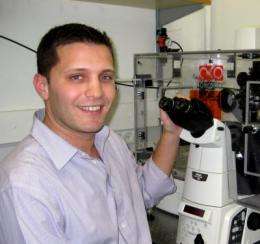
This is Dr. Daniel Kaganovich of the Hebrew University of Jerusalem. Credit: The Hebrew University of Jerusalem
A new understanding of what takes place on the cellular level during the development of neurodegenerative diseases, such as Parkinson's, Alzheimer's, ALS and Huntington's diseases, offers promise towards possible new strategies for combating such diseases, say Hebrew University of Jerusalem researchers.
Neurodegenerative conditions result from an impairment of motor function or cognitive function or both. This impairment results from degeneration in the particular area of the brain responsible for those functions.
Although these neurodegenerative diseases have been functionally linked to toxic protein aggregation (deposits), there is much that is unknown about the mechanism through which aggregation causes toxicity and death at the cellular level. Inclusion bodies – structures comprised of pathogenic protein aggregates—have long been seen as a hallmark of disease, but the relationship between inclusions and disease has remained somewhat mysterious.
In a study published in PNAS (Proceedings of the National Academy of Sciences). Hebrew University researchers (working in the lab of Dr. Daniel Kaganovich in the Cell and Developmental Biology Department, together with collaborators) present evidence that suggests that these inclusion bodies, which have traditionally been thought to accompany disease onset, actually have a cell-biological function that is not necessarily related to the disease conditions.
Further, the researchers suggest that some of those inclusion bodies not only are not toxic, but actually are part of a natural protective process. The researchers have identified two inclusion bodies, which they call JUNQ and IPOD. Aggregation in the JUNQ can lead to toxicity, whereas aggregation in the IPOD is protective.
These findings, say the Hebrew University researchers, point up a new potential strategy for designing therapeutics for neurodegenerative disease. Instead of preventing proteins from aggregating, which can be very difficult, it may be possible to enhance the cellular ability to actively enclose harmful aggregates within protective inclusions, thereby neutralizing the toxic proteins that bring on further neurodegenerative damage and even death.
Journal reference:
Proceedings of the National Academy of Sciences
Provided by
Hebrew University of Jerusalem
-
Neurodegeneration 'clumping proteins' common in aging process
Aug 10, 2010 |
not rated yet |
0
-
New findings on protein misfolding
Sep 18, 2012 |
not rated yet |
0
-
Scientists develop algorithm to understand certain human diseases
Jun 16, 2011 |
not rated yet |
0
-
Study identifies novel Parkinson's disease drug target
Jun 21, 2007 |
not rated yet |
0
-
Cellular stress can induce yeast to promote prion formation
Jul 23, 2011 |
not rated yet |
0
-
Motion perception revisited: High Phi effect challenges established motion perception assumptions
Apr 23, 2013 |
3 / 5 (2) |
2
-
Anything you can do I can do better: Neuromolecular foundations of the superiority illusion (Update)
Apr 02, 2013 |
4.5 / 5 (11) |
5
-
The visual system as economist: Neural resource allocation in visual adaptation
Mar 30, 2013 |
5 / 5 (2) |
9
-
Separate lives: Neuronal and organismal lifespans decoupled
Mar 27, 2013 |
4.9 / 5 (8) |
0
-
Sizing things up: The evolutionary neurobiology of scale invariance
Feb 28, 2013 |
4.8 / 5 (10) |
14
-
Pressure-volume curve: Elastic Recoil Pressure don't make sense
12 hours ago
-
If you became brain-dead, would you want them to pull the plug?
May 17, 2013
-
MRI bill question
May 15, 2013
-
Ratio of Hydrogen of Oxygen in Dessicated Animal Protein
May 13, 2013
-
Alcohol and acetaminophen
May 13, 2013
-
Marie Curie's leukemia
May 13, 2013
- More from Physics Forums - Medical Sciences
More news stories
Now we know why old scizophrenia medicine works on antibiotics-resistant bacteria
In 2008 researchers from the University of Southern Denmark showed that the drug thioridazine, which has previously been used to treat schizophrenia, is also a powerful weapon against antibiotic-resistant bacteria such as ...
Medical research
22 hours ago |
3.7 / 5 (3) |
0
|
SUMO wrestling cells reveal new protective mechanism target for stroke
Scientists investigating the interaction of a group of proteins in the brain responsible for protecting nerve cells from damage have identified a new target that could increase cell survival.
Medical research
May 17, 2013 |
5 / 5 (1) |
0
How serotonin receptors can shape drug effects, from LSD to migraine medication
New findings by researchers carrying out experiments at the U.S. Department of Energy Office of Science's Advanced Photon Source (APS) help explain why some drugs that interact with two kinds of human serotonin ...
Medical research
May 17, 2013 |
not rated yet |
0
|
Preventing blood poisoning
Peptide molecules derived from the body's natural immune system can help boost the body's defence against life-threatening blood poisoning, joint University research has uncovered.
Medical research
May 17, 2013 |
4 / 5 (1) |
0
|
New mechanism to prevent type 2 diabetes in obese individuals
A new Montréal study conducted by Dr. May Faraj, associate research professor at the Université de Montréal and invited scientist at the IRCM, along with her research team and medical collaborators, shows ...
Medical research
May 17, 2013 |
not rated yet |
0
|
New research identifies risks, interventions for children's GI health
An increasing number of U.S. children are experiencing gastrointestinal issues that require interventions to resolve, according to research presented at Digestive Disease Week (DDW).
US psychiatry gets makeover in new manual
The latest makeover to a massive psychiatric tome honored by some, reviled by others and even called the "Bible" of mental disorders is being released Saturday with a host of new changes.
New case of SARS-like virus in Saudi: ministry
A new case of the deadly coronavirus has been detected in Saudi Arabia where 15 people have already died after contracting it, the health ministry announced on Saturday on its Internet website.
AIDS science at 30: 'Cure' now part of lexicon
Big names in medicine are set to give an upbeat assessment of the war on AIDS on Tuesday, 30 years after French researchers identified the virus that causes the disease.
For combat veterans suffering from post-traumatic stress disorder, 'fear circuitry' in the brain never rests
Chronic trauma can inflict lasting damage to brain regions associated with fear and anxiety. Previous imaging studies of people with post-traumatic stress disorder, or PTSD, have shown that these brain regions can over-or ...
New colonoscope provides ground-breaking view of colon
A ground-breaking advance in colonoscopy technology signals the future of colorectal care, according to research presented today at Digestive Disease Week(DDW). Additional research focuses on optimizing the minimal withdrawal ...