Stress-resilience, susceptibility traced to neurons in reward circuit
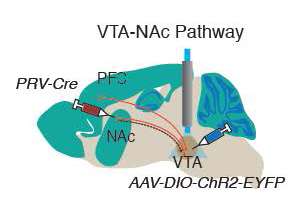
A specific pattern of neuronal firing in a brain reward circuit instantly rendered mice vulnerable to depression-like behavior induced by acute severe stress, a study supported by the National Institutes of Health has found. When researchers used a high-tech method to mimic the pattern, previously resilient mice instantly succumbed to a depression-like syndrome of social withdrawal and reduced pleasure-seeking – they avoided other animals and lost their sweet tooth. When the firing pattern was inhibited in vulnerable mice, they instantly became resilient.
"For the first time, we have shown that split-second control of specific brain circuitry can switch depression-related behavior on and off with flashes of an LED light," explained Ming-Hu Han, Ph.D., of the Mount Sinai School of Medicine, New York City, a grantee of NIH's National Institute of Mental Health (NIMH). "These results add to mounting clues about the mechanism of fast-acting antidepressant responses."
Han, Eric Nestler, M.D., Ph.D., of Mount Sinai, and colleagues, report on their study online, Dec. 12, 2012, in the journal Nature.
In a companion article, NIMH grantees Kay Tye, Ph.D., of the Massachusetts Institute of Technology, Cambridge, Mass., and Karl Deisseroth, M.D., Ph.D., of Stanford University, Stanford, Calif., used the same cutting-edge technique to control mouse brain activity in real time. Their study reveals that the same reward circuit neuronal activity pattern had the opposite effect when the depression-like behavior was induced by daily presentations of chronic, unpredictable mild physical stressors, instead of by shorter-term exposure to severe social stress.
Prior to the new studies, Han's team suspected that a telltale pattern – rapid firing of neurons that secrete the chemical messenger dopamine in a key circuit hub – makes an animal vulnerable to the depression-like effects of acute severe stress, and that slower firing supports resilience. But they lacked direct, real-time evidence.
To pinpoint cause-and-effect, they turned to a research technology pioneered by Deisseroth, called optogenetics. It melds fiber optics and genetic engineering to precisely control the activity of a specific brain circuit in a living, behaving animal. Genetically modified viruses are used to inject light-reactive proteins, borrowed from primitive organisms like algae, to make the circuitry similarly light-responsive.
The researchers had previously shown that neurons in the reward circuit hub deep in the brain, called the ventral tegmental area (VTA), fire at normal rates in social stress-resilient mice, but at high rates in social stress-susceptible mice. So they embedded an LED-lit optical fiber aimed at the VTA circuitry of genetically modified resilient mice to convert them into susceptible mice by triggering high firing rates.
Normally, it takes 10 days of repeated encounters with a dominant animal – an experimental procedure called social defeat stress – to induce depression-related behaviors. Even after that, some mice emerge seemingly unscathed. But these resilient animals – in which the reward circuit had been genetically modified for optogenetic control – instantly succumbed to a long-lasting depression-like syndrome after light pulses triggered neural activity mimicking the high firing rates seen in the susceptible animals.
In subsequent experiments, using similar optogenetic strategies, the researchers discovered that inhibiting the reward circuit activity pattern in stress-susceptible mice instantly converted them into stress-resilient animals. The reward circuit projects from the VTA to an area in the center front of the brain, called the nucleus accumbens. This study suggests that dopamine neurons firing at high rates in this specific circuit projection encode a signal for susceptibility to depression induced by acute, severe stress. By contrast, a circuit projection from the VTA to the prefrontal cortex, in the top front of the brain (see diagram), was found to serve an opposite function.
Depression in humans often stems from milder stressors over longer periods of time. Tye and Deisseroth used optogenetics to probe reward circuit workings related to depression-like behaviors in rodents exposed to stressors like white noise, crowded housing, or continuous darkness or illumination. Exposure to some of these milder stressors lasted 10 weeks, compared to the 10-days of social defeat stress.
"We sought to mimic gradual, stress-induced transitions to depressed-like states, as are often seen clinically," explained Deisseroth, who is a practicing psychiatrist as well as a neuroscientist.
In contrast to the Han-Nestler results after social defeat stress, following 10 weeks of unpredictable chronic mild stress, optogentically inducing high firing rates in VTA dopamine neurons instantly reversed such depression-like behaviors induced by chronic mild stressors – and vice versa. Also opposite to the social defeat stress findings, optogenetically inhibiting VTA dopamine neurons induced depression-like states.
"The variable effects that stressors of different types induce in the dopamine system may point to the need for distinct treatment strategies for patients whose depressions stem from different types of experiences," said Tye, who is leading a research group studying the neural underpinnings of motivational and emotional processing.
When Tye and Deisseroth infused agents that block binding of the chemical messenger glutatmate in the nucleus accumbens, they produced an antidepressant response – mice struggled more to escape the stressor. They note that this is consistent with the effects of the fast-acting antidepressant ketamine, which similarly blocks glutamate.
While optogenetics is providing insights into rapid antidepressant mechanisms, the technique is not suitable for treatment of depression in humans.
"These stunning demonstrations that depression-like states can literally be switched on and off underscore that context – stressor type and intensity – is pivotal in the workings of the neurons and circuit implicated," said NIMH Director Thomas R. Insel, M.D. "These new, precise circuit breakers are advancing our understanding of how specific brain pathways regulate behavior."
More information: Chaudhury D, Walsh JJ, Friedman AK, Juarez B, Ku SM, Koo JW, Ferguson D, Tsai H-C, Pomeranz L, Christoffel DJ, Nectow AR, Ekstrad M, Domingos A, Mazie-Robison M, Mouzon E, Lobo MK, Neve RL, Friedman JM, Russo SJ, Diesseroth K, Nestler E, Han M-H. Rapid regulation of depression-related behaviors by control of midbrain dopamine neurons. Dec. 12, 2012. Nature.
Tye KM, Mirzabekov JJ, Warden MR, Ferenczi EA, Tsai H-C, Finkelstein J, Kim S-Y, Adhikari A, Thompson KR, Andalman AS, Gunaydin LA, Witten LB, Deisseroth K. Dopamine neurons modulate neural encoding and expression of depression-related behaviour. Dec. 12, 2012. Nature.


