Team uncovers new insight into cell development and cancer
December 27, 2012 in Cancer

UNC research uncovers new insight into cell development and cancer

Enlarge

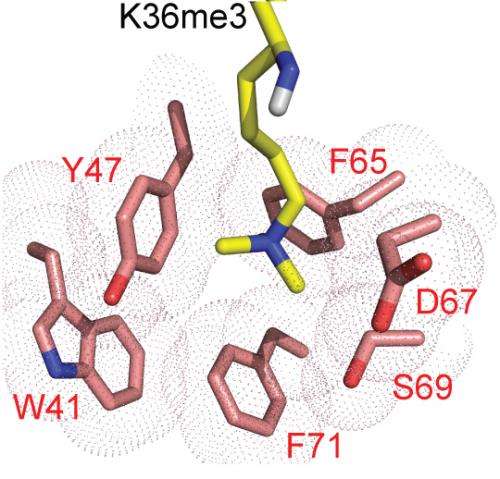
PCLs utilize an amino acid group to engage with a chemical marker that signals gene activation. Credit: University of North Carolina

Long-standing research efforts have been focused on understanding how stem cells, cells capable of transforming into any type of cell in the body, are capable of being programmed down a defined path to contribute to the development of a specific organ like a heart, lung, or kidney. Research from the University of North Carolina at Chapel Hill School of Medicine has shed new light on how epigenetic signals may function together to determine the ultimate fate of a stem cell.

The study, published December 27, 2012 by the journal Molecular Cell, implicates a unique class of proteins called polycomb-like proteins, or PCL's, as bridging molecules between the "on" and "off" state of a gene. While all of these specialized types of cells share the same genetic information encoded in our DNA, it is becoming increasingly clear that information outside the genome, referred to as epigenetics, plays a central role in orchestrating the reprogramming of a stem cell down a defined path.

Although it is understood that epigenetics is responsible for turning genes "on" and "off" at defined times during cellular development, the precise mechanisms controlling this delicate process are less well understood.

"This finding has important implications for both and , as the same controlled by PCL's in stem cells are often misregulated in tumors," said Dr. Greg Wang, senior author of the study and Assistant Professor of Biochemistry and Biophysics in the UNC School of Medicine and a member of UNC Lineberger Comprehensive Cancer Center.

The study, led by postdoctoral research fellows Drs. Ling Cai and Rui Lu in the Wang lab, and Dr. Scott Rothbart, a Lineberger postdoctoral fellow in the lab of Dr. Brian Strahl, Associate Professor of Biochemistry and Biophysics in the UNC School of Medicine and a member of UNC Lineberger Comprehensive Cancer Center, identified that PCL's interact with an epigenetic signal associated with genes that are turned on to recruit a group of proteins called the PRC2 complex which then turn genes off.

"In stem cells, the PRC2 complex turns genes off that would otherwise promote reprogramming into specialized cells of organs like the heart or lungs," said Wang.

In addition to its fundamental role in cellular development, elevated levels of PRC2 have been found in cancers of the prostate, breast, lung, and blood, and pharmaceutical companies are already developing drugs to target PRC2. Wang and colleagues determined that the same mechanisms controlling PRC2 function in stem cells also applies in human cancers.

"The identification of a specific PCL in controlling PRC2 in cancer cells suggests we may be able to develop drugs targeting this PCL to regulate PRC2 function in a more controlled manner that may maintain PRC2 function in while inhibiting it in the tumor," said Wang.

Journal reference: Molecular Cell search and more info website

Provided by University of North Carolina Health Care search and more info website

5 /5 (2 votes)  

Rank 5 /5 (2 votes)
Related Stories
Relevant PhysicsForums posts

More news stories

New colonoscope provides ground-breaking view of colon

A ground-breaking advance in colonoscopy technology signals the future of colorectal care, according to research presented today at Digestive Disease Week(DDW). Additional research focuses on optimizing the minimal withdrawal ...

Cancer created 9 hours ago | popularity 5 / 5 (1) | comments 0

ASCO: combo antibody therapy effective for melanoma

(HealthDay)—Concurrent use of two immune checkpoint antibodies—ipilimumab and nivolumab—may be effective for the treatment of advanced melanoma, according to a proof-of-principal study presented in ...

Cancer created May 17, 2013 | popularity not rated yet | comments 0

Risk factors ID'd for poor cutaneous cell CA outcomes

(HealthDay)—The risks of metastasis and death associated with cutaneous squamous cell carcinoma (CSCC) are low, but significant, and risk factors for poor outcome include tumor diameter, invasion beyond ...

Cancer created May 17, 2013 | popularity not rated yet | comments 0 | with audio podcast

Physical & emotional impairments common, often untreated in people with cancer

A new review finds cancer survivors suffer a diverse and complex set of impairments, affecting virtually every organ system. Writing in CA: A Cancer Journal for Clinicians, Julie Silver, M.D., associate professor at Harvar ...

Cancer created May 17, 2013 | popularity not rated yet | comments 0

Calif. doc with 'cancer cure' gets 14 years prison (Update)

(AP)—A California doctor has been sentenced to 14 years in federal prison for bilking her patients out of more than $1 million by promising that an herbal supplement could cure late-stage cancer and other diseases.

Cancer created May 17, 2013 | popularity not rated yet | comments 0


New research identifies risks, interventions for children's GI health

An increasing number of U.S. children are experiencing gastrointestinal issues that require interventions to resolve, according to research presented at Digestive Disease Week (DDW).

US psychiatry gets makeover in new manual

The latest makeover to a massive psychiatric tome honored by some, reviled by others and even called the "Bible" of mental disorders is being released Saturday with a host of new changes.

New case of SARS-like virus in Saudi: ministry

A new case of the deadly coronavirus has been detected in Saudi Arabia where 15 people have already died after contracting it, the health ministry announced on Saturday on its Internet website.

AIDS science at 30: 'Cure' now part of lexicon

Big names in medicine are set to give an upbeat assessment of the war on AIDS on Tuesday, 30 years after French researchers identified the virus that causes the disease.

For combat veterans suffering from post-traumatic stress disorder, 'fear circuitry' in the brain never rests

Chronic trauma can inflict lasting damage to brain regions associated with fear and anxiety. Previous imaging studies of people with post-traumatic stress disorder, or PTSD, have shown that these brain regions can over-or ...

Flesh-eating disease victim gets prosthetic hands

(AP)—A woman who lost both hands, her left leg and right foot after contracting a flesh-eating disease has been fitted with prosthetic hands.