Unexpected toughness may mark out cancer cells in the blood
(Medical Xpress)—A surprising discovery about the physical properties of cancer cells could help improve a new diagnostic approach – a liquid biopsy – that detects, measures, and evaluates cancer cells in blood.
Cancer cells circulating in the bloodstream can form metastases – new tumors. Detecting these rare circulating cancer cells in a blood sample is much less invasive than a standard tumor biopsy, and could prove useful for monitoring cancer progression and detecting recurrence.
While studying what happens to cancer cells when they are subjected to powerful fluid forces, like those encountered in the bloodstream, researchers at the University of Iowa unexpectedly discovered that cancer cells are actually more likely to survive this turbulent fluid environment than normal epithelial cells. The researchers suggest this surprising "hardiness" could be a potential biomarker for detecting and studying cancer cells in the blood. The findings were published Dec. 3 in the journal PLOS ONE.
"For many years, it's been assumed that these circulating cancer cells are quite fragile, and they essentially get 'blended' by the fluid forces in the blood," says Michael Henry, Ph.D., associate professor of molecular physiology and biophysics at the UI Carver College of Medicine and lead study author. "But there was no real direct evidence for how fluid forces in the blood affect cancer cells.
"What we found was that normal cells were, as expected, quite sensitive to the fluid forces and most did not survive. But, surprisingly, the cancer cells seemed to be remarkably resistant."
Henry suggests that resistance to fluid shear stress might be a way to distinguish benign from malignant cells in circulating tumor cell samples.
"By adding this really simple physical test to the isolation of circulating tumor cells, this technique might let us sort out malignant cells from benign cells. Being able to quantify the numbers of 'dangerous' cells might be a more accurate prognostic marker for the patient than simply counting the total number of circulating tumor cells," says Henry, who also is deputy director for research with Holden Comprehensive Cancer Center at the UI.
A simple system
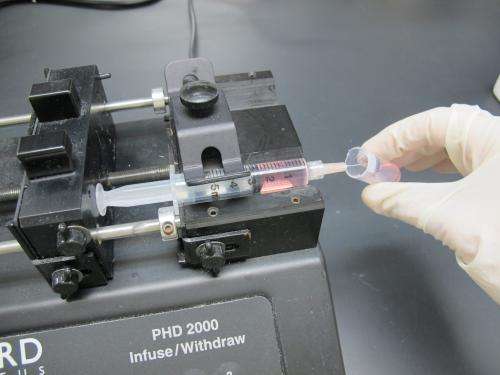
Using a simple syringe and precise mathematical calculations of fluid dynamics, the UI team created an experimental system to mimic the short bursts of turbulent flow that a cancer cell might experience in the blood. Passing a suspension of cells through the syringe needle allowed the researchers to study the effect of a series of millisecond pulses of high fluid shear stress on a variety of different cancer cell types (prostate, breast, and melanoma) as well as normal epithelial cells from breast and prostate tissue.
After 10 passages though the syringe needle at high flow rate, around half of the cancer cells were still alive. In contrast, very few normal epithelial cells survived the process.
Closer examination of the cell survival data revealed an additional twist. The rate at which the cancer cells are destroyed by passage through the syringe is not constant over all 10 passages. Instead, exposure to fluid shear stress during the earlier passages seems to trigger adaptive responses in cancer cells that actually increase the cells' resistance to fluid shear stress.
The UI team went on to show that this "toughening up" process appears to involve expression of common cancer-causing genes. They also showed that blocking the signaling pathway controlled by one of these oncogenes reduced the cancer cells' resistance to fluid shear stress.
Many different cellular pathways can go wrong to create cancer cells. Henry suggests that this newly discovered physical characteristic of cancer cells may be a common, convergent manifestation of these various, separate molecular abnormalities.
If that is true, simply measuring cancer cells' ability to resist fluid shear stresses might allow researchers to examine the behavior of cancer cells and investigate the effects of cancer drugs on tumor cells.
Translating to clinical
With the surprising findings and their potential for clinical use, the study has grown from a side project of study author and then-graduate student J. Matthew Barnes, and has now garnered external funding to support further research. Jones Nauseef, study author and a UI MSTP student in Henry's lab, has taken up the research, and Henry has established a collaboration with UI urologist James Brown, M.D., to test the technique with blood samples from patients with prostate cancer. That study is being funded by a grant from the Department of Defense.
"A next step for us is to translate these findings into patient specimens and determine whether this can be useful in a context that is clinically meaningful," Henry says, such as determining whether a cancer is progressing or if it may respond to a particular therapy.
More information: http://dx.plos.org/10.1371/journal.pone.0050973


