Testing brain pacemakers to zap Alzheimer's damage (Update)
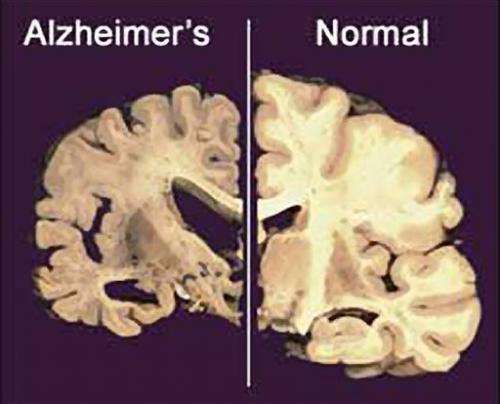
It has the makings of a science fiction movie: Zap someone's brain with mild jolts of electricity to try to stave off the creeping memory loss of Alzheimer's disease.
And it's not easy. Holes are drilled into the patient's skull so tiny wires can be implanted into just the right spot.
A dramatic shift is beginning in the disappointing struggle to find something to slow the damage of this epidemic: The first U.S. experiments with "brain pacemakers" for Alzheimer's are getting under way. Scientists are looking beyond drugs to implants in the hunt for much-needed new treatments.
The research is in its infancy. Only a few dozen people with early-stage Alzheimer's will be implanted in a handful of hospitals. No one knows if it might work, and if it does, how long the effects might last.
Kathy Sanford was among the first to sign up. Her early-stage Alzheimer's was gradually getting worse. She still lived independently, posting reminders to herself, but no longer could work. The usual medicines weren't helping.
Then doctors at Ohio State University explained the hope—that constant electrical stimulation of brain circuits involved in memory and thinking might keep those neural networks active for longer, essentially bypassing some of dementia's damage.
Sanford decided it was worth a try.
"The reason I'm doing it is, it's really hard to not be able, sometimes, to remember," Sanford, 57, said.
Her father was blunter.
"What's our choice? To participate in a program or sit here and watch her slowly deteriorate?" asked Joe Jester, 78.
A few months after the five-hour operation, the hair shaved for her brain surgery was growing back and Sanford said she felt good, with an occasional tingling that she attributes to the electrodes. A battery-powered generator near her collarbone powers them, sending the tiny shocks up her neck and into her brain.
It's too soon to know how she'll fare; scientists will track her for two years.
"This is an ongoing evaluation right now that we are optimistic about," is how Ohio State neurosurgeon Dr. Ali Rezai cautiously puts it.
More than 5 million Americans have Alzheimer's or similar dementias, and that number is expected to rise rapidly as the baby boomer generation ages. Today's drugs only temporarily help some symptoms. Attempts to attack Alzheimer's presumed cause, a brain-clogging material, so far haven't worked.
"We're getting tired of not having other things work," said Ohio State neurologist Dr. Douglas Scharre.
The new approach is called deep brain stimulation, or DBS. While it won't attack Alzheimer's root cause either, "maybe we can make the brain work better," he said.
Implanting electrodes into the brain isn't new.
Between 85,000 and 100,000 people around the world have had DBS to block the tremors of Parkinson's disease and other movement disorders. The continuous jolts quiet overactive nerve cells, with few side effects. Scientists also are testing whether stimulating other parts of the brain might help lift depression or curb appetite among the obese.
It was in one of those experiments that Canadian researchers back in 2003 stumbled onto the Alzheimer's possibility. They switched on the electrical jolts in the brain of an obese man and unlocked a flood of old memories. Continuing his DBS also improved his ability to learn. He didn't have dementia, but the researchers wondered if they could spur memory-making networks in someone who did.
But wait a minute.
Alzheimer's doesn't just steal memories. It eventually robs sufferers of the ability to do the simplest of tasks. How could stimulating a brain so damaged do any good?
A healthy brain is a connected brain. One circuit signals another to switch on and retrieve the memories needed to, say, drive a car or cook a meal.
At least early in the disease, Alzheimer's kills only certain spots. But the disease's hallmark plaques act as a roadblock, stopping the "on" switch so that healthy circuits farther away are deactivated, explained Dr. Andres Lozano, a neurosurgeon at Toronto Western Hospital whose research sparked the interest.
So the plan was to put the electrodes into hubs where brain pathways for memory, behavior, concentration and other cognitive functions converge, to see if the jolts reactivate those silenced circuits, added Ohio State's Rezai.
Lozano's team found the first clue that it's possible by implanting six Alzheimer's patients in Canada. After at least 12 months of continuous stimulation, brain scans showed a sign of more activity in areas targeted by Alzheimer's. Suddenly, the neurons there began using more glucose, the fuel for brain cells.
"It looked like a blackout before. We were able to turn the lights back on in those areas," Lozano said.
While most Alzheimer's patients show clear declines in function every year, one Canadian man who has had the implants for four years hasn't deteriorated, Lozano said, although he cautioned that there's no way to know whether that's due to the DBS.
The evidence is preliminary and will take years of study to prove, but "this is an exciting novel approach," said Dr. Laurie Ryan of the National Institutes of Health's aging division, which is funding a follow-up study.
Under way now:
—The Toronto researchers have teamed with four U.S. medical centers—Johns Hopkins University, the University of Pennsylvania, University of Florida and Arizona's Banner Health System—to try DBS in a part of the brain called the fornix, one of those memory hubs, in 40 patients. Half will have their electrodes turned on two weeks after the operation and the rest in a year, an attempt to spot any placebo effect from surgery.
—At Ohio State, Rezai is implanting the electrodes into a different spot, the frontal lobes, that his own DBS work suggests could tap into cognition and behavior pathways. That study will enroll 10 participants including Sanford.
Surgery back in October was Sanford's first step. Then it was time to fine-tune how the electrodes fire. She took problem-solving tests while neurologist Scharre adjusted the voltage and frequency and watched her reactions.
Sanford was cheered to see her test scores climb a bit during those adjustments. She said she knows there are no guarantees, but "if we can beat some of this stuff, or at least get a leading edge on it, I'm in for the whole deal."
Copyright 2013 The Associated Press. All rights reserved. This material may not be published, broadcast, rewritten or redistributed.


