A step toward repairing the central nervous system
January 29, 2013 in Medical research

A step towards repairing the central nervous system

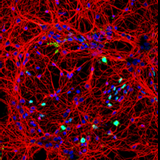
Neuronal cells cultures through a confocal microscope. The cytoskeleton is stained red, the nuclei blue and proliferative nuclei green.

Despite recent advances in understanding the mechanisms of nerve injury, tissue-engineering solutions for repairing damage in the central nervous system (CNS) remain elusive, owing to the crucial and complex role played by the neural stem cell (NSC) niche. This zone, in which stem cells are retained after embryonic development for the production of new cells, exerts a tight control over many crucial tasks such as growth promotion and the recreation of essential biochemical and physical cues for neural cell differentiation.

According to the first author of the paper, Zaida Álvarez, from the Group on Biomaterials for Regenerative Therapies of the Institute for Bioengineering of Catalonia (IBEC), "in order to develop tissue-engineering strategies to repair damage to the CNS, it is essential to design biomaterials that closely mimic the NSC niche and its physical and biochemical characteristics".

In the study headed by Soledad Alcántara of the University of Barcelona, the team tested types of polylactic acid (PLA) with different proportions of isomers L and D/L, a allowing neural cell adhesion and growth, as materials for . They found that one type, PLA with a proportion of isomers of 70/30, maintained the important pools of neuronal and glial progenitor cells in vitro. PLA 70/30 was more amorphous, degraded faster and, crucially, released significant amounts of L-lactate, which is essential for the maintenance and differentiation of neural progenitor cells. "The aim of the research was to find a biomaterial able to sustain the population of and to generate new differentiated cells in order to start the development of an implant that allows brain regeneration," explains Dr Alcántara.

"The mechanical and surface properties of PLA70/30, which we used here in the form of microthin films, make it a good substrate for neural cell adhesion, proliferation and differentiation," adds Álvarez. "The physical properties of this material and the release of L-lactate when it degrades, which provides an alternative oxidative substrate for neural cells, act synergistically to modulate progenitor phenotypes", concludes the researcher.

The results suggest that the introduction of 3D patterns mimicking the architecture of the embryonic NSC niches on PLA70/30-based scaffolds may be a good starting point for the design of brain-implantable devices. "These will be able to induce or activate existing to self-renew and produce new neurons, boosting the CNS regenerative response in situ," states Álvarez.

Enabling the CNS to regenerate could open doors to promising new strategies to tackle accidental damage as well as numerous diseases like stroke and degenerative disorders such as Parkinson's and Alzheimer's diseases.

More information: Alvarez, Z. et al. (March 2013). The effect of the composition of PLA films and lactate release on glial and neuronal maturation and the maintenance of the neuronal progenitor niche. Biomaterials 34, 9, 2221–2233.

Provided by University of Barcelona search and more info website

not rated yet  

Rank not rated yet
Relevant PhysicsForums posts

More news stories

H. pylori, smoking trends, and gastric cancer in US men

Trends in Helicobacter pylori (H. pylori) and smoking explain a significant proportion of the decline of intestinal-type noncardia gastric adenocarcinoma (NCGA) incidence in US men between 1978 and 2008, and are estimated ...

Medical research created 7 hours ago | popularity not rated yet | comments 0

Common food supplement fights degenerative brain disorders

Widely available in pharmacies and health stores, phosphatidylserine is a natural food supplement produced from beef, oysters, and soy. Proven to improve cognition and slow memory loss, it's a popular treatment for older ...

Medical research created 12 hours ago | popularity 5 / 5 (2) | comments 0 | with audio podcast

Finding a family for a pair of orphan receptors in the brain

Researchers at Emory University have identified a protein that stimulates a pair of "orphan receptors" found in the brain, solving a long-standing biological puzzle and possibly leading to future treatments for neurological ...

Medical research created 12 hours ago | popularity 5 / 5 (1) | comments 0 | with audio podcast

Insight into the dazzling impact of insulin in cells

Australian scientists have charted the path of insulin action in cells in precise detail like never before. This provides a comprehensive blueprint for understanding what goes wrong in diabetes.

Medical research created 13 hours ago | popularity 4.5 / 5 (6) | comments 0 | with audio podcast

Do men's and women's hearts burn fuel differently?

Researchers at the University of Illinois at Chicago College of Medicine will study gender differences in how the heart uses and stores fat—its main energy source—and how changes in fat metabolism play ...

Medical research created 16 hours ago | popularity not rated yet | comments 0


If you can remember it, you can remember it wrong

(Medical Xpress)—Native peoples in regions where cameras are uncommon sometimes react with caution when their picture is taken. The fear that something must have been stolen from them to create the photo ...

B vitamins could delay dementia

(Medical Xpress)—Despite spending billions of dollars on research and development, drug companies have been unable to come up with effective treatments for dementia and Alzheimer's Disease (AD). Now, A. ...

New sleeping pill poised to hit US markets

An experimental sleeping pill from US drug company Merck is effective at helping people fall and stay asleep, according to reviewers at the US Food and Drug Administration, which could soon approve the new drug.

Reducing caloric intake delays nerve cell loss

Activating an enzyme known to play a role in the anti-aging benefits of calorie restriction delays the loss of brain cells and preserves cognitive function in mice, according to a study published in the May ...

Antidepressant reduces stress-induced heart condition

A drug commonly used to treat depression and anxiety may improve a stress-related heart condition in people with stable coronary heart disease, according to researchers at Duke Medicine.

Small cancer risk following CT scans in childhood and adolescence confirmed

The gap between life expectancy in patients with a mental illness and the general population has widened since 1985 and efforts to reduce this gap should focus on improving physical health, suggest researchers in a paper ...