Study shows climate change could affect onset and severity of flu seasons
January 28, 2013 in Diseases, Conditions, Syndromes
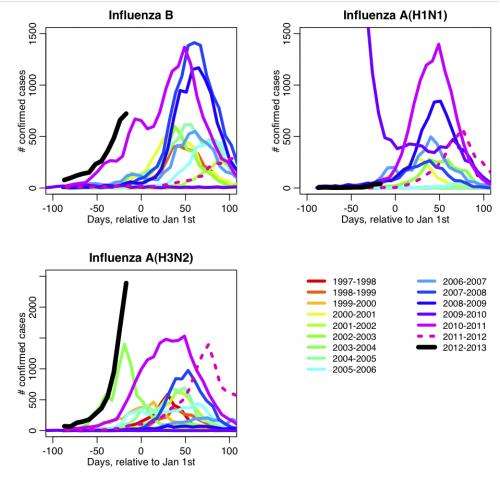
Research by Arizona State University scientists tracked the number of flu cases by week for the past 16 years. Their studies suggest there is a trend toward earlier and more severe flu seasons with potential link climate change. Credit: Arizona State University
The American public can expect to add earlier and more severe flu seasons to the fallout from climate change, according to a research study published online Jan. 28 in PLOS Currents: Influenza.
A team of scientists led by Sherry Towers, research professor in the Mathematical, Computational and Modeling Sciences Center at Arizona State University, studied waves of influenza and climate patterns in the U.S. from the 1997-1998 season to the present.
The team's analysis, which used Centers for Disease Control data, indicates a pattern for both A and B strains: warm winters are usually followed by heavy flu seasons.
"It appears that fewer people contract influenza during warm winters, and this causes a major portion of the population to remain vulnerable into the next season, causing an early and strong emergence," says Towers. "And when a flu season begins exceptionally early, much of the population has not had a chance to get vaccinated, potentially making that flu season even worse."
The current flu season, which is still in high gear in parts of the nation, began early and fiercely. It followed a relatively light 2011 season, which saw the lowest peak of flu since tracking efforts went into effect, and coincided with the fourth warmest winter on record. According to previous studies, flu transmission decreases in warm or humid conditions.
If global warming continues, warm winters will become more common, and the impact of flu will likely be more heavily felt, say the study's authors.
Mathematical epidemiologist Gerardo Chowell-Puente, an associate professor in the School of Human Evolution and Social Change in the College of Liberal Arts and Sciences, adds that the findings could inform preparedness efforts following mild winters: "The expedited manufacture and distribution of vaccines and aggressive vaccination programs could significantly diminish the severity of future influenza epidemics."
Provided by
Arizona State University
-
Flu season off to latest start in decades
Feb 17, 2012 |
not rated yet |
0
-
US flu season starts early, could be bad, CDC says
Dec 03, 2012 |
not rated yet |
0
-
Flu season came early but too soon to say it's bad
Jan 10, 2013 |
not rated yet |
0
-
Little U.S. flu activity so far, CDC says
Oct 04, 2012 |
not rated yet |
0
-
Flu remains widespread in US; eases in some areas
Jan 18, 2013 |
not rated yet |
0
-
Motion perception revisited: High Phi effect challenges established motion perception assumptions
Apr 23, 2013 |
3 / 5 (2) |
2
-
Anything you can do I can do better: Neuromolecular foundations of the superiority illusion (Update)
Apr 02, 2013 |
4.5 / 5 (11) |
5
-
The visual system as economist: Neural resource allocation in visual adaptation
Mar 30, 2013 |
5 / 5 (2) |
9
-
Separate lives: Neuronal and organismal lifespans decoupled
Mar 27, 2013 |
4.9 / 5 (8) |
0
-
Sizing things up: The evolutionary neurobiology of scale invariance
Feb 28, 2013 |
4.8 / 5 (10) |
14
-
Classical and Quantum Mechanics via Lie algebras
Apr 15, 2011
- More from Physics Forums - Independent Research
More news stories
Heart healthy lifestyle may cut kidney disease patients' risk of kidney failure
Maintaining a heart healthy lifestyle may also help protect chronic kidney disease patients from developing kidney failure and dying prematurely, according to a study appearing in an upcoming issue of the Journal of the Am ...
Diseases, Conditions, Syndromes
5 minutes ago |
not rated yet |
0
Flu vaccine also linked to narcolepsy in adults, study reports
Finnish researchers unveiled new data Thursday to link the Pandemrix flu vaccine to a higher risk of the sleeping disorder narcolepsy in adults.
Diseases, Conditions, Syndromes
35 minutes ago |
not rated yet |
0
Second child contracts polio in Pakistan's Waziristan
A second child has contracted polio in a restive Pakistani tribal region near the Afghan border after the Taliban banned vaccinations there nearly a year ago, a UN official said Thursday.
Diseases, Conditions, Syndromes
55 minutes ago |
not rated yet |
0
Ferrets, pigs susceptible to H7N9 avian influenza virus
Chinese and U.S. scientists have used virus isolated from a person who died from H7N9 avian influenza infection to determine whether the virus could infect and be transmitted between ferrets. Ferrets are often used as a mammalian ...
Diseases, Conditions, Syndromes
1 hour ago |
not rated yet |
0
|
WHO says 22 deaths worldwide from coronavirus (Update)
World Health Organization officials said Thursday that their probe into the deadly new coronavirus that has now claimed 22 lives is being delayed because of a dispute over the ownership rights to a sample—a claim disputed ...
Diseases, Conditions, Syndromes
4 hours ago |
not rated yet |
0
When oxygen is short, EGFR prevents maturation of cancer-fighting miRNAs
Even while being dragged to its destruction inside a cell, a cancer-promoting growth factor receptor fires away, sending signals that thwart the development of tumor-suppressing microRNAs (miRNAs) before it's dissolved, researchers ...
Diabetes' genetic underpinnings can vary based on ethnic background, studies say
Ethnic background plays a surprisingly large role in how diabetes develops on a cellular level, according to two new studies led by researchers at the Stanford University School of Medicine.
J&J expects 10-plus new drug applications by 2017
(AP)—Johnson & Johnson is developing what could eventually be game-changing treatments for depression and pain, and it's aiming to apply for approval of more than 10 new medicines by 2017, executives said Thursday during ...
Farm bill: Senate rejects GMO labeling amendment
The Senate has overwhelmingly rejected an amendment allowing states to require labeling of genetically modified foods.
Scientists discover cinnamon compounds' potential ability to prevent Alzheimer's
Cinnamon: Can the red-brown spice with the unmistakable fragrance and variety of uses offer an important benefit? The common baking spice might hold the key to delaying the onset of –– or warding off ...
Study reveals new mechanism for estrogen suppression of liver lipid synthesis
By discovering the new mechanism by which estrogen suppresses lipid synthesis in the liver, UC Irvine endocrinologists have revealed a potential new approach toward treating certain liver diseases.