Discovery of new class of damage-prone DNA regions could lead to better cancer treatments
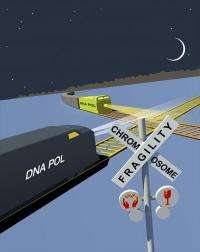
Replication-induced DNA damage is a potent source of genome instability; however the affected loci are largely uncharacterized. Using high throughput protein-DNA association and transcriptome assays, Barlow, Faryabi et al. generate a genome-wide map of hydroxyurea-induced DNA damage sites. These sites occur soon after replication initiation (early replication fragile sites, or ERFS), unlike well characterized common fragile sites (CFS). ERFS correlate with high transcription, and can arise from the collision of transcription and replication machineries. Credit: Cell, Nussenzweig et al.
Cancer is thought to arise from DNA damage at fragile sites in the genome. A study published by Cell Press on January 24th in the journal Cell reveals a new class of fragile sites that contributes to DNA alterations in a type of blood cancer called B cell lymphoma The findings could lead to the development of more effective treatments for B cell lymphoma and potentially other cancers.
"This study describes an underlying mechanism of genome instability in B cell lymphoma that could not be previously explained," says senior study author André Nussenzweig of the National Cancer Institute. "The phenomena that we show in mice may be important for cancer initiation and progression in humans."
DNA damage can occur at fragile sites when DNA is replicated prior to cell division, and regions that are hard to copy, such as repetitive sequences, are especially prone to double-strand breaks. Because immune system cells called B cell lymphocytes are among the most rapidly dividing cells, they are at great risk for replication-induced DNA damage. In addition, in the nonreplicative stage of the cell cycle, B cell lymphocytes can acquire double-strand breaks through the action of an enzyme that helps build antibody genes called activation-induced cytidine deaminase (AID), which causes a lot of collateral damage in the genome, storing up problems that get exacerbated during replication. But AID activity cannot account for many mutations associated with B cell lymphoma.
In the new study, Nussenzweig and his team uncovered an AID-independent source of DNA breaks associated with replication called early replicating fragile sites (ERFSs). Applying a genome-wide sequencing approach to mouse B cell lymphocytes, they found that DNA damage occurs at ERFSs during early stages of replication. Moreover, these sites overlapped significantly with DNA alterations associated with B cell lymphoma, suggesting that ERFSs are a major feature of the mutational landscape of this type of cancer and possibly other cancers.
"Cancer is an evolving disease, and DNA damage associated with replication is one of the processes occurring in malignant cells to help them adapt and survive when a tumor metastasizes," Nussenzweig says. "Therefore, understanding how replication-induced DNA damage occurs in both healthy and cancer cells may provide a better understanding of how cancer arises and help in designing more effective treatments."
More information: Cell, Nussenzweig et al.: "A novel class of early replicating fragile sites that contribute to genome instability in B cell lymphomas." dx.doi.org/10.1016… .2013.01.006
Journal reference:
Cell
Provided by
Cell Press
-
Scientists identify molecular basis for DNA breakage
Jul 19, 2011 |
not rated yet |
0
-
Researchers illuminate mechanisms that regulate DNA damage control and replication
Jan 05, 2009 |
not rated yet |
0
-
An enzyme that mutates antibodies also targets a cancer-causing oncogene
Dec 11, 2008 |
not rated yet |
0
-
Critical protein prevents DNA damage from persisting through generations
Jun 29, 2007 |
not rated yet |
0
-
Researchers demonstrate why DNA breaks down in cancer cells
May 03, 2011 |
not rated yet |
0
-
Motion perception revisited: High Phi effect challenges established motion perception assumptions
Apr 23, 2013 |
3 / 5 (2) |
2
-
Anything you can do I can do better: Neuromolecular foundations of the superiority illusion (Update)
Apr 02, 2013 |
4.5 / 5 (11) |
5
-
The visual system as economist: Neural resource allocation in visual adaptation
Mar 30, 2013 |
5 / 5 (2) |
9
-
Separate lives: Neuronal and organismal lifespans decoupled
Mar 27, 2013 |
4.9 / 5 (8) |
0
-
Sizing things up: The evolutionary neurobiology of scale invariance
Feb 28, 2013 |
4.8 / 5 (10) |
14
-
Why is zone 1 in liver more prone to ischemic injury?
May 23, 2013
-
How can there be villous adenoma in colon, if there are no villi there
May 22, 2013
-
How can there be a term called "intestinal metaplasia" of stomach
May 21, 2013
-
Pressure-volume curve: Elastic Recoil Pressure don't make sense
May 18, 2013
-
If you became brain-dead, would you want them to pull the plug?
May 17, 2013
-
MRI bill question
May 15, 2013
- More from Physics Forums - Medical Sciences
More news stories
New fluorescent tools for cancer diagnosis
In recent years, microRNAs (miRNAs) and other non-coding RNAs are small molecules that help control the expression of specific proteins. In recent years they have emerged as disease biomarkers. miRNA profiles have been used ...
Cancer
10 hours ago |
not rated yet |
0
Modulating the immune system to combat metastatic cancer
Cancer cells spread and grow by avoiding detection and destruction by the immune system. Stimulation of the immune system can help to eliminate cancer cells; however, there are many factors that cause the immune system to ...
Cancer
10 hours ago |
not rated yet |
0
Scientists put bowel cancer under the microscope
Researchers from London's Kingston University have begun a two-year study which could help prolong the lives of people with colorectal tumours.
Cancer
14 hours ago |
5 / 5 (1) |
0
Researcher identifies breast cancer fighting hormone
Transformative research from Western University has identified new hormones in the body which may suppress breast cancer and stimulate the regression of breast tumors.
Cancer
14 hours ago |
5 / 5 (1) |
0
Ground breaking cancer research finds immune system link
(Medical Xpress)—Curtin University researchers have found evidence that targeting specific cells in the body can reverse the effects of cancer on the immune system.
Cancer
15 hours ago |
5 / 5 (3) |
0
Engineered cytomegalovirus protects monkeys from HIV equivalent
(Medical Xpress)—A new study by researchers in the US has shown that an ancient virus can be modified to help in the fight against the simian immunodeficiency virus SIV, which is the equivalent in monkeys ...
Researchers identify first drug targets in childhood genetic tumor disorder
Two mutations central to the development of infantile myofibromatosis (IM)—a disorder characterized by multiple tumors involving the skin, bone, and soft tissue—may provide new therapeutic targets, according to researchers ...
Hormone levels may provide key to understanding psychological disorders in women
Women at a particular stage in their monthly menstrual cycle may be more vulnerable to some of the psychological side-effects associated with stressful experiences, according to a study from UCL.
Going live: Immune cell activation in multiple sclerosis
Biological processes are generally based on events at the molecular and cellular level. To understand what happens in the course of infections, diseases or normal bodily functions, scientists would need to ...
Driving and hands-free talking lead to spike in errors, study shows
Talking on a hands-free device while behind the wheel can lead to a sharp increase in errors that could imperil other drivers on the road, according to new research from the University of Alberta.
Depression raises diabetics' risk of severe low blood sugar episodes
(Medical Xpress)—Patients with diabetes who are depressed are much more likely to develop episodes of dangerously low blood sugars, or hypoglycemia, than are those who are not depressed, a new study has ...