Empa spin-off bound for success with its electronic bedside care assistant
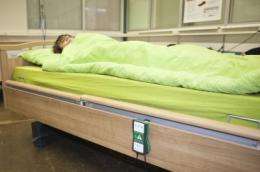
The first product to hit the Swiss market from Empa and ETH Zurich spin-off compliant concept is surpassing all expectations. The successful market launch of the electronic healthcare assistant also impressed investors. Following a successful round of financing, the company's investors now include Lausanne-based pharmaceutical development group Debiopharm, Zürcher Kantonalbank (Cantonal Bank of Zurich) and Empa. As a result, compliant concept can continue to grow and expand abroad.
Cost pressures in the healthcare system and care requirements are constantly increasing. At the same time, the individual workload managed by nurses and caretakers is becoming heavier. Consequently, intelligent solutions that ease their workload, and guarantee constant, high-quality care are more in demand than ever. Michael Sauter, CEO of compliant concept, a company founded in 2009 and located in Empa's "glaTec" technology centre, in Duebendorf does not just have some ideas on this subject. He also provides a solution. In July 2012, the mechanical engineer and his team launched their first product to form part of a comprehensive mobility and activity analysis concept for individuals in need of care. For the first time, it is possible to obtain objective information about sleep patterns and mobility. As well as benefiting those in need of care, the new possibilities offered by this product are of particular assistance to nurses and caretakers. The "Mobility Monitor" supports nurses and caretakers in their decision-making processes and contributes to the efficient planning, design and documentation of care.
According to Sauter, feedback from the first customers was overwhelming, with the monitor being used in a much more versatile manner than originally anticipated. In the first quarter after sales commenced, the company had already generated over 50 percent higher sales than had been forecast in the business plan. The first customers were already buying additional devices and the company had succeeded in obtaining a contract from the TERTIANUM Group – one of the market leaders – for use of the Mobility Monitor in all their residences. Luca Stäger, CEO of the TERTIANUM Group says: "The use of the Mobility Monitor supplements the professional nursing skills of staff at the 16 TERTIANUM residences as well as 5 Perlavita establishments and provides our guests requiring nursing care with individually tailored safety and quality." From the beginning of 2013, the Mobility Monitor will also be distributed in Germany and Sauter reports that discussions are already being held with partners in other countries.
First round of financing successfully completed
Both the idea and the product have convinced investors. Sauter recently completed the first round of financing. Now, he not only has the support of various private investors, but is also backed by institutional investors – Lausanne-based pharmaceutical development group Debiopharm, Zürcher Kantonalbank (Cantonal Bank of Zurich) and Empa, the Swiss Federal Laboratories for Materials Science and Technology.
"I am delighted with the excellent investment structure. We now benefit not only from the capital these investors are providing, but also from their expertise and huge networks", comments Sauter. Thierry Mauvernay, Debiopharm Group's Delegate of the Board adds: "The start-up spirit is greatly valued by Debiopharm. We want to foster and sustain it by supporting other entrepreneurs over the long term. compliant concept corresponds to our idea of the medicine for the future, where prevention reduces healthcare costs as well as the suffering of the most fragile patients."
The newly injected capital will enable compliant concept to grow further and expand into other countries.
How the Mobility Monitor works
A monitor is attached to the bed, beneath the mattress, and connected both to a display device at the edge of the bed and to a call light system. In a contactless manner, i.e. without touching the body, the monitor records and analyses the patient's minutest movements, evaluates these and displays the measured values on a small screen at the end of the bed. The computer evaluation also allows staff to efficiently plan and document further care. As the "electronic assistant" is also highly suitable for recording sleep patterns and it supports medication dosage verification, it is used not only in nursing homes and hospitals, but also in rehabilitation clinics.


