Good bacteria in the intestine prevent diabetes, study finds
January 18, 2013 in Diabetes

Good bacteria in the intestine prevent diabetes

Enlarge

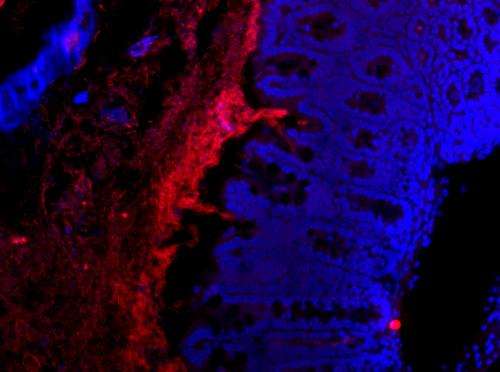
The picture shows the intestinal cells in blue with a very thick and dense layer of bacteria in red just above the top of the intestinal surface. The red bacteria produce chemicals that enter the body and help keep it healthy, for example by protecting it from diabetes. Credit: Dr. Li Hai, UCVM, University of Bern

All humans have enormous numbers of bacteria and other micro-organisms (10 to 14) in the lower intestine. In fact our bodies contain about ten times more bacteria than our own cells and these tiny passengers are extremely important for our health. They help us digest our food and provide us with energy and vitamins. These "friendly" commensal bacteria in the intestine help to stop the "bad guys" such as Salmonella that cause infections, taking hold. Even the biochemical reactions that build up and maintain our bodies come from our intestinal bacteria as well as our own cells. 

Pretty important that we get along with these little bacterial friends... definitely. But as in all beautiful relationships, things can sometimes turn sour. If the bacteria in the intestine become unbalanced, inflammation and damage can occur at many different locations in the body. The best known of these is the intestine itself: the wrong intestinal bacteria can trigger Crohn's disease and ulcerative colitis. The liver also becomes damaged when intestinal bacteria are unbalanced.

 Research groups led by Professor Jayne Danska at the Sick Children's Hospital of the University of Toronto and Professor Andrew Macpherson in the Clinic for Visceral Surgery and Medicine at the Inselspital and the University of Bern have now shown that the influence of the intestinal bacteria extends even deeper inside the body to influence the likelihood of getting diabetes. In children and young people, diabetes is caused by the of the body damaging the special cells in the pancreas that produce the . By chance, 30 years ago, before the development of , Japanese investigators noticed that a strain of NOD tended to get diabetes. These mice (also by chance) have many of the same genes that make some humans susceptible to the disease. With the help of the special facilities of the University of Bern and in Canada, these teams have been able to show that the intestinal bacteria, especially in male mice, can produce biochemicals and hormones that stop diabetes developing.

Diabetes in young people is becoming more and more frequent, and doctors even talk about a diabetes epidemic. This increase in diabetic disease has happened over the last 40 years as our homes and environment have become cleaner and more hygienic. At the moment, once a child has diabetes, he or she requires life-long treatment. "We hope that our new understanding of how may protect susceptible children from developing diabetes, will allow us to start to develop new treatments to stop children getting the disease", says Andrew Macpherson of the University Bern.

More information: Markle, J. et al. Sex-specific differences in the gut microbiome drive testosterone-dependent protection from autoimmunity that is transferable by early life conditioning in the NOD mouse, Science Express, 17. Januar 2013, DOI: 10.1126/science.1233521

Journal reference: Science Express search and more info website

Provided by University of Bern search and more info website

5 /5 (3 votes)  

Filter


Move the slider to adjust rank threshold, so that you can hide some of the comments.


Display comments: newest first

tadchem
Jan 18, 2013

Rank: not rated yet
A recent (Dec '12) report in the ISME Journal identifies Enterobacter cloacae as a commensal that can trigger obesity, and that: "a diet formulated specifically to kill off those bacteria succeeded in reducing (one subjects') levels to below what could be detected in a laboratory. He lost 113 pounds in 23 weeks.
His high blood pressure disappeared. So did his type-2 diabetes and his fatty liver disease."
Rank 5 /5 (3 votes)
Relevant PhysicsForums posts
  • Learning curve of Electromagnetism?
    created3 hours ago
  • thin glass in liquid
    created4 hours ago
  • How many joules expended for a push up?
    created7 hours ago
  • force to keep the folding doors
    created7 hours ago
  • Confusion regarding direction of kinetic friction on inclined plane.
    created8 hours ago
  • Mage hand
    created14 hours ago
  • More from Physics Forums - Classical Physics

More news stories

Exercise prevents fructose-induced hypertriglyceridemia

(HealthDay)—Moderate aerobic exercise prevents fructose-induced hypertriglyceridemia in healthy males, according to a study published online May 14 in Diabetes.

Diabetes created May 17, 2013 | popularity 5 / 5 (1) | comments 0 | with audio podcast

DNA variant affects diabetes risk and treatment response

A DNA variant near a digestive enzyme does not only affect risk of developing diabetes but also affects the response to treatment, an international consortium of researchers including the University of Dundee has found.

Diabetes created May 17, 2013 | popularity not rated yet | comments 0 | with audio podcast

The artificial pancreas that keeps tabs on sugar

(Medical Xpress)—Development of a sophisticated artificial pancreas holds potential to transform the lives of patients with Type 1 diabetes.

Diabetes created May 16, 2013 | popularity 5 / 5 (1) | comments 0 | with audio podcast

Study findings significant for treating infections in Type 1 diabetes

A small University at Buffalo study has found for the first time that in Type 1 diabetics, insulin injections exert a strong anti-inflammatory effect at the cellular and molecular level, while even small amounts of glucose ...

Diabetes created May 16, 2013 | popularity not rated yet | comments 0

Hospital hypoglycemia rates up in black men with diabetes

(HealthDay)—Home diabetes regimens partially explain the increased risk of having a hypoglycemia event during hospitalization among older African-American men with diabetes, according to a study published ...

Diabetes created May 14, 2013 | popularity not rated yet | comments 0


New research identifies risks, interventions for children's GI health

An increasing number of U.S. children are experiencing gastrointestinal issues that require interventions to resolve, according to research presented at Digestive Disease Week (DDW).

US psychiatry gets makeover in new manual

The latest makeover to a massive psychiatric tome honored by some, reviled by others and even called the "Bible" of mental disorders is being released Saturday with a host of new changes.

New case of SARS-like virus in Saudi: ministry

A new case of the deadly coronavirus has been detected in Saudi Arabia where 15 people have already died after contracting it, the health ministry announced on Saturday on its Internet website.

AIDS science at 30: 'Cure' now part of lexicon

Big names in medicine are set to give an upbeat assessment of the war on AIDS on Tuesday, 30 years after French researchers identified the virus that causes the disease.

For combat veterans suffering from post-traumatic stress disorder, 'fear circuitry' in the brain never rests

Chronic trauma can inflict lasting damage to brain regions associated with fear and anxiety. Previous imaging studies of people with post-traumatic stress disorder, or PTSD, have shown that these brain regions can over-or ...

New colonoscope provides ground-breaking view of colon

A ground-breaking advance in colonoscopy technology signals the future of colorectal care, according to research presented today at Digestive Disease Week(DDW). Additional research focuses on optimizing the minimal withdrawal ...