Can we all just get along? Immunological memory learns tolerance
January 15, 2013 by Chris Defrancesco in Immunology

Can we all just get along? Immunological memory learns tolerance

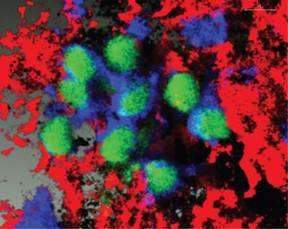
In this image from the UConn Health Center immunology researchers’ study, the T cells are depicted in green, while the red indicates dendritic cells, or cells that deliver antigens. Credit: Lefrançois Lab

(Medical Xpress)—Immunology researchers at the University of Connecticut Health Center are learning more about memory T cells, which are cells that fight infection from a previously encountered antigen.

"This work shows that under normal circumstances, memory ignore self-antigens, thereby prohibiting autoimmunity," says Leo Lefrançois, Department of Immunology chair, whose laboratory developed a genetically modified mouse model that made the research possible. "However, when inflammation is introduced the can respond, helping to explain why infections can trigger autoimmune diseases."

Memory T cells normally exist to protect from re-infection. But memory T cells also can cause autoimmune disease when they cross-react with self-antigens, sometimes triggered by infection.

An antigen is a substance normally foreign to the body that evokes an immune response and is bound by T cells. Autoimmunity can occur when T cells bind self-antigens. Co-authors include Evan Jellison, assistant professor of immunology, Lynn Puddington, associate professor of immunology and medicine, former UConn Health Center postdoctoral fellow Michael Turner, and research assistants Elizabeth Lingenheld and Li Zhu. Their work is published in the Dec. 26 issue of the .

"These results have implications for relapsing remitting forms of autoimmune disease as well as for cancer therapy where memory T cells might ignore but could potentially be triggered to attack the tumor," Jellison says.

More information: www.ncbi.nlm.nih.g… med/23236165

Journal reference: Proceedings of the National Academy of Sciences search and more info website

Provided by University of Connecticut search and more info website

5 /5 (1 vote)  

Rank 5 /5 (1 vote)
Relevant PhysicsForums posts

More news stories

New immune system discovered

(Medical Xpress)—A research team, led by Jeremy Barr, a biology post-doctoral fellow, unveils a new immune system that protects humans and animals from infection.

Immunology created May 20, 2013 | popularity 4.8 / 5 (23) | comments 8 | with audio podcast

Vitamin D could provide new and effective treatments for asthma

(Medical Xpress)—Scientists at King's College London have discovered that Vitamin D has the potential to significantly reduce the symptoms of asthma. The study, led by Professor Catherine Hawrylowicz from ...

Immunology created May 20, 2013 | popularity 5 / 5 (1) | comments 0 | with audio podcast

Immune protein could stop diabetes in its tracks

Melbourne researchers have identified an immune protein that has the potential to stop or reverse the development of type 1 diabetes in its early stages, before insulin-producing cells have been destroyed.

Immunology created May 20, 2013 | popularity 5 / 5 (5) | comments 0 | with audio podcast

Stem-cell-based strategy boosts immune system in mice

Raising hopes for cell-based therapies, UC San Francisco researchers have created the first functioning human thymus tissue from embryonic stem cells in the laboratory. The researchers showed that, in mice, ...

Immunology created May 16, 2013 | popularity 4.8 / 5 (5) | comments 0 | with audio podcast

Resistance to visceral leishmaniasis: New mechanisms involved

Researchers from CNRS, Université Toulouse III - Paul Sabatier and IRD have elucidated new molecular mechanisms involved in resistance to visceral leishmaniasis, a serious parasitic infection. They have shown that dectin-1 ...

Immunology created May 16, 2013 | popularity not rated yet | comments 0


Slowing the aging process—only with antibiotics

Swiss scientists reveal the mechanism responsible for aging hidden deep within mitochondria—and dramatically slow it down in worms by administering antibiotics to the young.

Rate of bicycle-related fatalities significantly lower in states with helmet laws

Existing research shows that bicyclists who wear helmets have an 88 percent lower risk of brain injury, but researchers at Boston Children's Hospital found that simply having bicycle helmet laws in place showed a 20 percent ...

Researchers complete largest genetic sequencing study of human disease

Researchers from Queen Mary, University of London have led the largest sequencing study of human disease to date, investigating the genetic basis of six autoimmune diseases.

Brain can be trained in compassion, study shows

Until now, little was scientifically known about the human potential to cultivate compassion—the emotional state of caring for people who are suffering in a way that motivates altruistic behavior.

Having both migraines, depression may mean smaller brain

(HealthDay)—Migraines and depression can each cause a great deal of suffering, but new research indicates the combination of the two may be linked to something else entirely—a smaller brain.

Novel approach for influenza vaccination shows promise in early animal testing

A new approach for immunizing against influenza elicited a more potent immune response and broader protection than the currently licensed seasonal influenza vaccines when tested in mice and ferrets. The vaccine ...