Researchers find certain kind of brain damage can cause people to be more reckless with investments
January 22, 2013 by Bob Yirka in Neuroscience report

Researchers find certain kind of brain damage can cause people to be more reckless with investments

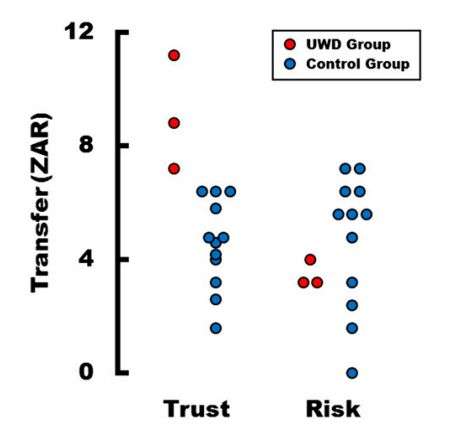
BLA-damaged subjects in the trust game transferred significantly more money to the anonymous trustees than control subjects. Credit: (c) PNAS, DOI:10.1073/pnas.1217316110

(Medical Xpress)—A team of researchers from several universities in Europe has found that human test subjects with a damaged portion of their brain were likely to invest more money in a risky trustee than those without the brain damage. In their paper published in the Proceedings of the National Academy of Sciences, the team says the subjects were willing to invest more despite being told that the trustee may not be trustworthy.

In their study, the researchers found that test subjects with damage to the part of their brain known as the basolateral , but who still had a normally functioning central-medial amygdale, tended to be far more generous in a role-playing game – individuals were asked to offer funds to a trustee who was supposed to invest the funds for them – than those without such . More surprising was that the test subjects continued to do so despite being made aware of the possibility that the trustee might abscond with their money. When asked why, the test subjects were unable to offer an explanation. Interestingly, there did appear to be a limit however – test subjects were willing to risk up to twice as much money as their non-brain damaged peers, but no more than that.

The researchers suggest that their findings do not indicate a change in risk-taking due to the brain damage, or that the test subjects expected a higher than average return on their investment. Instead, they suggest, it's more likely that the brain damage resulted in problems with comprehending . Prior research they say, with mice, has shown that damage to the amygdale resulted in rodents that appeared unable to assess the between risk taking and the reward that might come about as a result of engaging in a risky venture.

If further study adds credence to these new findings, it could have implications for investors and people with brain damage. Someone with minor damage to their amygdale (from playing football perhaps) could be living an otherwise normal life, for example, but make poor choices regarding investing, or even buying a house. If the brain damage is subsequently discovered, there would likely be legal implications that could result in changes to how such cases are decided.

More information: "Generous economic investments after basolateral amygdala damage," by Jack van Honk, Christoph Eisenegger, David Terburg, Dan J. Stein, and Barak Morgan, PNAS, 2013. www.pnas.org/cgi/d… s.1217316110

Abstract
Contemporary economic models hold that instrumental and impulsive behaviors underlie human social decision making. The amygdala is assumed to be involved in social-economic behavior, but its role in human behavior is poorly understood. Rodent research suggests that the basolateral amygdala (BLA) subserves instrumental behaviors and regulates the central-medial amygdala, which subserves impulsive behaviors. The human amygdala, however, typically is investigated as a single unit. If these rodent data could be translated to humans, selective dysfunction of the human BLA might constrain instrumental social-economic decisions and result in more impulsive social-economic choice behavior. Here we show that humans with selective BLA damage and a functional central-medial amygdala invest nearly 100% more money in unfamiliar others in a trust game than do healthy controls. We furthermore show that this generosity is not caused by risk-taking deviations in nonsocial contexts. Moreover, these BLA-damaged subjects do not expect higher returns or perceive people as more trustworthy, implying that their generous investments are not instrumental in nature. These findings suggest that the human BLA is essential for instrumental behaviors in socialeconomic interactions.

Journal reference: Proceedings of the National Academy of Sciences search and more info website

© 2013 Medical Xpress

5 /5 (2 votes)  

Filter


Move the slider to adjust rank threshold, so that you can hide some of the comments.


Display comments: newest first

VendicarD
Jan 22, 2013

Rank: 5 / 5 (1)
What kind of brain damage causes them to become Tea Baggers?

Rank 5 /5 (2 votes)
Relevant PhysicsForums posts

More news stories

If you can remember it, you can remember it wrong

(Medical Xpress)—Native peoples in regions where cameras are uncommon sometimes react with caution when their picture is taken. The fear that something must have been stolen from them to create the photo ...

Neuroscience created 45 minutes ago | popularity not rated yet | comments 0 | with audio podcast report

Study shows where scene context happens in our brain

In a remote fishing community in Venezuela, a lone fisherman sits on a cliff overlooking the southern Caribbean Sea. This man –– the lookout –– is responsible for directing his comrades on the water, ...

Neuroscience created 2 hours ago | popularity not rated yet | comments 0 | with audio podcast

Clouds in the head

Many brain researchers cannot see the forest for the trees. When they use electrodes to record the activity patterns of individual neurons, the patterns often appear chaotic and difficult to interpret.

Neuroscience created 4 hours ago | popularity not rated yet | comments 0

New theory offers clues to vital 'repair and maintenance' role of sleep

(Medical Xpress)—We spend about a third of our life asleep, but why we need to do so remains a mystery. In a recent publication, researchers at University of Surrey and University College London suggest a new hypothesis, ...

Neuroscience created 5 hours ago | popularity not rated yet | comments 0

Study puts Huntington's disease trials on TRACK

(Medical Xpress)—A three-year multinational study has tracked and detailed the progression of Huntington's disease (HD), predicting clinical decline in people carrying the HD gene more than 10 years before ...

Neuroscience created 6 hours ago | popularity not rated yet | comments 0


Insight into the dazzling impact of insulin in cells

Australian scientists have charted the path of insulin action in cells in precise detail like never before. This provides a comprehensive blueprint for understanding what goes wrong in diabetes.

Estimates reveal low population immunity to new bird flu virus H7N9 in humans

The level of immunity to the recently circulating H7N9 influenza virus in an urban and rural population in Vietnam is very low, according to the first population level study to examine human immunity to the virus, which was ...

Finding a family for a pair of orphan receptors in the brain

Researchers at Emory University have identified a protein that stimulates a pair of "orphan receptors" found in the brain, solving a long-standing biological puzzle and possibly leading to future treatments for neurological ...

Study finds vitamin C can kill drug-resistant TB (w/ video)

In a striking, unexpected discovery, researchers at Albert Einstein College of Medicine of Yeshiva University have determined that vitamin C kills drug-resistant tuberculosis (TB) bacteria in laboratory culture. The finding ...

Glaucoma drug can cause droopy eyelids

Prostaglandin analogues (PGAs), drugs which lower intraocular pressure, are often the first line of treatment for people with glaucoma, but their use is not without risks. PGAs have long been associated with blurred vision, ...

New search engine finds rare diagnoses

Doctors are trained to think "common disease" when they meet patients in their practices, and as they rarely or never meet a rare disease, it often takes many years to reach the right diagnosis. A new search tool called FindZebra ...