Lack of protein Sp2 disrupts neuron creation in brain
January 14, 2013 in Neuroscience
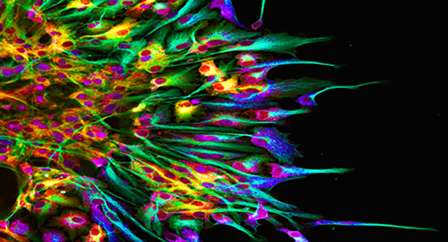
A rendered image of a primary neuronal stem cell culture in which cells were labeled with different fluorescently labeled proteins that differentiate between stem cells (orange/yellow) and their neuronal 'offspring' (blue/green/purple).
(Medical Xpress)—A protein known as Sp2 is key to the proper creation of neurons from stem cells, according to researchers at North Carolina State University. Understanding how this protein works could enable scientists to "program" stem cells for regeneration, which has implications for neural therapies.
Troy Ghashghaei and Jon Horowitz, both faculty in NC State's Department of Molecular Biomedical Sciences and researchers in the Center for Comparative Medicine and Translational Research, wanted to know more about the function of Sp2, a cell cycle regulator that helps control how cells divide. Previous research from Horowitz had shown that too much Sp2 in skin-producing stem cells resulted in tumors in experimental mice. Excessive amounts of Sp2 prevented the stem cells from creating normal cell "offspring," or skin cells. Instead, the stem cells just kept producing more stem cells, which led to tumor formation.
"We believe that Sp2 must play a fundamental role in the lives of normal stem cells," Horowitz says. "Trouble ensues when the mechanisms that regulate its activity are overwhelmed due to its excess abundance."
Ghashghaei and his team – led by doctoral candidate Huixuan Liang – took the opposite approach. Using genetic tools, they got rid of Sp2 in certain neural stem cells in mice, specifically those that produce the major neurons of the brain's cerebral cortex. They found that a lack of Sp2 disrupted normal cell formation in these stem cells, and one important result was similar to Horowitz's: the abnormal stem cells were unable to produce normal cell "offspring," or neurons. Instead, the abnormal stem cells just created copies of themselves, which were also abnormal.
"It's interesting that both an overabundance of this protein and a total lack of it result in similar disruptions in how stem cells divide," Ghashghaei says. "So while this work confirms that Sp2 is absolutely necessary for stem cell function, a lot of questions still remain about what exactly it is regulating, and whether it is present in all stem cells or just a few. We also need to find out if Sp2 deletion or overabundance can produce brain tumors in our mice as in the skin.
"Finally, we are very interested in understanding how Sp2 regulates a very important decision a stem cell has to make: whether to produce more of itself or to produce offspring that can become neurons or skin cells," Ghashghaei adds. "We hope to address those questions in our future research, because these cellular mechanisms have implications for cancer research, neurodevelopmental diseases and regenerative medicine."
The results appear online in Development.
NC State graduate students Guanxi Xiao, and Haifeng Yin, as well as Dr. Simon Hippenmeyer, a collaborator with the Ghashghaei lab from Austria's Institute of Science and Technology, contributed to the work. The work was funded by the National Institutes of Health and the American Federation for Aging Research.
More information: "Neural development is dependent on the function of specificity protein 2 in cell cycle progression" Development, 2013.
Abstract
Faithful progression through the cell cycle is crucial to the maintenance and developmental potential of stem cells. Here, we demonstrate that neural stem cells (NSCs) and intermediate neural progenitor cells (NPCs) employ a zinc-finger transcription factor specificity protein 2 (Sp2) as a cell cycle regulator in two temporally and spatially distinct progenitor domains. Differential conditional deletion of Sp2 in early embryonic cerebral cortical progenitors, and perinatal olfactory bulb progenitors disrupted transitions through G1, G2 and M phases, whereas DNA synthesis appeared intact. Cell-autonomous function of Sp2 was identified by deletion of Sp2 using mosaic analysis with double markers, which clearly established that conditional Sp2-null NSCs and NPCs are M phase arrested in vivo. Importantly, conditional deletion of Sp2 led to a decline in the generation of NPCs and neurons in the developing and postnatal brains. Our findings implicate Sp2-dependent mechanisms as novel regulators of cell cycle progression, the absence of which disrupts neurogenesis in the embryonic and postnatal brain.
Journal reference:
Development
Provided by
North Carolina State University
-
Too much SP2 protein turns stem cells into 'evil twin' cancer cells
Oct 27, 2010 |
not rated yet |
0
-
Genetic 'conductor' involved with new brain cell production in adults
Jun 29, 2011 |
not rated yet |
0
-
On your last nerve: Researchers advance understanding of stem cells
Nov 17, 2009 |
not rated yet |
0
-
Researchers find stem cells from monkey teeth can stimulate growth and generation of brain cells
Nov 11, 2008 |
not rated yet |
0
-
Following the Glow: Researchers Use 'Fluorescent Fish' to Study Gene Function
Jan 18, 2010 |
not rated yet |
0
-
Motion perception revisited: High Phi effect challenges established motion perception assumptions
Apr 23, 2013 |
3 / 5 (2) |
2
-
Anything you can do I can do better: Neuromolecular foundations of the superiority illusion (Update)
Apr 02, 2013 |
4.5 / 5 (11) |
5
-
The visual system as economist: Neural resource allocation in visual adaptation
Mar 30, 2013 |
5 / 5 (2) |
9
-
Separate lives: Neuronal and organismal lifespans decoupled
Mar 27, 2013 |
4.9 / 5 (8) |
0
-
Sizing things up: The evolutionary neurobiology of scale invariance
Feb 28, 2013 |
4.8 / 5 (10) |
14
-
Why is zone 1 in liver more prone to ischemic injury?
May 23, 2013
-
How can there be villous adenoma in colon, if there are no villi there
May 22, 2013
-
How can there be a term called "intestinal metaplasia" of stomach
May 21, 2013
-
Pressure-volume curve: Elastic Recoil Pressure don't make sense
May 18, 2013
-
If you became brain-dead, would you want them to pull the plug?
May 17, 2013
-
MRI bill question
May 15, 2013
- More from Physics Forums - Medical Sciences
More news stories
New neuron formation could increase capacity for new learning, at the expense of old memories
New research presented today shows that formation of new neurons in the hippocampus - a brain region known for its importance in learning and remembering - could cause forgetting of old memories by causing a reorganization ...
Neuroscience
20 hours ago |
4 / 5 (4) |
0
Help at hand for people with schizophrenia
How can healthy people who hear voices help schizophrenics? Finding the answer for this is at the centre of research conducted at the University of Bergen.
Neuroscience
21 hours ago |
4 / 5 (2) |
2
Japanese research organizations contribute to Human Brain Project
One of the major frontiers of modern science is a comprehensive understanding of the human brain and its functions to guide the development of new technologies in information and communication. In a major announcement for ...
Neuroscience
21 hours ago |
3.7 / 5 (3) |
0
Controlling mood through the motions of mitochondria
(Medical Xpress)—Regulating the distribution of power in neurons is done by a system that makes the national electric grid look simple by comparison. Each neuron has several thousand mitochondria confined ...
Neuroscience
May 23, 2013 |
4.9 / 5 (9) |
0
|
Brain uses internal 'average voice' prototype to identify who is talking
(Medical Xpress)—The human brain is able to identify individuals' voices by comparing them against an internal 'average voice' prototype, according to neuroscientists.
Neuroscience
May 23, 2013 |
3.7 / 5 (3) |
3
|
Engineered cytomegalovirus protects monkeys from HIV equivalent
(Medical Xpress)—A new study by researchers in the US has shown that an ancient virus can be modified to help in the fight against the simian immunodeficiency virus SIV, which is the equivalent in monkeys ...
Researchers identify first drug targets in childhood genetic tumor disorder
Two mutations central to the development of infantile myofibromatosis (IM)—a disorder characterized by multiple tumors involving the skin, bone, and soft tissue—may provide new therapeutic targets, according to researchers ...
Hormone levels may provide key to understanding psychological disorders in women
Women at a particular stage in their monthly menstrual cycle may be more vulnerable to some of the psychological side-effects associated with stressful experiences, according to a study from UCL.
Motion quotient: IQ predicted by ability to filter motion (w/ video)
A brief visual task can predict IQ, according to a new study. This surprisingly simple exercise measures the brain's unconscious ability to filter out visual movement. The study shows that individuals whose ...
Going live: Immune cell activation in multiple sclerosis
Biological processes are generally based on events at the molecular and cellular level. To understand what happens in the course of infections, diseases or normal bodily functions, scientists would need to ...
Driving and hands-free talking lead to spike in errors, study shows
Talking on a hands-free device while behind the wheel can lead to a sharp increase in errors that could imperil other drivers on the road, according to new research from the University of Alberta.