New norovirus strain could cause severe gastro epidemic
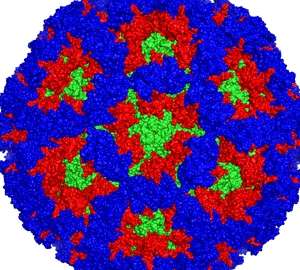
January 15, 2013 in Diseases, Conditions, Syndromes
(Medical Xpress)—UNSW researchers have discovered a new strain of norovirus that they warn could cause a severe epidemic of acute gastroenteritis in Australia this winter.
Known as Sydney 2012, the highly infectious mutant virus has already caused an epidemic of nausea, vomiting and diarrhoea in Europe, with an estimated 1.2 million cases of gastro in the UK during the colder months.
It has led to the closure of dozens of hospital wards there, and affected schools, age-cared facilities, cruise ships and workplaces, resulting in headlines in the British press such as the "Chunder from Down Under."
Professor Peter White, and his team in the School of Biotechnology and Biomolecular Sciences in the Faculty of Science, identified the new strain from Sydney patients last March, in collaboration with researchers at the Prince of Wales Hospital.
Of the 40 different strains of norovirus circulating in the community at any time, only one type, known as GII.4, causes epidemics and pandemics.
Professor White, a molecular virologist, said his team found that Sydney 2012 was a member of these notorious GII.4 noroviruses.
"So I knew straight away it was a potentially pandemic strain," he said.
Team member, Dr John-Sebastian Eden, worked out the complete genetic sequence of the virus.
"I noted it was quite different to what we'd seen before. It was a hybrid," Dr Eden said.
They found Sydney 2012 was a combination of two strains that originated in Holland and Japan in about 2007, and must have initially emerged in a patient who was infected with both.
It is no more virulent than other strains, but its novelty means it can evade the human immune system.
"Even if you've had a norovirus infection in the past it won't protect you from this one," Professor White said.
The researchers alerted scientists around the world that the new strain could be responsible for an increase in gastro. Following the publication of the new strain in Eurosurveillance it has been confirmed by the Health Protection Agency in the UK that it was responsible for the British epidemic.
Although it was first identified and characterised in Sydney, the new strain only accounted for about a quarter of the infections in NSW last winter, with this figure steadily increasing.
But it was responsible for 75 per cent of cases in Adelaide and almost all the cases of gastro in New Zealand.
It is expected to become the dominant strain in Australia in winter, taking over from the previous pandemic strain known as New Orleans 2009.
"As many as 400,000 people could become infected," Professor White said.
Pandemic norovirus strains have emerged around the world five times, in 1996-97, 2002, 2004, 2006 and 2009.
Sydney 2012 has also spread to Japan, France, Belgium, Denmark and the US.
It is likely to be the cause of an unusually high number of summer cases of gastroenteritis in Melbourne, and for recent outbreaks on cruise ships visiting Sydney.
Provided by
University of New South Wales
-
Vaccine against epidemic gastroenteritis being tested
Dec 09, 2011 |
not rated yet |
0
-
Australia: Vaccine-resistant whooping cough takes epidemic to new level
Mar 21, 2012 |
not rated yet |
0
-
Countdown to the introduction of a norovirus vaccine
Feb 17, 2012 |
not rated yet |
0
-
Scientists make key step in the development of a norovirus treatment
Feb 01, 2011 |
not rated yet |
0
-
Swine flu strain that is resistant to Tamiflu is spreading more easily
Dec 29, 2011 |
not rated yet |
0
-
Motion perception revisited: High Phi effect challenges established motion perception assumptions
Apr 23, 2013 |
3 / 5 (2) |
2
-
Anything you can do I can do better: Neuromolecular foundations of the superiority illusion (Update)
Apr 02, 2013 |
4.5 / 5 (11) |
5
-
The visual system as economist: Neural resource allocation in visual adaptation
Mar 30, 2013 |
5 / 5 (2) |
9
-
Separate lives: Neuronal and organismal lifespans decoupled
Mar 27, 2013 |
4.9 / 5 (8) |
0
-
Sizing things up: The evolutionary neurobiology of scale invariance
Feb 28, 2013 |
4.8 / 5 (10) |
14
-
Classical and Quantum Mechanics via Lie algebras
Apr 15, 2011
- More from Physics Forums - Independent Research
More news stories
Consuming coffee linked to lower risk of detrimental liver disease, study finds
Regular consumption of coffee is associated with a reduced risk of primary sclerosing cholangitis (PSC), an autoimmune liver disease, Mayo Clinic research shows. The findings were being presented at the Digestive Disease ...
Diseases, Conditions, Syndromes
6 minutes ago |
not rated yet |
0
|
New case of SARS-like virus in Saudi: ministry
A new case of the deadly coronavirus has been detected in Saudi Arabia where 15 people have already died after contracting it, the health ministry announced on Saturday on its Internet website.
Diseases, Conditions, Syndromes
12 hours ago |
not rated yet |
0
Little evidence for prediction rules for low back pain
(HealthDay)—Few randomized clinical trials have been done to assess clinical prediction rules for patients with lower back pain, and the trials that have been done are of low quality and do not provide ...
Diseases, Conditions, Syndromes
May 17, 2013 |
not rated yet |
0
|
New malaria test kit gives a boost to elimination efforts worldwide
A new, highly sensitive blood test that quickly detects even the lowest levels of malaria parasites in the body could make a dramatic difference in efforts to tackle the disease in the UK and across the world, according to ...
Diseases, Conditions, Syndromes
May 17, 2013 |
not rated yet |
0
WHO says single yellow fever shot is enough
(AP)—The World Health Organization says a yellow fever booster vaccination given 10 years after the initial shot isn't necessary.
Diseases, Conditions, Syndromes
May 17, 2013 |
not rated yet |
0
Ketamine shows significant therapeutic benefit in people with treatment-resistant depression
Patients with treatment-resistant major depression saw dramatic improvement in their illness after treatment with ketamine, an anesthetic, according to the largest ketamine clinical trial to-date led by researchers from the ...
New research identifies risks, interventions for children's GI health
An increasing number of U.S. children are experiencing gastrointestinal issues that require interventions to resolve, according to research presented at Digestive Disease Week (DDW).
US psychiatry gets makeover in new manual
The latest makeover to a massive psychiatric tome honored by some, reviled by others and even called the "Bible" of mental disorders is being released Saturday with a host of new changes.
AIDS science at 30: 'Cure' now part of lexicon
Big names in medicine are set to give an upbeat assessment of the war on AIDS on Tuesday, 30 years after French researchers identified the virus that causes the disease.
For combat veterans suffering from post-traumatic stress disorder, 'fear circuitry' in the brain never rests
Chronic trauma can inflict lasting damage to brain regions associated with fear and anxiety. Previous imaging studies of people with post-traumatic stress disorder, or PTSD, have shown that these brain regions can over-or ...
New colonoscope provides ground-breaking view of colon
A ground-breaking advance in colonoscopy technology signals the future of colorectal care, according to research presented today at Digestive Disease Week(DDW). Additional research focuses on optimizing the minimal withdrawal ...