Rice-cell cocktail kills cancer cells, leaves normal cells alone
January 14, 2013 by Marcia Goodrich in Cancer

Rice-cell cocktail kills cancer cells, leaves normal cells alone

In laboratory tests, juice from Ramakrishna Wusirika's rice cell culture was comparable to Taxol in cancer-killing strength but was far gentler on normal cells.

(Medical Xpress)—Juice from rice cells knocked out two kinds of human cancer cells as well or better than the potent anti-cancer drug Taxol in lab tests conducted by a Michigan Technological University scientist. Plus, it did something extra: it played nice with normal cells.

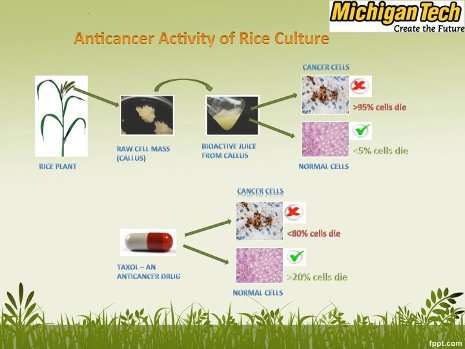
Biologist Ramakrishna Wusirika and his team made their anti-cancer cocktail with blobs of rice stem-cells called calli, which they cultured in their lab using seeds of the garden-variety rice plant Oryza sativa. Then they collected secretions from these calli and applied them to colon and kidney cancer cells in the lab.

After 96 hours of exposure to a 20-to-1 rice callus solution, 95 percent of the cells were killed, along with 83 percent of the , while normal were virtually unharmed. Taxol was lethal to the cancer cells too, but it also killed a significant number of normal cells.

Wusirika thinks the rice callus culture may be attacking cancer with the same sort of that make vegetables so healthy to eat.

"They are full of metabolic compounds that are good for us," he says. "We think that's what is killing the cancer."

Next, Wusirika would like to try the rice callus solution on prostate, lung and , the most common types of cancer in the US. "We think it will work with all of them, but we need to find out," he said.

He also wants to determine which of the compounds released by the rice callus have cancer-killing properties and how they work against tumor cells. Or, he notes, it's possible that the suite of biochemicals found in the callus solution work as a team to fight cancer.

Wusirika's work is described in the article "Anticancer Activity of Rice Callus Suspension Culture," published in the July 2012 edition of Phytotherapy Research.  In addition to Wusirika, the authors are research assistant professor Aparna Deshpande, former graduate student Surendar Dhadi of Michigan Tech and ex-research associate professor Elizabeth Hager, now at the National Cancer Institute.

More information: onlinelibrary.wile… 699/abstract

Provided by Michigan Technological University search and more info website

4.9 /5 (8 votes)  

Rank 4.9 /5 (8 votes)
Relevant PhysicsForums posts

More news stories

American cancer society celebrates 100 years of progress

(HealthDay)—The American Cancer Society, which is celebrating on Wednesday a century of fighting a disease once viewed as a death sentence, is making a pledge to put itself out of business.

Cancer created 13 hours ago | popularity not rated yet | comments 0

CT detects twice as many lung cancers as X-ray at initial screening exam

National Lung Screening Trial (NLST) investigators also conclude that the 20 percent reduction in lung cancer mortality with low-dose computed tomography (LDCT) versus chest X-ray (CXR) screening previously reported in the ...

Cancer created 13 hours ago | popularity not rated yet | comments 0

Research offers promising new approach to treatment of lung cancer

Researchers have developed a new drug delivery system that allows inhalation of chemotherapeutic drugs to help treat lung cancer, and in laboratory and animal tests it appears to reduce the systemic damage ...

Cancer created 17 hours ago | popularity not rated yet | comments 0 | with audio podcast

Study details genes that control whether tumors adapt or die when faced with p53 activating drugs

When turned on, the gene p53 turns off cancer. However, when existing drugs boost p53, only a few tumors die – the rest resist the challenge. A study published in the journal Cell Reports shows how: tumors that live even i ...

Cancer created 17 hours ago | popularity not rated yet | comments 0 | with audio podcast

Small increase in cancer risk following CT scans in childhood and adolescence

Study leader, Professor John Mathews from the University of Melbourne said this small increase in cancer risk must be weighed against the undoubted benefits from CT scans in diagnosing and monitoring disease.

Cancer created 21 hours ago | popularity not rated yet | comments 0


US teen birth rate drops to record low

US teen births have dropped to a record low, but the country still has one of the highest rates among developed nations, the US Centers for Disease Control and Prevention said Thursday.

Slowing the aging process—only with antibiotics

Swiss scientists reveal the mechanism responsible for aging hidden deep within mitochondria—and dramatically slow it down in worms by administering antibiotics to the young.

Researchers complete largest genetic sequencing study of human disease

Researchers from Queen Mary, University of London have led the largest sequencing study of human disease to date, investigating the genetic basis of six autoimmune diseases.

Brain can be trained in compassion, study shows

Until now, little was scientifically known about the human potential to cultivate compassion—the emotional state of caring for people who are suffering in a way that motivates altruistic behavior.

Rate of bicycle-related fatalities significantly lower in states with helmet laws

Existing research shows that bicyclists who wear helmets have an 88 percent lower risk of brain injury, but researchers at Boston Children's Hospital found that simply having bicycle helmet laws in place showed a 20 percent ...

Having both migraines, depression may mean smaller brain

(HealthDay)—Migraines and depression can each cause a great deal of suffering, but new research indicates the combination of the two may be linked to something else entirely—a smaller brain.