Scientists use luminescent mice to track cancer and aging in real-time
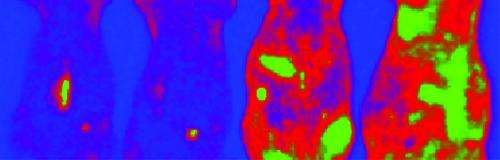
In a study published in the January 18 issue of Cell, researchers from the University of North Carolina Lineberger Comprehensive Cancer Center have developed a new method to visualize aging and tumor growth in mice using a gene closely linked to these processes.
Researchers have long known that the gene, p16INK4a (p16), plays a role in aging and cancer suppression by activating an important tumor defense mechanism called 'cellular senescence'. The UNC team led by Norman Sharpless, MD, Wellcome Distinguished Professor of Cancer Research and Deputy Cancer Center Director, has developed a strain of mice that turns on a gene from fireflies when the normal p16 gene is activated. In cells undergoing senescence, the p16 gene is switched on, activating the firefly gene and causing the affected tissue to glow.
Throughout the entire lifespan of these mice, the researchers followed p16 activation by simply tracking the brightness of each animal. They found that old mice are brighter than young mice, and that sites of cancer formation become extremely bright, allowing for the early identification of developing cancers.
"With these mice, we can visualize in real-time the activation of cellular senescence, which prevents cancer but causes aging. We can literally see the earliest molecular stages of cancer and aging in living mice." said Sharpless.
The researchers envision immediate practical uses for these mice. By providing a visual indication of the activation cellular senescence, the mice will allow researchers to test substances and exposures that promote cellular aging ("gerontogen testing") in the same way that other mouse models currently allow toxicologists to identify cancer-causing substances ("carcinogen testing"). Moreover, these mice are already being used by scientists at UNC and other institutions to identify early cancer development and the response of tumors to anti-cancer treatments.
"This work builds on previous work by the same group, as well as others, showing intriguing relationships among aging, cancer and cell senescence. It provides a valuable new tool to probe these relationships," said Felipe Sierra, Ph.D., director of the Division of Aging Biology, National Institute on Aging, NIH.
The researchers used these mice to make several unexpected discoveries. First, the group was able to track the accumulation of senescent cells in aging mice by assessing how brightly each mouse glowed. Surprisingly, the brightest animals were no more likely to die from spontaneous cancer than dimmer animals of the same age. That is, the number of senescent cells in the mouse did not predict its risk of dying.
"The result we, and I think others, predicted is that the animals with the highest number of senescent cells would get more cancers and die sooner, but this was not the case" said Sharpless.
Another surprise came from the disparities in p16 levels among the mice. The authors studied a large group of genetically identical animals that were all housed in the same way and fed the same diet. However, despite identical genetic and environmental conditions, the brightness of individual mice at any given age was highly variable, suggesting that factors beyond genetics and diet influence aging.
The glowing mice also provide a window into the formation of cancers. Expression of p16 is activated in the earliest stages of cancer formation to suppress cancer. Usually activation of p16 prevents cancer, but rarely this tumor suppressor mechanism fails and tumors develop, while still activating the p16 gene. As such, all tumors forming in these mice strongly glowed, allowing researchers to monitor early tumor formation in a wide variety of cancer types. In contrast to expectations, the researchers also found that p16 was activated not only in the tumor cells themselves, but also in normal, neighboring cells.
"This finding suggests that activation of senescence results from an abnormal milieu within a developing cancer. Somehow, many or all the cells in a would-be tumor know they are in a bad place, and activate this tumor suppressor gene as a defense mechanism, even if they are not the would-be cancer cells themselves. This occurs really early in the cancer; we're talking about the earliest events of neoplasia that have ever been measured in living animals," said Sharpless.
The Sharpless group believes similar approaches to monitoring senescence can be developed in order to study aging and tumor development in humans. The group is particularly interested in how cancer therapies influence human aging and patient outcome. Working with UNC oncologists, the Sharpless group has already measured p16 expression in several hundred patients undergoing cancer therapy. These studies, along with efforts employing the glowing mouse, aims to develop more effective and tolerable patient treatment schemes based upon 'molecular', as opposed to 'chronologic', age.


