Sperm donor offspring call for privacy changes
January 1, 2013 by Kyoko Hasegawa in Other
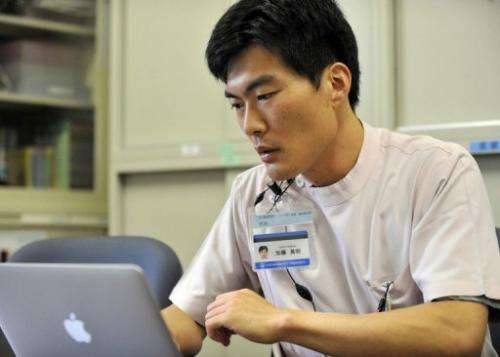
This photo taken on June 25, 2012 shows 39-year-old Japanese doctor Hideaki Kato speaking during an interview with AFP at his office in Yokohama, suburban Tokyo. Kato discovered his true identity by accident, but his desire to learn more was hampered by his upset parents and a lack of laws in Japan over access to details of his genetic parentage
Hideaki Kato discovered his true identity by accident. During his medical training a decade ago, the now 39-year-old Japanese doctor was performing blood tests on family members when he learned something startling: his dad was not his biological father.
Suspecting an extramarital affair, the Tokyo-area physician questioned his mother while the man he had always known as his father was away on a trip.
But rather than uncovering a cheating parent, Kato learned his biological father was an anonymous sperm donor and that his parents had hidden the infertility from him.
"I felt as if half of me had collapsed," he said.
"I asked myself 'were childhood memories of my family's smiling faces at the beach just a fake?'"
But Kato's desire to learn more was hampered by his upset parents and a lack of laws in Japan over access to details of his genetic parentage.
It is a challenge shared by thousands of people in Japan and elsewhere who were the product of anonymous sperm and egg donors.
Many suffer identity crises upon learning of their background and wonder about the existence of a brother or sister, or fear unwittingly forming a romantic relationship with a half-sibling.
Such concerns have led many donor-conceived children to call for the practice to be banned, among them a 33-year-old editor at a Tokyo publishing company.
Ten years ago, the woman dropped out of university, distraught after being told her father was not biologically related to her.
"I hope (it) will be banned," she said, referring to anonymous donors.
"Why isn't adoption enough? To me, the technology is a way to pretend that you have a 'normal family', to hide infertility in a society where the pressure is still high to get married and have children."
She added that treatment with donor eggs was another worrying technology.
"I don't want children of donor eggs to suffer the same mental anguish that I experienced," she said.
She is far from alone.
Canadian Olivia Pratten filed a lawsuit to learn her genetic identity, and in 2011 the British Columbia Supreme Court ruled donor-conceived children in the province should be guaranteed access to their biological parents' identities.
That ruling was overturned in November 2012 on appeal, but Pratten may take the case to the country's top court, according to Canadian media reports.
She rejects arguments that lifting anonymity would all but empty the pool of willing donors.
"The fertility industry likes to falsely claim that no anonymity equals no donors. This is absolutely false," Pratten said in an email to AFP.
"Other countries, from New Zealand to Sweden to the United Kingdom to certain states in Australia have successfully banned anonymity," she added.
In 2005, Britain changed the law so donor-conceived people could learn the identity of their parents, according to the country's National Health Service.
Elsewhere, there is a patchwork of anonymity laws, or no relevant legislation at all including in Japan, which also has no regulations for doctors carrying out the procedure.
"It is more complex and less cost-effective to run an open system, but the rights and needs of the resulting children must be kept paramount," Pratten said.
"I am sympathetic to those facing infertility, but the desire to have genetic lineage needs to be respected for both the parents and children."
For his part, Kato's efforts to learn his father's identity included getting a list of medical school graduates at Japan's Keio University—where his parents had sought treatment.
The graduates were potential sperm donors, but Kato's decision to pay them a visit in his quest to learn more drew a bewildered reaction from the men.
Yahiro Netsu, whose maternity clinic pioneered fertility treatment with donor eggs in Japan, said he cannot ignore patients' desire to have children.
"If a child born from a donor egg faces an identity crisis, it will eventually ease if there is trust between the child and the parents," Netsu said.
But he agreed children should have the right to know their genetic history.
Mari Saimura, a professor at Tezukayama University, is among those who are calling for Japan to establish laws on the issue.
"Japan should give up the technology unless it sets up guidelines to guarantee people's right to know their identity," Saimura said.
There has been little progress on the issue in Japan since a decade-old government report recommended rules guaranteeing information about donor parents and notifying children of their parentage early on, she said.
For Kato, his paternal roots remain a mystery.
"I've never forgotten about my biological father. I always carry a list of potential donors, which is a sort of talisman to me," he said.
"But I don't want my biological father to become my 'father.' I just want to know my genetic origin."
(c) 2013 AFP
-
Re-shaping the family: What happens when parents seek siblings of their donor-conceived children
Feb 24, 2009 |
not rated yet |
0
-
Mom calls for egg/sperm donor registry
Mar 28, 2008 |
not rated yet |
0
-
Danish sperm donor passes genetic disorder to five children
Sep 24, 2012 |
not rated yet |
0
-
Sharp drop in British sperm donors
Sep 10, 2007 |
not rated yet |
0
-
Children born after donor insemination should be told as soon as possible about their conception
Jul 07, 2008 |
not rated yet |
0
-
Motion perception revisited: High Phi effect challenges established motion perception assumptions
Apr 23, 2013 |
3 / 5 (2) |
2
-
Anything you can do I can do better: Neuromolecular foundations of the superiority illusion (Update)
Apr 02, 2013 |
4.5 / 5 (11) |
5
-
The visual system as economist: Neural resource allocation in visual adaptation
Mar 30, 2013 |
5 / 5 (2) |
9
-
Separate lives: Neuronal and organismal lifespans decoupled
Mar 27, 2013 |
4.9 / 5 (8) |
0
-
Sizing things up: The evolutionary neurobiology of scale invariance
Feb 28, 2013 |
4.8 / 5 (10) |
14
-
Classical and Quantum Mechanics via Lie algebras
Apr 15, 2011
- More from Physics Forums - Independent Research
More news stories
Wireless ultrasound transducers help physicians
Siemens has presented the world's first ultrasound system with wireless transducers. The system's transducers, which can be easily operated with one hand, transmit ultrasound images via radio waves to the ...
Other
25 seconds ago |
not rated yet |
0
Flesh-eating disease victim gets prosthetic hands
(AP)—A woman who lost both hands, her left leg and right foot after contracting a flesh-eating disease has been fitted with prosthetic hands.
Other
May 18, 2013 |
not rated yet |
0
Illinois Senate approves medical marijuana bill
(AP)—Medical marijuana use in Illinois is now in Gov. Pat Quinn's hands after the state Senate approved legislation.
Other
May 17, 2013 |
5 / 5 (1) |
0
Nigerian court jails two over killer teething drug
A Nigerian court on Friday sentenced two officials from a pharmaceutical company to seven years in prison over the sale of an adulterated teething drug which killed 84 babies in 2008.
Other
May 17, 2013 |
not rated yet |
0
Many patients would switch doc to cut health care costs
(HealthDay)—Many Americans feel that keeping out-of-pocket health care costs is more important than staying with the same primary care physician.
Other
May 17, 2013 |
not rated yet |
0
Lymphatic fluid takes detour
When tumours metastasise, they can block lymphatic vessels, as researchers from ETH Zurich have discovered using a new method. The lymphatic fluid subsequently has to find a new path through the tissue. Such ...
Research uncovers a potential role of two proteins in diabetes
(Medical Xpress)—Flinders University researchers are breaking new ground in a decade-long journey to pinpoint the function of two closely related proteins.
Vitamin D could provide new and effective treatments for asthma
(Medical Xpress)—Scientists at King's College London have discovered that Vitamin D has the potential to significantly reduce the symptoms of asthma. The study, led by Professor Catherine Hawrylowicz from ...
Rethinking treatment goals improves results for 'untreatable' anorexics
(Medical Xpress)—Patients with the most severe and dangerous form of chronic anorexia are more likely to make a significant improvement towards recovery and stay in therapy if traditional psychological treatments are re-focused ...
Discovery of novel medicine for treatment of chronic wounds
Every 20 seconds, a limb is lost as a consequence of diabetic foot ulcer that does not heal. To date, medical solutions that can change this situation are very limited. In his doctoral thesis Yue Shen from the Industrial ...
Novel mechanism allows Legionella to hide in body
(Medical Xpress)—The feared Legionella pneumophila is responsible for legionellosis, an infectious disease that can lead to pneumonia. To infect humans, this pathogen has developed a complex method that allows it to camouflage ...
Jan 01, 2013
Rank: 5 / 5 (1)
Banning anonymous sperm donations would end sperm donation. No one will donate knowing they will be forced to have contact and probably pay child support. It is already a gamble since gene testing and geographic genetic profiles can often narrow the donor to a family name which along with limited donor info and such pretty much ends guaranteed anonymity. They really need to warn potential donors that they may be exposed and held financially responsible. In Canada, a mother can not legally sign away the child's right to child support.
Jan 01, 2013
Rank: 1 / 5 (1)
Jan 02, 2013
Rank: not rated yet
Nobody gets to choose who their parents are anyway, so why is it any different for donor babies compared to "natural" babies?
He probably, almost certainly, had a better upbringing than I did, so he should be proud of his parents, both the real ones and the fake.