Suppliers, grocers turning to DNA testing on meat (Update)
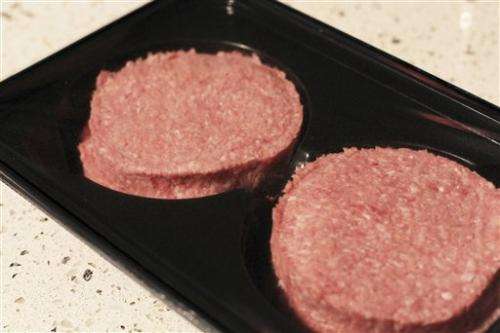
Ireland's surprise discovery this month of horsemeat traces in factory-produced burgers is boosting business for one trade: Forensics labs that use DNA fingerprinting to tell you what's on your plate.
Horsemeat, which costs a fraction of beef, might not be bad for you to eat but it's definitely bad for sales of products that are labeled as beef.
Until now, supermarkets and food processors have not used DNA testing to determine whether food products marked as chicken, pork, beef, lamb or fish contain bits of other animals. Experts say that's because such findings don't affect food safety, only the integrity of labeling.
But a growing list of food processors and retailers say they will introduce such testing after the Food Safety Authority of Ireland—seeking to confirm whether food labels on meat and fish are accurate—used DNA testing to show that even "pure" processed meat products often contain traces of other animals slaughtered in the same facilities or carried in the same vehicles.
Worse, the agency's testing found that bargain-brand burgers produced at the Silvercrest food processing plant for sale by British supermarket king Tesco contained up to 29 percent horsemeat, a revelation that government and Silvercrest officials have pinned this week to a meat supplier from Poland.
Catherine Brown, chief executive of Britain's Food Standards Agency, told London lawmakers on Wednesday that the undisclosed Polish firm supplied frozen blocks of offcuts—slaughterhouse leftovers—that were labeled as "beef trim" but actually were a mixture of cow and horse.
Brown said consumers in Britain and Ireland may have been eating horsemeat-heavy burgers for up to a year.
And compounding that impression, another British supermarket chain, the Co-operative Group, announced Wednesday its own DNA testing had found 17.7 percent horsemeat in one of 17 burger products pulled from its shelves earlier this month as a precaution. It blamed Silvercrest and immediately severed its supply contract with the company.
In Dublin, the government has also declined to identify the Polish company. Irish lawmakers accused Silvercrest of endangering the integrity of Irish meat exports by using ill-labeled imports to boost their profit margins.
Beef is Ireland's No. 1 food export, and Tesco is Ireland's No. 1 customer, accounting for nearly one-tenth of the country's annual €1.9 billion ($2.5 billion) in beef exports.
"I want to know how much Silvercrest paid for these boxes of 'beef trim' and if they paid below-market price for the meat," said Irish Senator Susan O'Keeffe.
"Most importantly, I want to know why Silvercrest thought it was appropriate to put 'beef trim' bought in Poland into burgers and label them Irish. I want to know what 'beef trim' is meant to be and how often other meats are added to 'beef trim' to bulk it up," she said.
Tesco, which saw its shares slump following the horsemeat discovery, has announced it will become the first supermarket chain to perform DNA tests on its meat products. Hours later, a second UK chain called Iceland that also received Silvercrest burgers tainted with traces of horse and pig meat said it also planned to start DNA testing.
"These checks will set a new standard," Tesco, the largest grocer in both Britain and Ireland, said in a statement. "We want to leave customers in no doubt that that we will do whatever it takes to ensure the quality of their food and that the food they buy is exactly what the label says it is."
Industry analysts expect other supermarket chains in Europe to follow suit, because the cross-contamination detected in Ireland is likely to happen in processed meat products worldwide.
While government authorities in Spain have yet to conduct such tests, the Spanish consumer rights watchdog OCU announced this week it had commissioned DNA tests on 20 factory-made burger products—and found two that contained horsemeat. The OCU tests could only identify the presence of equine DNA, not its quantity.
Ireland conducted the DNA tests in one of its own labs, which found the presence of horsemeat, and sent the samples to a more sophisticated lab in Germany to break down the precise quantities of each species of meat in each sample burger.
"This sort of species testing simply has not been done in other nations. It looks like that's going to change," said Patrick Wall, the professor of public health at University College Dublin and former chairman of the Food Safety Authority for the 27-nation European Union.
Silvercrest supplied most of the supermarket chains in Ireland and Britain. After the Irish findings Jan. 15, Silvercrest withdrew about 10 million burgers from those stores. It suspended all production a week later once a second round of DNA tests found more horsemeat traces in recently produced burgers.
Silvercrest's parent company, ABP Food Group, said in a statement it understood Tesco's decision and would introduce its own random DNA testing of products at all of its facilities in Ireland and Britain. Other Irish processors say they plan to follow suit.
Food policy experts say meat labels may eventually be changed in many countries to reflect the kind of warnings already familiar for people allergic to nuts: This beef product may contain traces of other animals.
Wall said consumers shouldn't be unduly unsettled by the Irish findings, which included results showing that most cheaply produced "beef" burgers also contained minute elements of pork. He said such molecular transfers were almost impossible to prevent though, until now they hadn't been measured.
"People need to understand how sensitive these DNA tests are," Wall said. "This thing will pick up molecules. So if horsemeat traveled in a refrigerated lorry one day and beef was carried in it the next day, molecules would travel over."
He also said if both horse and beef were processed at the same facility "you could get a carry-over of molecules."
Copyright 2013 The Associated Press. All rights reserved. This material may not be published, broadcast, rewritten or redistributed.


