Take-home CPR kit offers efficient, effective training for families of children with serious health conditions
January 14, 2013 by Erin Digitale in Other
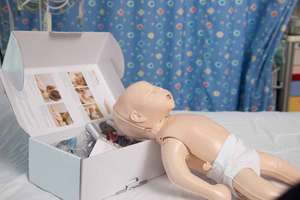
The CPR kit tested in the study includes an instructional video and a mannequin for practicing cardiopulmonary resuscitation techniques, and is endorsed by the American Heart Association. Credit: Lucile Packard Children's Hospital
(Medical Xpress)—Many children with chronic disease or serious health conditions are at risk of cardiac arrest. Teaching their parents to perform cardiopulmonary resuscitation can save kids' lives and prevent brain damage caused by delayed resuscitation. But ensuring that these parents receive timely, effective CPR training before they leave the hospital with their child has been challenging.
Now, new research from Lucile Packard Children's Hospital shows that a video-based, self-instructional take-home CPR kit provides these families with effective, efficient CPR training. The kit tested, called CPR Anytime, includes an instructional video and a mannequin for practicing CPR techniques, and is endorsed by the American Heart Association. Parents reported that this method of providing CPR improved their lasting knowledge of CPR techniques and improved their confidence in their ability to perform CPR, the study found. The kits also decreased the time nurses spent teaching CPR at hospital discharge, making discharge procedures more efficient. And for a few families in the study, the information parents learned may have saved their children's lives.
The findings were published Jan. 8 in the Journal for Healthcare Quality.
"Parents felt empowered," said senior author Lynda Knight, RN. "It allowed them to feel relieved that they would know what to do if something ever happened and their child required CPR after they left the hospital." Knight is the resuscitation educator for Packard Children's Center for Nursing Excellence and the director of the hospital's AHA training center.
If a child's breathing stops and his or her heart rate drops, prompt CPR can improve survival and prevent neurologic problems caused by oxygen deprivation, Knight said. But it usually takes 7 to 10 minutes for paramedics to arrive after a 911 call, a dangerously long time for the brain to go without oxygen, so it's important for parents to initiate CPR prior to paramedics' arrival.
The study examined 117 families whose children under age 18 were discharged from Packard Children's after receiving care for serious medical conditions, including premature birth; episodes of interrupted breathing or unstable heartbeat during the newborn period; solid-organ transplant; and several types of heart problems. Parents of patients who went home from the hospital using oxygen, a ventilator or a tracheostomy tube to help them breathe were also included in the study.
During their hospital stay, each family received a CPR Anytime kit and used the video and mannequin to learn basic CPR skills. The kit follows principles shown to be effective for adult learning, allowing simultaneous CPR instruction and hands-on practice.
When these young patients left the hospital, the families took the kits and were encouraged to review them again at home. The research team called the parents at one, three and six months after discharge for brief telephone surveys about their use of the kits.
Six months after hospital discharge, the majority of parents in the study felt confident in their CPR skills. Eighty-two percent of parents had watched the video at least once after leaving the hospital, and 79 percent had shared the kit with at least two other family members or friends, suggesting that the kits were also helping spread CPR skills in the community.
The fact that families could review the material at home is especially useful in light of the many other skills they had to learn in the hospital, Knight said. Children with serious medical conditions may leave the hospital with complex medication regimens or medical equipment that parents must learn to manage. Nurses, who were also questioned in the study, liked that the CPR kits reduced the amount of material they had to teach families, and appreciated that the information was consistent and that the kits prevented families from having to wait for a nurse to become available for CPR instruction before hospital discharge.
The kits may even have saved the lives of a few children in the study. Five parents who received the kits reported performing CPR on their children at home, and four of the five children survived without neurologic damage. In contrast, overall survival rates for people who receive CPR in non-hospital settings tend to be quite low; one estimate put the survival rate at 5 to 10 percent. The five parents who performed CPR said that if they had not received the kits they would not have had time to attend CPR classes. They attributed knowing what to do in this scary situation to reviewing the materials in the kit.
Journal reference:
Journal for Healthcare Quality
Provided by
Stanford University Medical Center
-
Members of the public lack skills, confidence necessary to save lives with CPR, research shows
Nov 12, 2011 |
not rated yet |
0
-
Learn two-step method of CPR to save lives
Jun 12, 2012 |
not rated yet |
0
-
For cardiac arrest CPR performed by laypersons, chest compression-only may lead to better outcomes
Oct 05, 2010 |
not rated yet |
0
-
Continuous chest compression-CPR improved cardiac arrest survival in Arizona
Nov 16, 2009 |
not rated yet |
0
-
More rib fractures, but better survival rates
May 31, 2007 |
not rated yet |
0
-
Motion perception revisited: High Phi effect challenges established motion perception assumptions
Apr 23, 2013 |
3 / 5 (2) |
2
-
Anything you can do I can do better: Neuromolecular foundations of the superiority illusion (Update)
Apr 02, 2013 |
4.5 / 5 (11) |
5
-
The visual system as economist: Neural resource allocation in visual adaptation
Mar 30, 2013 |
5 / 5 (2) |
9
-
Separate lives: Neuronal and organismal lifespans decoupled
Mar 27, 2013 |
4.9 / 5 (8) |
0
-
Sizing things up: The evolutionary neurobiology of scale invariance
Feb 28, 2013 |
4.8 / 5 (10) |
14
-
Classical and Quantum Mechanics via Lie algebras
Apr 15, 2011
- More from Physics Forums - Independent Research
More news stories
Survey points out deficiencies in addictions training for medical residents
A 2012 survey of internal medicine residents at Massachusetts General Hospital (MGH) – one of the nation's leading teaching hospitals – found that more than half rated the training they had received in addiction and other ...
Other
12 hours ago |
not rated yet |
0
Early use of tracheostomy for mechanically ventilated patients not associated with improved survival
For critically ill patients receiving mechanical ventilation, early tracheostomy (within the first 4 days after admission) was not associated with an improvement in the risk of death within 30 days compared to patients who ...
Other
May 21, 2013 |
not rated yet |
0
Decisions to forgo life support may depend heavily on the ICU where patients are treated
The decision to limit life support in patients in the intensive care unit (ICU) appears to be significantly influenced by physician practices and/or the culture of the hospital, suggests new findings from researchers at the ...
Other
May 21, 2013 |
not rated yet |
0
People on higher incomes are happier with new knees
Knee replacement surgery is a very common procedure. However, it does not always resolve function or pain in all the recipients of new knees. A study by Robert Barrack, MD and his colleagues from the Washington University ...
Other
May 21, 2013 |
not rated yet |
0
New search engine finds rare diagnoses
Doctors are trained to think "common disease" when they meet patients in their practices, and as they rarely or never meet a rare disease, it often takes many years to reach the right diagnosis. A new search tool called FindZebra ...
Other
May 21, 2013 |
not rated yet |
0
Slowing the aging process—only with antibiotics
Swiss scientists reveal the mechanism responsible for aging hidden deep within mitochondria—and dramatically slow it down in worms by administering antibiotics to the young.
Researchers complete largest genetic sequencing study of human disease
Researchers from Queen Mary, University of London have led the largest sequencing study of human disease to date, investigating the genetic basis of six autoimmune diseases.
Rate of bicycle-related fatalities significantly lower in states with helmet laws
Existing research shows that bicyclists who wear helmets have an 88 percent lower risk of brain injury, but researchers at Boston Children's Hospital found that simply having bicycle helmet laws in place showed a 20 percent ...
Brain can be trained in compassion, study shows
Until now, little was scientifically known about the human potential to cultivate compassion—the emotional state of caring for people who are suffering in a way that motivates altruistic behavior.
Having both migraines, depression may mean smaller brain
(HealthDay)—Migraines and depression can each cause a great deal of suffering, but new research indicates the combination of the two may be linked to something else entirely—a smaller brain.
Novel approach for influenza vaccination shows promise in early animal testing
A new approach for immunizing against influenza elicited a more potent immune response and broader protection than the currently licensed seasonal influenza vaccines when tested in mice and ferrets. The vaccine ...