Eliminating useless information important to learning, making new memories
January 9, 2013 in Neuroscience
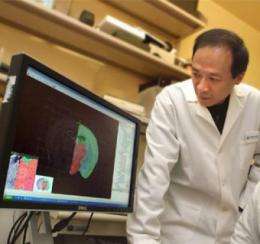
As we age, it just may be the ability to filter and eliminate old information -- rather than take in the new stuff -- that makes it harder to learn, according to Dr. Joe Tsien, Medical College of Georgia at Georgia Regents University, neuroscientist and Co-Director of the GRU Brain & Behavior Discovery Institute. Credit: Phil Jones, Georgia Regents University, Campus Photographer
As we age, it just may be the ability to filter and eliminate old information – rather than take in the new stuff - that makes it harder to learn, scientists report.
"When you are young, your brain is able to strengthen certain connections and weaken certain connections to make new memories," said Dr. Joe Z. Tsien, neuroscientist at the Medical College of Georgia at Georgia Regents University and Co-Director of the GRU Brain & Behavior Discovery Institute.
It's that critical weakening that appears hampered in the older brain, according to a study in the journal Scientific Reports.
The NMDA receptor in the brain's hippocampus is like a switch for regulating learning and memory, working through subunits called NR2A and NR2B. NR2B is expressed in higher percentages in children, enabling neurons to talk a fraction of a second longer; make stronger bonds, called synapses; and optimize learning and memory. This formation of strong bonds is called long-term potentiation. The ratio shifts after puberty, so there is more NR2A and slightly reduced communication time between neurons.
When Tsien and his colleagues genetically modified mice that mimic the adult ratio – more NR2A, less NR2B – they were surprised to find the rodents were still good at making strong connections and short-term memories but had an impaired ability to weaken existing connections, called long-term depression, and to make new long-term memories as a result. It's called information sculpting and adult ratios of NMDA receptor subunits don't appear to be very good at it.
"If you only make synapses stronger and never get rid of the noise or less useful information then it's a problem," said Tsien, the study's corresponding author. While each neuron averages 3,000 synapses, the relentless onslaught of information and experiences necessitates some selective whittling. Insufficient sculpting, at least in their mouse, meant a reduced ability to remember things short-term – like the ticket number at a fast-food restaurant – and long-term – like remembering a favorite menu item at that restaurant. Both are impacted in Alzheimer's and age-related dementia.
All long-term depression was not lost in the mice, rather just response to the specific electrical stimulation levels that should induce weakening of the synapse. Tsien expected to find the opposite: that long-term potentiation was weak and so was the ability to learn and make new memories. "What is abnormal is the ability to weaken existing connectivity."
Acknowledging the leap, this impaired ability could also help explain why adults can't learn a new language without their old accent and why older people tend to be more stuck in their ways, the memory researcher said.
"We know we lose the ability to perfectly speak a foreign language if we learn than language after the onset of sexual maturity. I can learn English but my Chinese accent is very difficult to get rid of. The question is why," Tsien said.
Tsien and his colleagues already have learned what happens when NR2B is overexpressed. He and East China Normal University researchers announced in 2009 the development of Hobbie-J, a smarter than average rat. A decade earlier, Tsien reported in the journal Nature the development of a smart mouse dubbed Doogie using the same techniques to over-express the NR2B gene in the hippocampus.
Doogie, Hobbie-J and their descendants have maintained superior memory as they age. Now Tsien is interested in following the NR2A over-expressing mouse to see what happens.
Journal reference:
Scientific Reports
Nature
Provided by
Georgia Health Sciences University
-
Smart rat 'Hobbie-J' produced by over-expressing a gene that helps brain cells communicate
Oct 19, 2009 |
not rated yet |
0
-
Forget about it: Inducible and selective erasure of memories in mice
Oct 22, 2008 |
not rated yet |
0
-
Habit formation is enabled by gateway to brain cells
Dec 21, 2011 |
not rated yet |
0
-
Brain's 'reward' center also responds to bad experiences
Feb 22, 2011 |
not rated yet |
0
-
New target for Alzheimer's drugs
Feb 09, 2012 |
not rated yet |
0
-
Motion perception revisited: High Phi effect challenges established motion perception assumptions
Apr 23, 2013 |
3 / 5 (2) |
2
-
Anything you can do I can do better: Neuromolecular foundations of the superiority illusion (Update)
Apr 02, 2013 |
4.5 / 5 (11) |
5
-
The visual system as economist: Neural resource allocation in visual adaptation
Mar 30, 2013 |
5 / 5 (2) |
9
-
Separate lives: Neuronal and organismal lifespans decoupled
Mar 27, 2013 |
4.9 / 5 (8) |
0
-
Sizing things up: The evolutionary neurobiology of scale invariance
Feb 28, 2013 |
4.8 / 5 (10) |
14
-
Pressure-volume curve: Elastic Recoil Pressure don't make sense
May 18, 2013
-
If you became brain-dead, would you want them to pull the plug?
May 17, 2013
-
MRI bill question
May 15, 2013
-
Ratio of Hydrogen of Oxygen in Dessicated Animal Protein
May 13, 2013
-
Alcohol and acetaminophen
May 13, 2013
-
Marie Curie's leukemia
May 13, 2013
- More from Physics Forums - Medical Sciences
More news stories
Researchers find far-reaching, microvascular damage in uninjured side of brain after stroke
While the effects of acute stroke have been widely studied, brain damage during the subacute phase of stroke has been a neglected area of research. Now, a new study by the University of South Florida reports that within a ...
Neuroscience
2 hours ago |
not rated yet |
0
|
Neurons that can multitask greatly enhance the brain's computational power, study finds
Over the past few decades, neuroscientists have made much progress in mapping the brain by deciphering the functions of individual neurons that perform very specific tasks, such as recognizing the location ...
Neuroscience
5 hours ago |
5 / 5 (5) |
0
|
For combat veterans suffering from post-traumatic stress disorder, 'fear circuitry' in the brain never rests
Chronic trauma can inflict lasting damage to brain regions associated with fear and anxiety. Previous imaging studies of people with post-traumatic stress disorder, or PTSD, have shown that these brain regions can over-or ...
Neuroscience
May 18, 2013 |
5 / 5 (1) |
0
|
Temporal processing in the olfactory system
The neural machinery underlying our olfactory sense continues to be an enigma for neuroscience. A recent review in Neuron seeks to expand traditional ideas about how neurons in the olfactory bulb might encode information about ...
Neuroscience
May 17, 2013 |
4 / 5 (1) |
0
|
Melon focus headband turns to Kickstarter for rollout plans
(Medical Xpress)—What if the quality of your work depends more on your focus on the piano keys or canvas or laptop than your musical or painting or computing skills? If target users can be convinced, they ...
Neuroscience
May 17, 2013 |
3.7 / 5 (3) |
0
|
Music therapy reduces anxiety, use of sedatives for patients receiving ventilator support
New research suggests that for some hospitalized ICU patients on mechanical ventilators, using headphones to listen to their favorite types of music could lower anxiety and reduce their need for sedative medications.
Tiny, implantable coil promises hope for emphysema patients
A small, easily implantable device called the Lung Volume Reduction Coil (LVRC) may play a key role in the treatment of two types of emphysema, according to a study conducted in Europe. Results of the study indicate the beneficial ...
Early IV nutrition for certain patients does improve survival or reduce ICU length of stay
The early (within 24 hours of intensive care unit [ICU] admission) provision of intravenous nutrition among critically ill patients with contraindications (a condition that makes a particular procedure potentially inadvisable) ...
Having a nighttime critical care physician in the ICU doesn't improve patient outcomes, research finds
With little evidence to guide them, many hospital intensive care units (ICUs) have been employing critical care physicians at night with the notion it would improve patients' outcomes. However, new results from a one-year ...
CT radiation risk less than risk of examination indicator
(HealthDay)—For young adults needing either a chest or abdominopelvic computed tomography (CT), the short-term risk of death from underlying morbidity is greater than the long-term risk of radiation-induced ...
Extra vitamin D may ease Crohn's symptoms, study finds
(HealthDay)—Vitamin D supplements may help those with Crohn's disease overcome the fatigue and decreased muscle strength associated with the inflammatory bowel disease, according to new research.
Jan 09, 2013
Rank: not rated yet
The Revelers
A melody replaces your accent when 'speaking'(singing) the songs' text/lyrics.
The question is why.
Answering your question of why:
What sounds are overriding(?) the sounds of normal conversational pronunciation?
How is 'connectivity' being 'outwitted'?