Wash. vows to try to keep weed in state—but how?
January 29, 2013 by Gene Johnson in Health
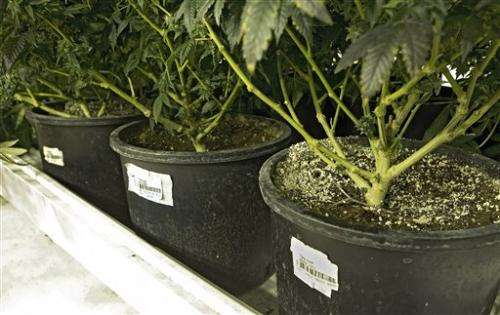
This Jan. 26, 2013 photo shows a a bar code attached to the pots growing marijuana plants at a grow house in Denver. The bar codes are assigned to each plant and follow it through the growing and distribution process. Washington state is considering the use of a similar tracking system. (AP Photo/Ed Andrieski)
So far, no one is suggesting checkpoints or fences to keep Washington state's legal pot within its borders.
But Gov. Jay Inslee insists there are ways to prevent the bulk smuggling of the state's newest cash crop into the black market, including digitally tracking weed to ensure that it goes from where it is grown to the stores where it is sold.
With sales set to begin later this year, he hopes to be a good neighbor and keep vanloads of premium, legal bud from cruising into Idaho, Oregon and other states that don't want people getting stoned for fun.
It's not just about generating goodwill with fellow governors. Inslee is trying to persuade U.S. Attorney General Eric Holder not to sue to block Washington from licensing pot growers, processors and sellers. Marijuana remains illegal under federal law.
"I am going to be personally committed to have a well regulated, well disciplined, well tracked, well inventory-controlled, well law-enforcement-coordinated approach," said Inslee, who is due to give Holder more details this week.
Keeping a lid on the weed is just one of the numerous challenges Washington state authorities and their counterparts in Colorado—where voters also legalized pot use—will face in the coming months.
The potential of regulatory schemes to keep pot from being diverted isn't clear. Colorado already has intensive rules aimed at keeping its medical marijuana market in line, including the digital tracking of cannabis, bar codes on every plant, surveillance video and manifests of all legal pot shipments.
But law enforcement officials say marijuana from Colorado's dispensaries often makes its way to the black market, and even the head of the Colorado agency charged with tracking the medical pot industry suggests no one should copy its measures.

This Jan. 26, 2013 photo shows bar codes attached containers of processed marijuana at a grow house in Denver. The bar codes are assigned to each plant and follow it through the growing and distribution process. Washington state is considering the use of a similar tracking system. (AP Photo/Ed Andrieski)
The agency has been beset by money woes and had to cut many of its investigators. Even if the agency had all the money it wanted, the state's medical pot rules are "a model of regulatory overreach," too cumbersome and expensive to enforce, Laura Harris said in a statement.
Last fall, voters made Washington and Colorado the first states to pass laws legalizing the recreational use of marijuana and setting up systems of state-licensed growers, processors and retail stores where adults over 21 can walk in and buy up to an ounce (28 grams) of heavily taxed cannabis.
Both states are working to develop rules for the emerging pot industry.
The Obama administration could sue to block the legal markets from operating, on the grounds that actively regulating an illegal substance conflicts with federal drug law. The DOJ is reviewing the laws but has given no signals about its plans.
It has never sued states like Colorado that have regulated medical marijuana, even though it could under the same legal principles.
Part of the DOJ's political calculus in deciding whether to sue is likely to be how well the department believes the two states can keep the legal weed within their borders. During a meeting with Inslee last week, Holder asked a lot of questions about diversion, Inslee said.
Alison Holcomb, who led Washington's legal pot campaign, said it's important to respect states that haven't legalized weed by not flooding their black markets. The first step, she said, is for the state to figure out how much pot should be produced, and then grant licenses accordingly.

This Jan. 26, 2013 photo taken at a grow house in Denver shows a marijuana plants ready to be harvested. Last fall, voters made Washington and Colorado the first states to pass laws legalizing the recreational use of marijuana and setting up systems of state-licensed growers, processors and retail stores where adults over 21 can walk in and buy up to an ounce of heavily taxed cannabis. Both states are working to develop rules for the emerging recreational pot industry, with sales set to begin later this year.(AP Photo/Ed Andrieski)
"Excess supply creates incentive to divert outside the state," she said.Washington's Liquor Control Board is planning a comprehensive survey to estimate how much marijuana is consumed in the state.
Inslee has boasted about the effectiveness of the State Patrol's highway interdiction program in stopping drug trafficking. Traditional police work, combined with inventory controls, will be key to clamping down on diversion, he said.
Digital tracking of the weights of marijuana shipments between processors and retailers would help make sure there isn't "10- to 20-percent shrinkage that's going to the black market," he said.
But even if the state can prevent bulk pot from being diverted, there's nothing to keep customers from walking into multiple stores, or returning to the same store, to collect more than their 1-ounce limit. Some traffickers could recruit many people to buy weed for them.
Tom Gorman, head of the Rocky Mountain High Intensity Drug-Trafficking Area, said efforts to keep a lid on legal marijuana simply don't work.
Pot from Colorado's medical marijuana system—often described as the most closely regulated in the world—routinely makes its way into Kansas, Nebraska, Wyoming and points east, often from dispensaries that have sold out the back door, he said.
Copyright 2013 The Associated Press. All rights reserved. This material may not be published, broadcast, rewritten or redistributed.
-
Feds to stop prosecuting medical marijuana users (Update)
Oct 19, 2009 |
not rated yet |
0
-
Medical marijuana backers seek inroads in South
Sep 03, 2012 |
not rated yet |
0
-
Pot opponents regroup after US state votes
Jan 09, 2013 |
not rated yet |
0
-
LA council votes to repeal pot dispensary ban
Oct 03, 2012 |
not rated yet |
0
-
Colorado weighs difficulties of pot regulations
Nov 26, 2010 |
not rated yet |
0
-
Motion perception revisited: High Phi effect challenges established motion perception assumptions
Apr 23, 2013 |
3 / 5 (2) |
2
-
Anything you can do I can do better: Neuromolecular foundations of the superiority illusion (Update)
Apr 02, 2013 |
4.5 / 5 (11) |
5
-
The visual system as economist: Neural resource allocation in visual adaptation
Mar 30, 2013 |
5 / 5 (2) |
9
-
Separate lives: Neuronal and organismal lifespans decoupled
Mar 27, 2013 |
4.9 / 5 (8) |
0
-
Sizing things up: The evolutionary neurobiology of scale invariance
Feb 28, 2013 |
4.8 / 5 (10) |
14
-
Classical and Quantum Mechanics via Lie algebras
Apr 15, 2011
- More from Physics Forums - Independent Research
More news stories
Bed sharing with parents increases risk of cot death fivefold
Bed sharing with parents is linked to a fivefold increased risk of sudden infant death syndrome (SIDS), even when the parents are non-smokers and the mother has not been drinking alcohol and does not use illegal drugs, according ...
Health
4 hours ago |
1.5 / 5 (2) |
0
Sports seem OK for many with heart-zapping device
Doctors tell people with a heart-zapping device in their chests to give up intense sports like basketball and soccer in favor of golf or bowling. But lots of patients ignore that advice—and now new research is challenging ...
Health
4 hours ago |
not rated yet |
0
Gym class reduces probability of obesity, study finds for first time
Little is known about the effect of physical education (PE) on child weight, but a new study from Cornell University finds that increasing the amount of time that elementary schoolchildren spent in gym class reduces the probability ...
Health
6 hours ago |
not rated yet |
0
Prenatal exposure to traffic is associated with respiratory infection in young children
Living near a major roadway during the prenatal period is associated with an increased risk of respiratory infection developing in children by the age of 3, according to a new study from researchers in Boston.
Health
8 hours ago |
not rated yet |
0
Combined wood and tobacco smoke exposure increases risk and symptoms of COPD
People who are consistently exposed to both wood smoke and tobacco smoke are at a greater risk for developing chronic obstructive pulmonary disease (COPD) and for experiencing more frequent and severe symptoms of the disease, ...
Health
8 hours ago |
not rated yet |
0
The compound in the Mediterranean diet that makes cancer cells 'mortal'
New research suggests that a compound abundant in the Mediterranean diet takes away cancer cells' "superpower" to escape death. By altering a very specific step in gene regulation, this compound essentially re-educates cancer ...
Do salamanders hold the solution to regeneration?
Salamanders' immune systems are key to their remarkable ability to regrow limbs, and could also underpin their ability to regenerate spinal cords, brain tissue and even parts of their hearts, scientists have ...
Scientists identify molecular trigger for Alzheimer's disease
Researchers have pinpointed a catalytic trigger for the onset of Alzheimer's disease – when the fundamental structure of a protein molecule changes to cause a chain reaction that leads to the death of neurons ...
Practice makes perfect? Not so much
Turns out, that old "practice makes perfect" adage may be overblown. New research led by Michigan State University's Zach Hambrick finds that a copious amount of practice is not enough to explain why people ...
Older prostate cancer patients should think twice before undergoing treatment
Older prostate cancer patients with other underlying health conditions should think twice before committing to surgery or radiation therapy for their cancer, according to a multicenter study led by researchers in the UCLA ...
New test better detects elephantiasis worm infection
A new diagnostic test for a worm infection that can lead to severe enlargement and deformities of the legs and genitals is far more sensitive than the currently used test, according to results of a field ...

