Bionic eye gives hope to the blind
February 5, 2013 by Jean-Louis Santini in Ophthalmology
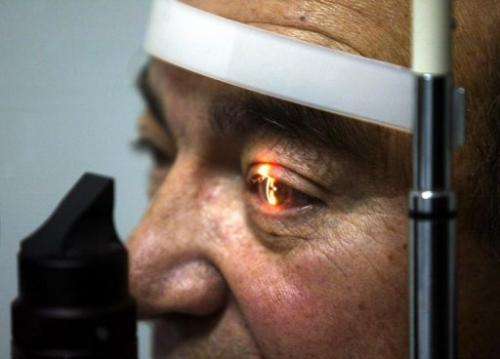
A man receives a medical checkup before surgery, in Santiago, Chile, on July 5, 2005. After years of research, the first bionic eye has seen the light of day in the United States, giving hope to the blind around the world.
After years of research, the first bionic eye has seen the light of day in the United States, giving hope to the blind around the world.
Developed by Second Sight Medical Products, the Argus II Retinal Prosthesis System has helped more than sixty people recover partial sight, with some experiencing better results than others.
Consisting of 60 electrodes implanted in the retina and glasses fitted with a special mini camera, Argus II has already won the approval of European regulators. The US Food and Drug Administration is soon expected to follow suit, making this bionic eye the world's first to become widely available.
"It's the first bionic eye to go on the market in the world, the first in Europe and the first one in the US," said Brian Mech, the California-based company's vice president of business development.
Those to benefit from Argus II are people with retinitis pigmentosa, a rare genetic disease, affecting about 100,000 people in the US, that results in the degeneration of the retinal photoreceptors.
The photoreceptor cells convert light into electrochemical impulses that are transmitted to the brain via the optic nerve, where they are decoded into images.
"The way the prosthesis works (is) it replaces the function of the photoreceptors," Mech told AFP.
Thirty people aged 28 to 77 took part in the clinical trial for the product, all of whom were completely blind.
Mech said the outcomes varied by participant.
"We had some patients who got just a little bit of benefit and others who could do amazing things like reading newspaper headlines," he said.
In some cases, the subjects could even see in color.
"Mostly they see in black and white, but we have demonstrated more recently we can produce color vision as well," Mech said.
According to Mech, Argus II is already available in several European countries for 73,000 euros ($99,120). A US price has not been set but is likely to be higher, he said.
"Now we are (at) around 60 patients... We have tons of surgeries scheduled, the number is growing almost daily," he said.
Other researchers are also vying to develop bionic eyes of their own, that would offer higher resolution images with more electrodes implanted in the retina.
At the Massachusetts Institute of Technology, a team lead by John Wyatt is working on a system that would have up to 400 electrodes.
Daniel Palanker of California's Stanford University is proposing a different approach based on tiny photovoltaic cells instead of electrodes.
"We're thinking about implanting up to 5,000 of these cells at the back of the eye that would theoretically allow for a resolution that is ten times better," George Goetz, a member of Palanker's team, told AFP. This system would also help individuals who lost their sight due to age-related macular degeneration, he added.
These photovoltaic cells convert light into electrical impulses that stimulate the nerve cells in the retina, which then transmit the signals to the brain.
This system has successfully been tested in rats, and the first clinical trial could begin in a year, probably in France. Palanker is linked with French company Pixium Vision based in Paris.
Grace Shen, of the National Eye Institute that has supported both the Argus and Palanker projects, said work on stem cells and optogenetics were also important areas to focus on in developing treatments or the prevention of blindness. Through optogenetics, retina cells can be genetically modified to render them light-sensitive again.
"I think the bionic eye is something that is going to work in some patients and is not going to work with all patients, but it's an exciting time ahead," said Shen.
"We know it's feasible, it can work, but we still have a long way to go."
(c) 2013 AFP
-
Eye implants make vision-restoring progress
Jul 18, 2012 |
not rated yet |
0
-
USC researchers begin tests on next generation of retinal implant
Feb 16, 2007 |
not rated yet |
0
-
Researchers' vision: restoring sight through artificial retinas
Dec 30, 2008 |
not rated yet |
0
-
'Bionic eye' implant offers hope to the blind
Apr 03, 2011 |
not rated yet |
0
-
FDA recommends approval for Second Sight's Argus II retinal prosthesis system in the US
Oct 03, 2012 |
not rated yet |
0
-
Motion perception revisited: High Phi effect challenges established motion perception assumptions
Apr 23, 2013 |
3 / 5 (2) |
2
-
Anything you can do I can do better: Neuromolecular foundations of the superiority illusion (Update)
Apr 02, 2013 |
4.5 / 5 (11) |
5
-
The visual system as economist: Neural resource allocation in visual adaptation
Mar 30, 2013 |
5 / 5 (2) |
9
-
Separate lives: Neuronal and organismal lifespans decoupled
Mar 27, 2013 |
4.9 / 5 (8) |
0
-
Sizing things up: The evolutionary neurobiology of scale invariance
Feb 28, 2013 |
4.8 / 5 (10) |
14
-
Differences of Classical Mechanics when learned with Calc vs algebra?
3 hours ago
-
what is the distance traveled
7 hours ago
-
Image of a Convex Lens Cut in Half Horizontally
11 hours ago
-
Ray tracing throught optical system of thick lenses
11 hours ago
-
Faraday's law on circular wire
12 hours ago
-
Specific Exergy vs Specific Flow Exergy
13 hours ago
- More from Physics Forums - Classical Physics
More news stories
Glaucoma drug can cause droopy eyelids
Prostaglandin analogues (PGAs), drugs which lower intraocular pressure, are often the first line of treatment for people with glaucoma, but their use is not without risks. PGAs have long been associated with blurred vision, ...
Ophthalmology
May 21, 2013 |
not rated yet |
0
Eyes on the sun: Child sunshine exposure and eye development
(Medical Xpress)—Exposure to sunshine as a small child is crucial to the development of a healthy eye according to results of long-term myopia study conducted by University of Sydney researchers.
Ophthalmology
May 21, 2013 |
5 / 5 (1) |
0
New study pinpoints biochemical mechanism underlying fibrosis following glaucoma surgery
The most common cause of failure after glaucoma surgery is scarring at the surgical site, so researchers are actively looking for ways to minimize or prevent scar formation. Previous work had suggested that vascular endothelial ...
Ophthalmology
May 17, 2013 |
not rated yet |
0
|
Early screenings key to diagnosing glaucoma
New research is emphasizing the importance of regular screenings for glaucoma, a disease that deteriorates the optic nerve over time and is a leading cause of irreversible blindness worldwide. The onset of glaucoma is associated ...
Ophthalmology
May 17, 2013 |
not rated yet |
0
|
University partners with Sony to find cure for 'lazy eye'
The University of Nottingham and Nottingham University Hospitals NHS Trust, have been working with Sony Computer Entertainment Europe (SCEE) to develop special 3-D glasses and games to help treat children ...
Ophthalmology
May 08, 2013 |
not rated yet |
0
Calorie information in fast food restaurants used by 40 percent of 9-18 year olds when making food choices
A new study published online today (Thursday) in the Journal of Public Health has found that of young people who visited fast food or chain restaurants in the U.S. in 2010, girls and youth who were obese were more likely ...
Having both migraines, depression may mean smaller brain
(HealthDay)—Migraines and depression can each cause a great deal of suffering, but new research indicates the combination of the two may be linked to something else entirely—a smaller brain.
Slowing the aging process—only with antibiotics
Swiss scientists reveal the mechanism responsible for aging hidden deep within mitochondria—and dramatically slow it down in worms by administering antibiotics to the young.
Brain can be trained in compassion, study shows
Until now, little was scientifically known about the human potential to cultivate compassion—the emotional state of caring for people who are suffering in a way that motivates altruistic behavior.
Researchers complete largest genetic sequencing study of human disease
Researchers from Queen Mary, University of London have led the largest sequencing study of human disease to date, investigating the genetic basis of six autoimmune diseases.
Experts favor US approval of Merck sleeping pill (Update)
An independent panel of experts on Wednesday recommended US approval of a new Merck sleeping pill called suvorexant, but expressed concerns over the highest dosage and risks of drowsy daytime driving.