Blood vessels 'sniff' gut microbes to regulate blood pressure
February 26, 2013 in Medical research
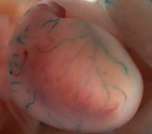
A blue dye marks the presence of olfactory receptor 78 in blood vessels in a mouse's heart. Credit: Jinah Han and Anne Eichmann, Yale University
Researchers at The Johns Hopkins University and Yale University have discovered that a specialized receptor, normally found in the nose, is also in blood vessels throughout the body, sensing small molecules created by microbes that line mammalian intestines, and responding to these molecules by increasing blood pressure. The finding suggests that gut bacteria are an integral part of the body's complex system for maintaining a stable blood pressure.
A description of the research, conducted in mice and test tubes, appeared online Feb. 11 in the journal Proceedings of the National Academy of Sciences.
"The contribution that gut microbes apparently make to blood pressure regulation and human health is a surprise," says Jennifer Pluznick, Ph.D., assistant professor of physiology at the Johns Hopkins University School of Medicine. "There is still much to learn about this mechanism, but we now know some of the players and how they interact," she adds.
Pluznick says that several years ago, thanks to a "happy coincidence," she found—in the kidney—some of the same odor-sensing proteins that give the nose its powers. Focusing on one of those proteins, olfactory receptor 78 (Olfr78), her team specifically located it in the major branches of the kidney's artery and in the smaller arterioles that lead into the kidney's filtering structures. Olfr78 also turned up in the walls of small blood vessels throughout the body, she says, particularly in the heart, diaphragm, skeletal muscle and skin.
This video is not supported by your browser at this time.
Dr. Jennifer Pluznick, Johns Hopkins University School of Medicine, is an assistant professor of physiology. In this two-minute video, she describes her lab's research, particularly the role of smell receptors in the kidney and how they help the kidney maintain homeostasis. Credit: Johns Hopkins Medicine
To figure out which molecules bind and activate Olfr78, the scientists programmed cells to have Olfr78 protein receptors on their surface. They also gave these same cells the ability to start a light-producing chemical reaction whenever Olfr78 is activated. By adding different cocktails of molecules to the cells and measuring the light the cells produced, they homed in on a single mixture that activated Olfr78. They then tested each component in that mix and found that only acetic acid (a.k.a. vinegar) bound Olfr78 and caused the reaction.Acetic acid and its alter ego, acetate, are part of a group of molecules known as short chain fatty acids (SCFAs). When the team tested other molecules in this group, they found that propionate, which is similar to acetate, also binds Olfr78. In the body of mammals, including humans, SCFAs are made when zillions of bacteria lining the gut digest starch and cellulose from plant-based foods. The SCFAs are absorbed by the intestines into the blood stream, where they can interact with Olfr78.
To pinpoint the effect of Olfr78, the scientists gave SCFAs to mice missing the Olfr78 gene and found that the rodents' blood pressure decreased, suggesting that SCFAs normally induce Olfr78 to elevate blood pressure. However, when they gave SCFAs to normal mice with intact Olfr78, they did not see the expected increase in blood pressure, but rather a decrease, though it was less pronounced than before.
To test the effect of reducing the SCFAs available to Olfr78, the team gave mice a three-week course of antibiotics to wipe out the gut microbes responsible for SCFA production. In this case, normal mice showed very little change in blood pressure, but mice without Olfr78 experienced an increase in blood pressure, suggesting that there were other factors involved in the Olfr78/SCFA/blood pressure relationship.
The mystery was solved, Pluznick says, when the team examined mice lacking Gpr41, a non-smell-related protein receptor located in blood vessel walls that also binds SCFAs. When SCFAs bind to Gpr41, blood pressure is decreased. The researchers eventually discovered that Olfr78 and Gpr41 both are activated by SCFAs, but with contradictory effects. The negative effect of Gpr41 is counterbalanced by the positive effect of Olfr78, but Gpr41's effect is stronger, so an increase in SCFAs produces an overall decrease in blood pressure.
"We don't have the full story yet," says Pluznick. "There are many players involved in the maintenance of stable levels of blood pressure, and these are just a few of them. We don't know why it would be beneficial for blood pressure to decrease after eating or why gut microbes would play a part in signaling that change. But our work opens the door for exploring the effects of antibiotic treatments, probiotics and other dietary changes on blood pressure levels in mice, and perhaps eventually people."
More information: Link to article in PNAS: dx.doi.org/10.1073… s.1215927110
Journal reference:
Proceedings of the National Academy of Sciences
Provided by
Johns Hopkins University School of Medicine
-
Switch in cell's 'power plant' declines with age, rejuvenated by drug
Aug 16, 2011 |
not rated yet |
0
-
Scientists discover a new way our bodies control blood pressure: the P450-EET system
Sep 30, 2010 |
not rated yet |
0
-
Study shows oxidants help maintain healthy blood pressure
Jan 17, 2012 |
not rated yet |
0
-
The effect of body mass index on blood pressure varies by race among children
Sep 21, 2012 |
not rated yet |
0
-
Dangerous blood pressure increases during exercise can be blocked: research
Apr 04, 2011 |
not rated yet |
0
-
Motion perception revisited: High Phi effect challenges established motion perception assumptions
Apr 23, 2013 |
3 / 5 (2) |
2
-
Anything you can do I can do better: Neuromolecular foundations of the superiority illusion (Update)
Apr 02, 2013 |
4.5 / 5 (11) |
5
-
The visual system as economist: Neural resource allocation in visual adaptation
Mar 30, 2013 |
5 / 5 (2) |
9
-
Separate lives: Neuronal and organismal lifespans decoupled
Mar 27, 2013 |
4.9 / 5 (8) |
0
-
Sizing things up: The evolutionary neurobiology of scale invariance
Feb 28, 2013 |
4.8 / 5 (10) |
14
-
Pressure-volume curve: Elastic Recoil Pressure don't make sense
11 hours ago
-
If you became brain-dead, would you want them to pull the plug?
May 17, 2013
-
MRI bill question
May 15, 2013
-
Ratio of Hydrogen of Oxygen in Dessicated Animal Protein
May 13, 2013
-
Alcohol and acetaminophen
May 13, 2013
-
Marie Curie's leukemia
May 13, 2013
- More from Physics Forums - Medical Sciences
More news stories
Now we know why old scizophrenia medicine works on antibiotics-resistant bacteria
In 2008 researchers from the University of Southern Denmark showed that the drug thioridazine, which has previously been used to treat schizophrenia, is also a powerful weapon against antibiotic-resistant bacteria such as ...
Medical research
22 hours ago |
3.7 / 5 (3) |
0
|
SUMO wrestling cells reveal new protective mechanism target for stroke
Scientists investigating the interaction of a group of proteins in the brain responsible for protecting nerve cells from damage have identified a new target that could increase cell survival.
Medical research
May 17, 2013 |
5 / 5 (1) |
0
How serotonin receptors can shape drug effects, from LSD to migraine medication
New findings by researchers carrying out experiments at the U.S. Department of Energy Office of Science's Advanced Photon Source (APS) help explain why some drugs that interact with two kinds of human serotonin ...
Medical research
May 17, 2013 |
not rated yet |
0
|
Preventing blood poisoning
Peptide molecules derived from the body's natural immune system can help boost the body's defence against life-threatening blood poisoning, joint University research has uncovered.
Medical research
May 17, 2013 |
4 / 5 (1) |
0
|
New mechanism to prevent type 2 diabetes in obese individuals
A new Montréal study conducted by Dr. May Faraj, associate research professor at the Université de Montréal and invited scientist at the IRCM, along with her research team and medical collaborators, shows ...
Medical research
May 17, 2013 |
not rated yet |
0
|
New research identifies risks, interventions for children's GI health
An increasing number of U.S. children are experiencing gastrointestinal issues that require interventions to resolve, according to research presented at Digestive Disease Week (DDW).
US psychiatry gets makeover in new manual
The latest makeover to a massive psychiatric tome honored by some, reviled by others and even called the "Bible" of mental disorders is being released Saturday with a host of new changes.
New case of SARS-like virus in Saudi: ministry
A new case of the deadly coronavirus has been detected in Saudi Arabia where 15 people have already died after contracting it, the health ministry announced on Saturday on its Internet website.
AIDS science at 30: 'Cure' now part of lexicon
Big names in medicine are set to give an upbeat assessment of the war on AIDS on Tuesday, 30 years after French researchers identified the virus that causes the disease.
For combat veterans suffering from post-traumatic stress disorder, 'fear circuitry' in the brain never rests
Chronic trauma can inflict lasting damage to brain regions associated with fear and anxiety. Previous imaging studies of people with post-traumatic stress disorder, or PTSD, have shown that these brain regions can over-or ...
New colonoscope provides ground-breaking view of colon
A ground-breaking advance in colonoscopy technology signals the future of colorectal care, according to research presented today at Digestive Disease Week(DDW). Additional research focuses on optimizing the minimal withdrawal ...