Cooling may prevent trauma-induced epilepsy
February 21, 2013 by Michael C. Purdy in Neuroscience
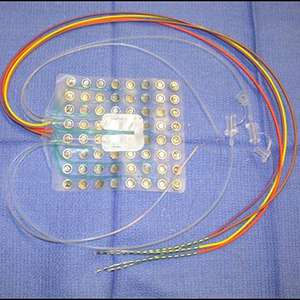
Researchers at Washington University School of Medicine in St. Louis are currently testing the ability of this cooling grid to reduce seizures that cannot be controlled through medication or surgery. In a separate study, they showed that brain cooling reduced seizures in a rat model of epilepsy. Credit: Matthew D. Smyth, MD
(Medical Xpress)—In the weeks, months and years after a severe head injury, patients often experience epileptic seizures that are difficult to control. A new study in rats suggests that gently cooling the brain after injury may prevent these seizures.
"Traumatic head injury is the leading cause of acquired epilepsy in young adults, and in many cases the seizures can't be controlled with medication," says senior author Matthew Smyth, MD, associate professor of neurological surgery and of pediatrics at Washington University School of Medicine in St. Louis. "If we can confirm cooling's effectiveness in human trials, this approach may give us a safe and relatively simple way to prevent epilepsy in these patients."
The researchers reported their findings in Annals of Neurology.
Cooling the brain to protect it from injury is not a new concept. Cooling slows down the metabolic activity of nerve cells, and scientists think this may make it easier for brain cells to survive the stresses of an injury.
Doctors currently cool infants whose brains may have had inadequate access to blood or oxygen during birth. They also cool some heart attack patients to reduce peripheral brain damage when the heart stops beating.
Smyth has been exploring the possibility of using cooling to prevent seizures or reduce their severity.
"Warmer brain cells seem to be more electrically active, and that may increase the likelihood of abnormal electrical discharges that can coalesce to form a seizure," Smyth says. "Cooling should have the opposite effect."
Smyth and colleagues at the University of Washington and the University of Minnesota test potential therapies in a rat model of brain injury. These rats develop chronic seizures weeks after the injury.
Researchers devised a headset that cools the rat brain. They were originally testing its ability to stop seizures when they noticed that cooling seemed to be not only stopping but also preventing seizures.
Scientists redesigned the study to focus on prevention. Under the new protocols, they put headsets on some of the rats that cooled their brains by less than 4 degrees Fahrenheit. Another group of rats wore headsets that did nothing. Scientists who were unaware of which rats they were observing monitored them for seizures during treatment and after the headsets were removed.
Rats that wore the inactive headset had progressively longer and more severe seizures weeks after the injury, but rats whose brains had been cooled only experienced a few very brief seizures as long as four months after injury.
Brain injury also tends to reduce cell activity at the site of the trauma, but the cooling headsets restored the normal activity levels of these cells.
The study is the first to reduce injury-related seizures without drugs, according to Smyth, who is director of the Pediatric Epilepsy Surgery program at St. Louis Children's Hospital.
"Our results show that the brain changes that cause this type of epilepsy happen in the days and weeks after injury, not at the moment of injury or when the symptoms of epilepsy begin," says Smyth. "If clinical trials confirm that cooling has similar effects in humans, it could change the way we treat patients with head injuries, and for the first time reduce the chance of developing epilepsy after brain injury."
Smyth and his colleagues have been testing cooling devices in humans in the operating room, and are planning a multi-institutional trial of an implanted focal brain cooling device to evaluate the efficacy of cooling on established seizures.
More information: D'Ambrosio. R. et al. Mild passive focal cooling prevents epileptic seizures after head injury in rats. Annals of Neurology, DOI: 10.1002/ana.23764
Journal reference:
Annals of Neurology
Provided by
Washington University School of Medicine in St. Louis
-
Mild brain cooling after head injury prevents epileptic seizures in lab study
Dec 21, 2012 |
not rated yet |
0
-
Non-epileptic seizures may be misdiagnosed longer in veterans
Sep 05, 2011 |
not rated yet |
0
-
Brain's immune system may cause chronic seizures
Jul 06, 2009 |
not rated yet |
0
-
Surprising results from study of non-epileptic seizures
Dec 02, 2012 |
not rated yet |
0
-
Dogs may be responding to psychological seizures, not epilepsy seizures
Jan 22, 2007 |
not rated yet |
0
-
Motion perception revisited: High Phi effect challenges established motion perception assumptions
Apr 23, 2013 |
3 / 5 (2) |
2
-
Anything you can do I can do better: Neuromolecular foundations of the superiority illusion (Update)
Apr 02, 2013 |
4.5 / 5 (11) |
5
-
The visual system as economist: Neural resource allocation in visual adaptation
Mar 30, 2013 |
5 / 5 (2) |
9
-
Separate lives: Neuronal and organismal lifespans decoupled
Mar 27, 2013 |
4.9 / 5 (8) |
0
-
Sizing things up: The evolutionary neurobiology of scale invariance
Feb 28, 2013 |
4.8 / 5 (10) |
14
-
Why is zone 1 in liver more prone to ischemic injury?
9 hours ago
-
How can there be villous adenoma in colon, if there are no villi there
May 22, 2013
-
How can there be a term called "intestinal metaplasia" of stomach
May 21, 2013
-
Pressure-volume curve: Elastic Recoil Pressure don't make sense
May 18, 2013
-
If you became brain-dead, would you want them to pull the plug?
May 17, 2013
-
MRI bill question
May 15, 2013
- More from Physics Forums - Medical Sciences
More news stories
Depression common among children with temporal lobe epilepsy
A new study determined that children and adolescents with seizures involving the temporal lobe are likely to have clinically significant behavioral problems and psychiatric illness, especially depression. Findings published ...
Neuroscience
7 minutes ago |
not rated yet |
0
The secret lives, and deaths, of neurons
As the human body fine-tunes its neurological wiring, nerve cells often must fix a faulty connection by amputating an axon—the "business end" of the neuron that sends electrical impulses to tissues or other ...
Neuroscience
1 hour ago |
5 / 5 (1) |
0
|
Regenerating spinal cord fibers may be treatment for stroke-related disabilities
A study by researchers at Henry Ford Hospital found "substantial evidence" that a regenerative process involving damaged nerve fibers in the spinal cord could hold the key to better functional recovery by most stroke victims.
Neuroscience
1 hour ago |
not rated yet |
0
|
Breakthrough on Huntington's disease
Researchers at Lund University have succeeded in preventing very early symptoms of Huntington's disease, depression and anxiety, by deactivating the mutated huntingtin protein in the brains of mice.
Neuroscience
2 hours ago |
not rated yet |
0
Researchers identify networks of neurons in the brain that are disrupted in psychiatric disease
Studying the networks of connections in the brains of people affected by schizophrenia, bipolar disease or depression has allowed Dr. Peter Williamson, from Western University, to gain a better understanding of the biological ...
Neuroscience
3 hours ago |
not rated yet |
0
Researchers find common childhood asthma unconnected to allergens or inflammation
Little is known about why asthma develops, how it constricts the airway or why response to treatments varies between patients. Now, a team of researchers at Weill Cornell Medical College, Columbia University Medical Center ...
Motion quotient: IQ predicted by ability to filter motion (w/ video)
A brief visual task can predict IQ, according to a new study. This surprisingly simple exercise measures the brain's unconscious ability to filter out visual movement. The study shows that individuals whose ...
Defective cellular waste removal explains why Gaucher patients often develop Parkinson's disease
Gaucher disease causes debilitating and sometimes fatal neurodegeneration in early childhood. Recent studies have uncovered a link between the mutations responsible for Gaucher disease and an increased risk ...
Protein preps cells to survive stress of cancer growth and chemotherapy
Scientists have uncovered a survival mechanism that occurs in breast cells that have just turned premalignant-cells on the cusp between normalcy and cancers-which may lead to new methods of stopping tumors.
Researchers suggest boosting body's natural flu killers
A known difficulty in fighting influenza (flu) is the ability of the flu viruses to mutate and thus evade various medications that were previously found to be effective. Researchers at the Hebrew University of Jerusalem have ...
Discarded immune cells induce the relocation of stem cells
Spanish researchers have discovered that the daily clearance of neutrophils from the body stimulates the release of hematopoietic stem cells from the bone marrow into the bloodstream, according to a report published today ...