Experimental drug combination selectively destroys lymphoma cells
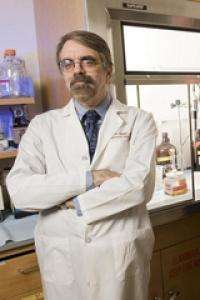
This is Steven Grant, M.D. Credit: Virginia Commonwealth University Massey Cancer Center
Laboratory experiments conducted by scientists at Virginia Commonwealth University Massey Cancer Center suggest that a novel combination of the drugs ibrutinib and bortezomib could potentially be an effective new therapy for several forms of blood cancer, including diffuse large B-cell lymphoma (DLBCL) and mantle cell lymphoma (MCL).
The study, published in the British Journal of Hematology, showed that the experimental drug combination killed cancer cells through a form of cell suicide known as apoptosis, but was relatively non-toxic to normal, healthy cells. Ibrutinib is a new agent that inhibits the B-cell receptor (BCR) signaling complex, which plays an important role in the survival of malignant B-cells. It has shown very promising initial results in the treatment of patients with B-cell malignancies, including chronic lymphocytic leukemia (CLL), DLBCL and MCL. The synergistic interaction of the two drugs proved lethal even to lymphoma cells that had become resistant to bortezomib, when used alone.
"Bortezomib is currently used to treat MCL and multiple myeloma, but, unfortunately, many patients develop resistance to the drug," says the study's principle investigator Steven Grant, M.D., Shirley Carter Olsson and Sture Gordon Olsson Chair in Oncology Research, associate director for translational research, program co-leader of Developmental Therapeutics and Cancer Cell Signaling research member at VCU Massey Cancer Center. "We are hopeful that this combination therapy may circumvent such resistance and eventually help fill an urgent need for more effective therapies for patients with these uncommon blood disorders."
With cultured DLBCL and MCL cells in laboratory experiments spearheaded by Girija Dasmahapatra, Ph.D., lead author of the study's manuscript and instructor in the Department of Internal Medicine at VCU School of Medicine, the scientists found that ibrutinib blocked several molecular pathways that the cancer cells use for growth and survival. When ibrutinib was combined with bortezomib, the scientists observed a high level of synergism between the two drugs that resulted in profound cell death due to DNA damage, culminating in apoptosis. The research findings suggest that the effectiveness of the combination therapy against bortezomib-resistant lymphoma cells may stem from ibrutinib's ability to block signaling pathways used by the cancer cells to survive bortezomib exposure.
Specifically, exposure of DLBCL and MCL cells to ibrutinib blocked the cancer-promoting NF-κB, AKT and ERK1/2 signaling pathways. These signaling pathways provide cells with the ability to adapt to otherwise harmful environmental stimuli by transmitting messages from receptors located at the cell's surface to proteins within the cell that trigger a variety of biological processes. In particular, NF-κB, AKT and ERK1/2 have been shown to carry out many functions that allow cancer cells to survive and proliferate. Significantly, each of these pathways has been implicated in the development of resistance to proteasome inhibitors such as bortezomib.
"We have provided a framework for understanding how an agent like ibrutinib might be employed to enhance the activity of an established anti-cancer agent like bortezomib," says Grant. "We are currently working with representatives from the pharmaceutical industry and the National Cancer Institute to develop a new treatment strategy in which ibrutinib will be combined with proteasome inhibitors like bortezomib for the treatment of patients with lymphomas and potentially other blood cancers."
More information: onlinelibrary.wile… 206/abstract
Journal reference:
British Journal of Hematology
Provided by
Virginia Commonwealth University
-
Novel drug preventing protein recycling shows potential for treating leukemia
Apr 19, 2007 |
not rated yet |
0
-
Researchers induce cell death in leukemia
Apr 16, 2007 |
not rated yet |
0
-
In the lab and clinic, researchers develop a new therapy for blood cancers
Jun 02, 2011 |
not rated yet |
0
-
Ibrutinib has 'unprecedented' impact on mantle cell lymphoma
Dec 14, 2012 |
not rated yet |
0
-
Scientists see potential in novel leukemia treatment
May 22, 2012 |
not rated yet |
0
-
Motion perception revisited: High Phi effect challenges established motion perception assumptions
Apr 23, 2013 |
3 / 5 (2) |
2
-
Anything you can do I can do better: Neuromolecular foundations of the superiority illusion (Update)
Apr 02, 2013 |
4.5 / 5 (11) |
5
-
The visual system as economist: Neural resource allocation in visual adaptation
Mar 30, 2013 |
5 / 5 (2) |
9
-
Separate lives: Neuronal and organismal lifespans decoupled
Mar 27, 2013 |
4.9 / 5 (8) |
0
-
Sizing things up: The evolutionary neurobiology of scale invariance
Feb 28, 2013 |
4.8 / 5 (10) |
14
-
Pressure-volume curve: Elastic Recoil Pressure don't make sense
20 hours ago
-
If you became brain-dead, would you want them to pull the plug?
May 17, 2013
-
MRI bill question
May 15, 2013
-
Ratio of Hydrogen of Oxygen in Dessicated Animal Protein
May 13, 2013
-
Alcohol and acetaminophen
May 13, 2013
-
Marie Curie's leukemia
May 13, 2013
- More from Physics Forums - Medical Sciences
More news stories
New colonoscope provides ground-breaking view of colon
A ground-breaking advance in colonoscopy technology signals the future of colorectal care, according to research presented today at Digestive Disease Week(DDW). Additional research focuses on optimizing the minimal withdrawal ...
Cancer
13 hours ago |
5 / 5 (2) |
0
ASCO: combo antibody therapy effective for melanoma
(HealthDay)—Concurrent use of two immune checkpoint antibodies—ipilimumab and nivolumab—may be effective for the treatment of advanced melanoma, according to a proof-of-principal study presented in ...
Cancer
May 17, 2013 |
not rated yet |
0
Risk factors ID'd for poor cutaneous cell CA outcomes
(HealthDay)—The risks of metastasis and death associated with cutaneous squamous cell carcinoma (CSCC) are low, but significant, and risk factors for poor outcome include tumor diameter, invasion beyond ...
Cancer
May 17, 2013 |
not rated yet |
0
|
Physical & emotional impairments common, often untreated in people with cancer
A new review finds cancer survivors suffer a diverse and complex set of impairments, affecting virtually every organ system. Writing in CA: A Cancer Journal for Clinicians, Julie Silver, M.D., associate professor at Harvar ...
Cancer
May 17, 2013 |
not rated yet |
0
Calif. doc with 'cancer cure' gets 14 years prison (Update)
(AP)—A California doctor has been sentenced to 14 years in federal prison for bilking her patients out of more than $1 million by promising that an herbal supplement could cure late-stage cancer and other diseases.
Cancer
May 17, 2013 |
not rated yet |
0
New research identifies risks, interventions for children's GI health
An increasing number of U.S. children are experiencing gastrointestinal issues that require interventions to resolve, according to research presented at Digestive Disease Week (DDW).
US psychiatry gets makeover in new manual
The latest makeover to a massive psychiatric tome honored by some, reviled by others and even called the "Bible" of mental disorders is being released Saturday with a host of new changes.
New case of SARS-like virus in Saudi: ministry
A new case of the deadly coronavirus has been detected in Saudi Arabia where 15 people have already died after contracting it, the health ministry announced on Saturday on its Internet website.
AIDS science at 30: 'Cure' now part of lexicon
Big names in medicine are set to give an upbeat assessment of the war on AIDS on Tuesday, 30 years after French researchers identified the virus that causes the disease.
For combat veterans suffering from post-traumatic stress disorder, 'fear circuitry' in the brain never rests
Chronic trauma can inflict lasting damage to brain regions associated with fear and anxiety. Previous imaging studies of people with post-traumatic stress disorder, or PTSD, have shown that these brain regions can over-or ...
Body clocks of depressed people altered at cell level, researchers show
Every cell in our bodies runs on a 24-hour clock, tuned to the night-day, light-dark cycles that have ruled us since the dawn of humanity. The brain acts as timekeeper, keeping the cellular clock in sync ...