New flu drug stops virus in its tracks
February 21, 2013 in Medical research
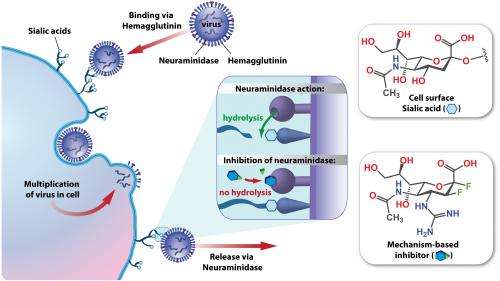
This figure shows the life cycle of the flu virus and how the new flu drug agent prevents the virus from spreading from cell to cell by irreversibly inhibiting the action of the neuraminidase like a broken key left in a lock. Credit: Tom Wennekes, UBC
A new class of influenza drug has been shown effective against drug-resistant strains of the flu virus, according to a study led by University of British Columbia researchers.
Published online today in the journal Science Express, the study details the development of a new drug candidate that prevents the flu virus from spreading from one cell to the next. The drug is shown to successfully treat mice with lethal strains of the flu virus.
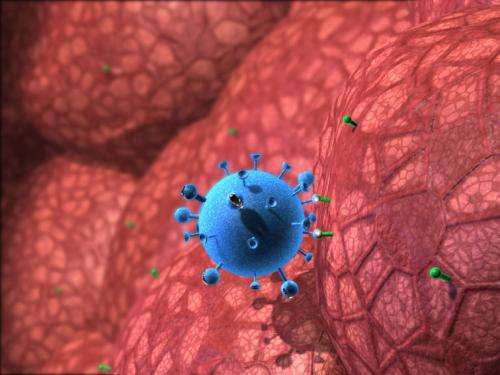
In order to spread in the body, the flu virus (blue) first uses a protein, called hemagglutinin, to bind to the receptors (green) on a healthy cell (red).
In order to spread in the body, the flu virus first uses a protein, called hemagglutinin, to bind to the healthy cell's receptors. Once it has inserted its RNA and replicated, the virus uses an enzyme, called neuraminidase, to sever the connection and move on to the next healthy cell."Our drug agent uses the same approach as current flu treatments – by preventing neuraminidase from cutting its ties with the infected cell," says UBC Chemistry Prof. Steve Withers, the study's senior author. "But our agent latches onto this enzyme like a broken key, stuck in a lock, rendering it useless."
The World Health Organization estimates that influenza affects three to five million people globally each year, causing 250,000 to 500,000 deaths. In some pandemic years, the figure rose to millions.
This video is not supported by your browser at this time.
"One of the major challenges of the current flu treatments is that new strains of the flu virus are becoming resistant, leaving us vulnerable to the next pandemic," says Withers, whose team includes researchers from Canada, the UK, and Australia."By taking advantage of the virus's own 'molecular machinery' to attach itself," Withers adds. "The new drug could remain effective longer, since resistant virus strains cannot arise without destroying their own mechanism for infection."
More information: "Mechanism-Based Covalent Neuraminidase Inhibitors with Broad Spectrum Influenza Antiviral Activity," by J.-H; Kim et al, Science, 2013.
Journal reference:
Science Express
Provided by
University of British Columbia
-
FDA approves first 4-in-1 flu vaccine
Feb 29, 2012 |
not rated yet |
0
-
Why do some influenza virus subtypes die out?
Nov 14, 2011 |
not rated yet |
0
-
Searchers map the global spread of drug-resistant influenza
Sep 14, 2011 |
not rated yet |
0
-
Drug to fight tumors also fights the flu and possibly other viruses
Feb 28, 2011 |
not rated yet |
0
-
Fast and sensitive flu tracking
Jun 15, 2012 |
not rated yet |
0
-
Motion perception revisited: High Phi effect challenges established motion perception assumptions
Apr 23, 2013 |
3 / 5 (2) |
2
-
Anything you can do I can do better: Neuromolecular foundations of the superiority illusion (Update)
Apr 02, 2013 |
4.5 / 5 (11) |
5
-
The visual system as economist: Neural resource allocation in visual adaptation
Mar 30, 2013 |
5 / 5 (2) |
9
-
Separate lives: Neuronal and organismal lifespans decoupled
Mar 27, 2013 |
4.9 / 5 (8) |
0
-
Sizing things up: The evolutionary neurobiology of scale invariance
Feb 28, 2013 |
4.8 / 5 (10) |
14
-
Why is zone 1 in liver more prone to ischemic injury?
May 23, 2013
-
How can there be villous adenoma in colon, if there are no villi there
May 22, 2013
-
How can there be a term called "intestinal metaplasia" of stomach
May 21, 2013
-
Pressure-volume curve: Elastic Recoil Pressure don't make sense
May 18, 2013
-
If you became brain-dead, would you want them to pull the plug?
May 17, 2013
-
MRI bill question
May 15, 2013
- More from Physics Forums - Medical Sciences
More news stories
Study reveals new mechanism for estrogen suppression of liver lipid synthesis
By discovering the new mechanism by which estrogen suppresses lipid synthesis in the liver, UC Irvine endocrinologists have revealed a potential new approach toward treating certain liver diseases.
Medical research
May 23, 2013 |
5 / 5 (1) |
0
|
MRI-based measurement helps predict vascular disease in the brain
Aortic arch pulse wave velocity, a measure of arterial stiffness, is a strong independent predictor of disease of the vessels that supply blood to the brain, according to a new study published in the June issue the journal ...
Medical research
May 23, 2013 |
not rated yet |
0
Antibiotics: A new understanding of sulfonamide nervous system side effects
Since the discovery of Prontosil in 1932, sulfonamide antibiotics have been used to combat a wide spectrum of bacterial infections, from acne to chlamydia and pneumonia. However, their side effects can include serious neurological ...
Medical research
May 23, 2013 |
3 / 5 (1) |
0
|
Scientists discover molecule triggers sensation of itch
Scientists at the National Institutes of Health report they have discovered in mouse studies that a small molecule released in the spinal cord triggers a process that is later experienced in the brain as ...
Medical research
May 23, 2013 |
5 / 5 (3) |
0
|
Discarded immune cells induce the relocation of stem cells
Spanish researchers have discovered that the daily clearance of neutrophils from the body stimulates the release of hematopoietic stem cells from the bone marrow into the bloodstream, according to a report published today ...
Medical research
May 23, 2013 |
5 / 5 (2) |
0
Heart failure accelerates male 'menopause'
Heart failure accelerates the aging process and brings on early andropausal syndrome (AS), according to research presented today at the Heart Failure Congress 2013. AS, also referred to as male 'menopause', was four times ...
First drug to improve heart failure mortality in over a decade
Coenzyme Q10 decreases all cause mortality by half, according to the results of a multicentre randomised double blind trial presented today at Heart Failure 2013 congress. It is the first drug to improve heart failure mortality ...
Feds fight morning-after pill age ruling in NY
(AP)—Department of Justice lawyers have again asked a federal appeals court in New York to delay lifting age restrictions and prescription requirements on an emergency contraceptive popularly known as the morning-after ...
Death highest in heart failure patients admitted in January, on Friday, and overnight
Mortality and length of stay are highest in heart failure patients admitted in January, on Friday, and overnight, according to research presented today at the Heart Failure Congress 2013. The analysis of nearly 1 million ...
Engineered cytomegalovirus protects monkeys from HIV equivalent
(Medical Xpress)—A new study by researchers in the US has shown that an ancient virus can be modified to help in the fight against the simian immunodeficiency virus SIV, which is the equivalent in monkeys ...
Researchers identify first drug targets in childhood genetic tumor disorder
Two mutations central to the development of infantile myofibromatosis (IM)—a disorder characterized by multiple tumors involving the skin, bone, and soft tissue—may provide new therapeutic targets, according to researchers ...
