Gene is marker only for mild cognitive impairment
February 12, 2013 by Susan Kelley in Alzheimer's disease & dementia
Credit: Jennifer Infante
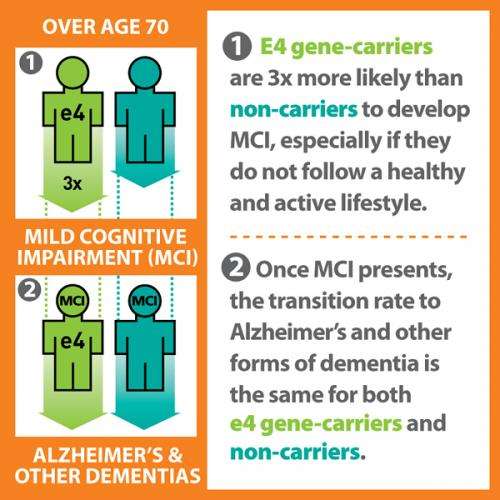
Defying the widely held belief that a specific gene is the biggest risk factor for Alzheimer's disease, two Cornell developmental psychologists and their colleagues report that people with that gene are more likely to develop mild cognitive impairment—but not Alzheimer's.
The study suggests that older adults with healthy brain function can get genetic tests to predict increased risk of future mild cognitive impairment. However, once they are impaired cognitively, the tests won't predict their likelihood of developing Alzheimer's.
"Right now, genetic tests are used in exactly the opposite way. That is, healthy people don't get the tests to predict their risk of mild cognitive impairment, but impaired people get them to predict their risk of Alzheimer's disease," said Charles Brainerd, professor of human development and the study's lead co-author with Valerie Reyna, professor of human development. "So, impaired people think that tests will tell them if they are at increased risk of Alzheimer's, which they won't. And healthy people think that tests won't tell them whether they are at increased risk of cognitive impairment, which they will."
The researchers describe their findings in the January issue of Neuropsychology.
The work builds on previous research by Brainerd and associates that suggested the ε4 allele of the APOE genotype increases the risk of mild cognitive impairment as well as Alzheimer's.
The researchers analyzed data from the only nationally representative dataset of its kind, the National Institute on Aging's Aging, Demographics and Memory Study. They looked at data from 418 people over age 70 to see if those who carried the allele were more likely to develop mild cognitive impairment compared with those who did not have the allele. They also looked at whether ε4 carriers with mild cognitive impairment were more likely to develop Alzheimer's disease compared with non-carriers with mild cognitive impairment.
They found that healthy ε4 carriers were nearly three times—58 percent—more likely to develop mild cognitive impairment compared with non-carriers. However, ε4 carriers with mild cognitive impairment developed Alzheimer's at the same rate as non-carriers.
While previous studies showed that the ε4 allele was more common in people with Alzheimer's disease, this study shows that it does not increase the risk that healthy or impaired people will become demented. Rather, ε4 increases the risk that healthy people will become cognitively impaired, and impaired people are the primary source of new Alzheimer's diagnoses, Brainerd explained. "The reason ε4 is a risk factor for mild cognitive impairment, but not for progression from mild cognitive impairment to Alzheimer's disease, is that this allele is a marker of initial cognitive declines—for example, memory and executive function—that are associated with mild cognitive impairment but not of subsequent declines in cognition or in daily functioning that are associated with forms of Alzheimer's disease."
Brainerd also noted that the effects of ε4 in healthy adults can be detected by the mid-20s. While ε4 is not a risk factor for the severe cognitive declines that signal dementia, it is risk factor for the weaker declines that eventually produce mild cognitive impairment.
Journal reference:
Neuropsychology
Provided by
Cornell University
-
Cardiac disease linked to higher risk of mental impairment
Jan 28, 2013 |
not rated yet |
0
-
High blood pressure associated with risk for mild cognitive impairment
Dec 10, 2007 |
not rated yet |
0
-
Education protects against pre-Alzheimer's memory loss
Oct 20, 2008 |
not rated yet |
0
-
Alzheimer's disease risks are gender specific
May 01, 2008 |
not rated yet |
0
-
Diabetes may be associated with increased risk of mild cognitive impairment
Apr 09, 2007 |
not rated yet |
0
-
Motion perception revisited: High Phi effect challenges established motion perception assumptions
Apr 23, 2013 |
3 / 5 (2) |
2
-
Anything you can do I can do better: Neuromolecular foundations of the superiority illusion (Update)
Apr 02, 2013 |
4.5 / 5 (11) |
5
-
The visual system as economist: Neural resource allocation in visual adaptation
Mar 30, 2013 |
5 / 5 (2) |
9
-
Separate lives: Neuronal and organismal lifespans decoupled
Mar 27, 2013 |
4.9 / 5 (8) |
0
-
Sizing things up: The evolutionary neurobiology of scale invariance
Feb 28, 2013 |
4.8 / 5 (10) |
14
-
question on coriolis effect with drag force
5 hours ago
-
Question of reflection and transmission of TEM wave in normal incidenc
11 hours ago
-
the rudyak-krasnolutski effective potencial
12 hours ago
-
Normal force for a lever model
13 hours ago
-
gravity is std. therefore can we rate a 'mass at height' by watts?
19 hours ago
-
Calculating on-axis elements of a solenoid
May 22, 2013
- More from Physics Forums - Classical Physics
More news stories
Scientists discover cinnamon compounds' potential ability to prevent Alzheimer's
Cinnamon: Can the red-brown spice with the unmistakable fragrance and variety of uses offer an important benefit? The common baking spice might hold the key to delaying the onset of –– or warding off ...
Alzheimer's disease & dementia
12 hours ago |
5 / 5 (5) |
0
|
Drug reverses Alzheimer's disease deficits in mice, research confirms
An anti-cancer drug reverses memory deficits in an Alzheimer's disease mouse model, University of Pittsburgh Graduate School of Public Health researchers confirm in the journal Science.
Alzheimer's disease & dementia
14 hours ago |
not rated yet |
0
|
Multiple research teams unable to confirm high-profile Alzheimer's study
Teams of highly respected Alzheimer's researchers failed to replicate what appeared to be breakthrough results for the treatment of this brain disease when they were published last year in the journal Science.
Alzheimer's disease & dementia
14 hours ago |
5 / 5 (1) |
2
|
Major human drug trial underway for Alzheimer's
A potentially ground-breaking human drug trial is currently underway, which aims to discover whether blood pressure medication can slow or halt the progression of Alzheimer's Disease (AD). This is the latest ...
Alzheimer's disease & dementia
17 hours ago |
not rated yet |
0
Drugs found to both prevent and treat Alzheimer's disease in mice
Researchers at USC have found that a class of pharmaceuticals can both prevent and treat Alzheimer's Disease in mice.
Alzheimer's disease & dementia
May 21, 2013 |
5 / 5 (7) |
0
|
Controlling mood through the motions of mitochondria
(Medical Xpress)—Regulating the distribution of power in neurons is done by a system that makes the national electric grid look simple by comparison. Each neuron has several thousand mitochondria confined ...
Motion quotient: IQ predicted by ability to filter motion (w/ video)
A brief visual task can predict IQ, according to a new study. This surprisingly simple exercise measures the brain's unconscious ability to filter out visual movement. The study shows that individuals whose ...
Scientists discover molecule triggers sensation of itch
Scientists at the National Institutes of Health report they have discovered in mouse studies that a small molecule released in the spinal cord triggers a process that is later experienced in the brain as ...
Researchers find common childhood asthma unconnected to allergens or inflammation
Little is known about why asthma develops, how it constricts the airway or why response to treatments varies between patients. Now, a team of researchers at Weill Cornell Medical College, Columbia University Medical Center ...
Diabetes' genetic underpinnings can vary based on ethnic background, studies say
Ethnic background plays a surprisingly large role in how diabetes develops on a cellular level, according to two new studies led by researchers at the Stanford University School of Medicine.
Study reveals new mechanism for estrogen suppression of liver lipid synthesis
By discovering the new mechanism by which estrogen suppresses lipid synthesis in the liver, UC Irvine endocrinologists have revealed a potential new approach toward treating certain liver diseases.