Researchers discover gene that suppresses herpesviruses
February 13, 2013 in Medical research

UNC researchers discover gene that suppresses herpesviruses

Enlarge

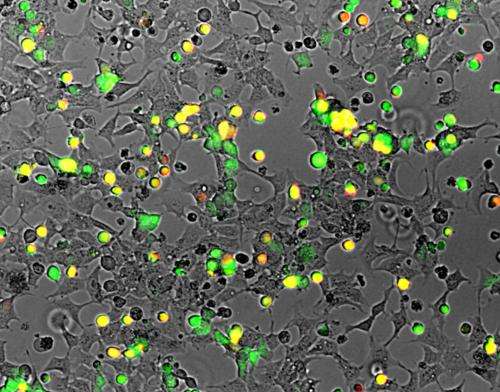
Cells infected with the KSHV virus fluoresce yellow. The KSHV virus remains dormant in more than 95 percent of infected patients. Credit: UNC/Damania Lab

Kaposi's sarcoma-associated herpesvirus (KSHV) and Epstein-Barr virus (EBV) hide within the worldwide human population. While dormant in the vast majority of those infected, these active herpesviruses can develop into several forms of cancer. In an effort to understand and eventually develop treatments for these viruses, researchers at the University of North Carolina have identified a family of human genes known as Tousled-like kinases (TLKs) that play a key role in the suppression and activation of these viruses.

In a paper published by Cell Host and Microbe on Feb. 13, a research team led by Blossom Damania, PhD, of the Department of Microbiology and Immunology and member of the UNC Lineberger Comprehensive Cancer Center, found that suppressing the TLK enzyme causes the activation of the lytic cycle of both EBV and KSHV. During this active phase, these begin to spread and replicate, and become vulnerable to anti-viral treatments.

"When TLK is present, these viruses stay latent, but when it is absent, these viruses can replicate" said Dr. Damania.

Patrick Dillon, a postdoctoral fellow in Dr. Damania's lab, led the study. Other co-authors included UNC Lineberger members Drs. Dirk Dittmer, Nancy Raab-Traub and Gary Johnson.

and EBV are blood-borne viruses that remain dormant in more than 95 percent of those infected, making treatment of these viruses difficult. Both viruses are associated with a number of different lymphomas, , and carcinomas, and many patients with suppressed immune systems are at risk for these virus-associated cancers.

"The dormant state of these viruses is what makes it so hard to treat these infections and the cancers associated with these infections," said Dr. Damania.

Researchers have known that stimuli such as stress can activate the virus from dormancy, but they do not understand the molecular basis of the viral activation cycle. With the discovery of the link between these viruses and TLKs, Dr. Damania said that researchers can begin to look for the molecular actions triggered by events like stress, and how they lead to the suppression of the TLK enzymes.

"What exactly is stress at a molecular level? We don't really understand it fully," said Dr. Damania.

With the discovery that TLKs suppresses these viruses, Dr. Damania said that the proteins can now be investigated as a possible drug target for these virus-associated cancers. In its normal function in the cell, TLKs play a role in the maintenance of the genome, repairing DNA and the assembly of the chromatin, but there is a lot more to learn about the function of the TLKs, said Dr. Damania. One avenue of her lab's future research will investigate how TLKs function in absence of the virus.

"If we prevent this protein from functioning, and we combine this with a drug that inhibits viral replication, then we could have a target to cure the cell of the virus. If the virus isn't there, the viral-associated cancers aren't present," said Dr. Damania.

Journal reference: Cell Host and Microbe search and more info website

Provided by University of North Carolina Health Care search and more info website

4.9 /5 (8 votes)  

Rank 4.9 /5 (8 votes)
Relevant PhysicsForums posts

More news stories

Study reveals new mechanism for estrogen suppression of liver lipid synthesis

By discovering the new mechanism by which estrogen suppresses lipid synthesis in the liver, UC Irvine endocrinologists have revealed a potential new approach toward treating certain liver diseases.

Medical research created May 23, 2013 | popularity 5 / 5 (1) | comments 0 | with audio podcast

MRI-based measurement helps predict vascular disease in the brain

Aortic arch pulse wave velocity, a measure of arterial stiffness, is a strong independent predictor of disease of the vessels that supply blood to the brain, according to a new study published in the June issue the journal ...

Medical research created May 23, 2013 | popularity not rated yet | comments 0

Antibiotics: A new understanding of sulfonamide nervous system side effects

Since the discovery of Prontosil in 1932, sulfonamide antibiotics have been used to combat a wide spectrum of bacterial infections, from acne to chlamydia and pneumonia. However, their side effects can include serious neurological ...

Medical research created May 23, 2013 | popularity 3 / 5 (1) | comments 0 | with audio podcast

Scientists discover molecule triggers sensation of itch

Scientists at the National Institutes of Health report they have discovered in mouse studies that a small molecule released in the spinal cord triggers a process that is later experienced in the brain as ...

Medical research created May 23, 2013 | popularity 5 / 5 (3) | comments 0 | with audio podcast

Discarded immune cells induce the relocation of stem cells

Spanish researchers have discovered that the daily clearance of neutrophils from the body stimulates the release of hematopoietic stem cells from the bone marrow into the bloodstream, according to a report published today ...

Medical research created May 23, 2013 | popularity 5 / 5 (2) | comments 0


First drug to improve heart failure mortality in over a decade

Coenzyme Q10 decreases all cause mortality by half, according to the results of a multicentre randomised double blind trial presented today at Heart Failure 2013 congress. It is the first drug to improve heart failure mortality ...

Seniors more likely to crash when driving with pet, study finds

(HealthDay)—Animals make great companions for senior citizens, but elderly people who always drive with a pet in the car are far more likely to crash than those who never drive with a pet, researchers have ...

Heart failure accelerates male 'menopause'

Heart failure accelerates the aging process and brings on early andropausal syndrome (AS), according to research presented today at the Heart Failure Congress 2013. AS, also referred to as male 'menopause', was four times ...

Death highest in heart failure patients admitted in January, on Friday, and overnight

Mortality and length of stay are highest in heart failure patients admitted in January, on Friday, and overnight, according to research presented today at the Heart Failure Congress 2013. The analysis of nearly 1 million ...

Feds fight morning-after pill age ruling in NY

(AP)—Department of Justice lawyers have again asked a federal appeals court in New York to delay lifting age restrictions and prescription requirements on an emergency contraceptive popularly known as the morning-after ...

New immune system discovered

(Medical Xpress)—A research team, led by Jeremy Barr, a biology post-doctoral fellow, unveils a new immune system that protects humans and animals from infection.