Study identifies growth factor essential to the most common malignant pediatric brain tumor
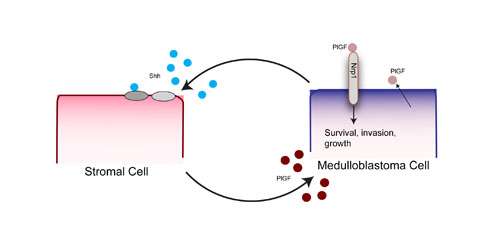
Medulloblastoma cells secrete the developmental protein Shh, which binds to receptors in stromal cells and triggers signaling that leads to the production of PlGF. Stromal-derived PlGF then binds to Nrp1 receptors in the cancer cell and conveys signals that sustain the growth and spread of the tumor. Credit: Lance Munn, Ph.D., and Nathaniel Kirkpatrick, Ph.D., Steele Laboratory for Tumor Biology, Massachusetts General Hospital.
A multi-institutional team led by Massachusetts General Hospital (MGH) researchers has identified a molecular pathway that appears to be essential for the growth and spread of medulloblastoma, the most common malignant brain tumor in children. In their report in the Feb. 28 issue of Cell, they show that blocking this pathway – which involves interactions between tumor cells and the surrounding tissues – leads to regression of all four molecular subtypes of medulloblastoma in several mouse models.
"Our finding that a pathway carrying signals from host cells to tumor cells via placental growth factor and its receptor neuropilin 1 is critical to the growth of medulloblastoma, regardless of molecular subtype, strongly supports evaluating antibodies against these proteins as a novel therapeutic approach to this pediatric cancer," says Rakesh K. Jain, PhD, director of the Steele Laboratory for Tumor Biology at MGH and corresponding author of the study.
A highly malignant tumor that originates in the cerebellum, medulloblastoma accounts for about 20 percent of all pediatric brain tumors and is ten times more common in children than in adults. While aggressive treatment with surgery, chemotherapy and radiation significantly improves patient survival, those treatments can have long-term developmental, behavioral, and neurological side effects, particularly in the youngest patients, making the need for less damaging therapies essential.
Impetus for the current investigation began with studies by Peter Carmeliet, MD, PhD, of the Vesalius Research Center in Belgium, a co-author of the current study. Carmeliet found that an antibody against placental growth factor (PlGF) could block angiogenesis in a number of adult tumors. Since PlGF, unlike other angiogenic proteins, is not required for normal postnatal development, Jain and his Steele Lab colleague Lei Xu, MD, PhD, proposed targeting PlGF as anti-angiogenic treatment for pediatric tumors. Matija Snuderl, MD, of the Steele Lab, a co-lead author of the current study, then found that PlGF was highly expressed in all types of medulloblastoma. Other members of Jain's team found that high expression of the P1GF receptor neuropilin 1 (Nrp1) was associated with poor survival in medulloblastoma patients.
To investigate mechanisms behind the potential role of PlGF in medulloblastoma, the MGH investigators collaborated with colleagues in the U.S., Belgium, Canada and Germany. They first confirmed that PlGF is expressed in patient samples of all subtypes of medulloblastoma and that expression of Nrp1 was more significant than that of PlGF's more common receptor, VEGFR1. Experiments in several mouse models revealed that the presence of PlGF is essential for the progression of medulloblastoma and that treatment with several antibodies against the growth factor reduced tumor growth and spread, increasing animal survival even without substantially inhibiting angiogenesis
The researchers were surprised to find that most PlGF was produced by surrounding supportive tissue called stroma and not by the tumor cells. Further investigation revealed that release of the developmental protein Shh (sonic hedgehog) by tumor cells induces expression in nearby stromal cells of PlGF, which then binds to the Nrp1 receptor on tumor cells, leading to further tumor growth. The authors note that therapies that block the interaction between PlGF and Nrp1 are less likely to lead to treatment resistance than are therapies directly targeting mutations that drive tumor growth.
"The importance of tumor-stromal interactions has been recognized for decades, especially the formation of new blood vessels to supply tumors," says Jain, the Cook Professor of Radiation Oncology (Tumor Biology) at Harvard Medical School. "Our discovery of an entirely different way that tumor-stromal interactions drive cancer progression supports the exciting possibility that targeting that pathway in medulloblastoma could be more broadly effective with fewer side effects for patients. Antibodies against both PlGF and Nrp1 have been developed and tested in adult patients. There is hope that they could be safe in pediatric patients, but that needs to be established in clinical trials."
Journal reference:
Cell
Provided by
Massachusetts General Hospital
-
Vessel-thwarting antibody might help starve cancerous tumors
Nov 01, 2007 |
not rated yet |
0
-
Estrogen found to increase growth of the most common childhood brain tumor
Feb 17, 2009 |
not rated yet |
0
-
Scientists clear the way to alternative anti-angiogenic cancer therapy
Jan 07, 2011 |
not rated yet |
0
-
Ovarian cancer cells hijack surrounding tissues to enhance tumor growth
Sep 04, 2012 |
not rated yet |
0
-
Could targeting a virus treat a common pediatric brain tumor?
Sep 26, 2011 |
not rated yet |
0
-
Motion perception revisited: High Phi effect challenges established motion perception assumptions
Apr 23, 2013 |
3 / 5 (2) |
2
-
Anything you can do I can do better: Neuromolecular foundations of the superiority illusion (Update)
Apr 02, 2013 |
4.5 / 5 (11) |
5
-
The visual system as economist: Neural resource allocation in visual adaptation
Mar 30, 2013 |
5 / 5 (2) |
9
-
Separate lives: Neuronal and organismal lifespans decoupled
Mar 27, 2013 |
4.9 / 5 (8) |
0
-
Sizing things up: The evolutionary neurobiology of scale invariance
Feb 28, 2013 |
4.8 / 5 (10) |
14
-
Why is zone 1 in liver more prone to ischemic injury?
14 hours ago
-
How can there be villous adenoma in colon, if there are no villi there
May 22, 2013
-
How can there be a term called "intestinal metaplasia" of stomach
May 21, 2013
-
Pressure-volume curve: Elastic Recoil Pressure don't make sense
May 18, 2013
-
If you became brain-dead, would you want them to pull the plug?
May 17, 2013
-
MRI bill question
May 15, 2013
- More from Physics Forums - Medical Sciences
More news stories
Research identifies a way to make cancer cells more responsive to chemotherapy
Breast cancer characterized as "triple negative" carries a poor prognosis, with limited treatment options. In some cases, chemotherapy doesn't kill the cancer cells the way it's supposed to. New research from Western University ...
Cancer
40 minutes ago |
5 / 5 (1) |
0
Mayo Clinic genomic analysis lends insight to prostate cancer
Mayo Clinic researchers have used next generation genomic analysis to determine that some of the more aggressive prostate cancer tumors have similar genetic origins, which may help in predicting cancer progression. The findings ...
Cancer
44 minutes ago |
not rated yet |
0
When oxygen is short, EGFR prevents maturation of cancer-fighting miRNAs
Even while being dragged to its destruction inside a cell, a cancer-promoting growth factor receptor fires away, sending signals that thwart the development of tumor-suppressing microRNAs (miRNAs) before it's dissolved, researchers ...
Cancer
1 hour ago |
not rated yet |
0
|
Improved chemo regimen for childhood leukemia may offer high survival, no added heart toxicity
Treating pediatric leukemia patients with a liposomal formulation of anthracycline-based chemotherapy at a more intense-than-standard dose during initial treatment may result in high survival rates without causing any added ...
Cancer
5 hours ago |
not rated yet |
0
Protein preps cells to survive stress of cancer growth and chemotherapy
Scientists have uncovered a survival mechanism that occurs in breast cells that have just turned premalignant-cells on the cusp between normalcy and cancers-which may lead to new methods of stopping tumors.
Cancer
6 hours ago |
not rated yet |
0
|
Controlling mood through the motions of mitochondria
(Medical Xpress)—Regulating the distribution of power in neurons is done by a system that makes the national electric grid look simple by comparison. Each neuron has several thousand mitochondria confined ...
Future doctors unaware of their obesity bias
Two out of five medical students have an unconscious bias against obese people, according to a new study by researchers at Wake Forest Baptist Medical Center. The study is published online ahead of print in the Journal of ...
WHO: Scientific red tape mars efforts vs. virus
International efforts to combat a new pneumonia-like virus that has now killed 22 people are being slowed by unclear rules and competition for the potentially profitable rights to disease samples, the head ...
Shortage of key drug hampering U.S. efforts to control TB, report says
(HealthDay)—A shortage of a critical tuberculosis drug has hampered the efforts of health departments across the United States to contain the spread of the highly infectious lung disease, federal officials ...
Merck ends development of Parkinson's disease drug
(AP)—Merck & Co. says it is ending development of an experimental Parkinson's disease drug because the drug wasn't working.
New microsphere-based methods for detecting HIV antibodies
Detection of HIV antibodies is used to diagnose HIV infection and monitor trials of experimental HIV/AIDS vaccines. New, more sensitive detection systems being developed use microspheres to capture HIV antibodies ...