New hope in fight against multi-resistant germs
February 13, 2013 in Diseases, Conditions, Syndromes
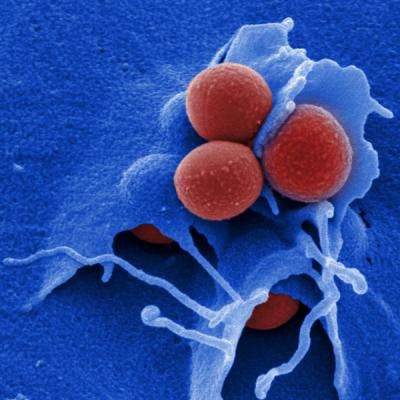
This image shows Staphylococcus aureus bacteria, magnified by electron microscopy. Credit: HZI / Rohde
An increasing number of bacteria is evolving antibiotic resistance. Much-feared representatives of this steadily growing group include Staphylococci strains. At this point, multi-resistant forms of the bacterium Staphylococcus aureus - the "hospital germ" known commonly by its acronym, MRSA - can only be treated with a select subset of antibiotics as many drugs have simply stopped working. This is precisely why the field of medicine is in desperate need of new treatment options.
One highly promising drug candidate is now scheduled for testing in clinical trials. The substance, developed by the British pharmaceutical company GlaxoSmithKline, is still known by its rather cryptic working name, GSK1322322. In the course of clinical trials to evaluate new drugs, physicians typically end up with large numbers of patient samples that are invaluable in studying the different diseases patients are suffering from - samples that have, until recently, rarely been recruited for research purposes. Now, scientists at the Helmholtz Centre for Infection Research (HZI) in Braunschweig, Germany, and at the TWINCORE Centre for Experimental and Clinical Infection Research in Hannover, Germany, aim to study such patient samples for a five-year-period. Part of a special collection at the Hannover Medical School's biobank, the samples will allow researchers to find out more about the etiology, course, and characteristic marker substances of infectious diseases. IMI, the Innovative Medicines Initiative, has awarded the scientists research grants totaling 6 million Euros as part of the COMBACTE (Combating Bacterial Resistance in Europe) project. IMI is a joint initiative by the European Union and the pharmaceutical industry. Dr. Frank Pessler, who heads TWINCORE's "Biomarkers in Infectious Diseases" research group, secured the grant and is the project's coordinator at HZI. Under his helmage, the scientists, along with their colleagues in Paris, Barcelona, and Philadelphia, will be searching for biomarkers - molecules that are unique to a particular disease and which may provide information about if the diagnosis was correct and whether or not the therapy is working.
The new antibiotic, GSK1322322, targets gram-positive bacteria including methicillin-resistant strains of Staphylococcus aureus - notorious MRSA - capable of causing serious skin and wound infections. Gram-positive germs are also frequently the culprit behind pneumonia. The drug targets the bacterial enzyme peptide deformylase. Phase I clinical trials, designed to evaluate a new drug's tolerability and safety profile, have already successfully concluded and showed only minor adverse effects. If the next study shows that GSK1322322 does not bestow any added benefit compared to current treatments, it will not be admitted into the next round of clinical trials. "This is where COMBACTE's added scientific value comes into play. In case this happens, the samples that were obtained will still offer insights into the infections they were supposed to treat, and perhaps aid in developing other better treatments" Frank Pessler explains.
Besides Pessler's own group, research teams headed by Prof. Susanne Häussler, Prof. Singh Chhatwal, Prof. Dietmar Pieper, Dr. Eva Medina, Prof. Irene Wagner-Döbler, Dr. Robert Geffers and Prof. Frank Klawonn are also involved in the project. Each team contributes its own special know-how, and, in concert, they are an excellent force. Adds Pessler: "Where else do you find this many experts from all these different disciplines under one roof, some of them even on the same floor? It makes the whole collaboration smooth and efficient."
Provided by Helmholtz Centre for Infection Research
-
Outsmarting killer bacteria: Next generation of antibiotics to combat drug-resistant 'superbugs'
Sep 14, 2010 |
not rated yet |
0
-
Image of new antibiotic in action opens up new opportunities to combat antibacterial resistance
Aug 04, 2010 |
not rated yet |
0
-
Expert warning: Resistance to antibiotics to be apocalyptic
Jan 25, 2013 |
not rated yet |
0
-
New, virulent strain of MRSA poses renewed antibiotic resistance concerns
Dec 22, 2009 |
not rated yet |
0
-
New antibiotic proves safe and well tolerated
Jun 03, 2010 |
not rated yet |
0
-
Motion perception revisited: High Phi effect challenges established motion perception assumptions
Apr 23, 2013 |
3 / 5 (2) |
2
-
Anything you can do I can do better: Neuromolecular foundations of the superiority illusion (Update)
Apr 02, 2013 |
4.5 / 5 (11) |
5
-
The visual system as economist: Neural resource allocation in visual adaptation
Mar 30, 2013 |
5 / 5 (2) |
9
-
Separate lives: Neuronal and organismal lifespans decoupled
Mar 27, 2013 |
4.9 / 5 (8) |
0
-
Sizing things up: The evolutionary neurobiology of scale invariance
Feb 28, 2013 |
4.8 / 5 (10) |
14
-
Classical and Quantum Mechanics via Lie algebras
Apr 15, 2011
- More from Physics Forums - Independent Research
More news stories
Ginger compounds may be effective in treating asthma symptoms
Gourmands and foodies everywhere have long recognized ginger as a great way to add a little peppery zing to both sweet and savory dishes; now, a study from researchers at Columbia University shows purified components of the ...
Diseases, Conditions, Syndromes
4 hours ago |
not rated yet |
0
New research identifies practice changes to improve value and quality of GI procedures
There are significant cost and risk factors associated with two procedures commonly used to diagnose or treat gastrointestinal problems, according to research presented at Digestive Disease Week (DDW).
Diseases, Conditions, Syndromes
16 hours ago |
not rated yet |
0
Consuming coffee linked to lower risk of detrimental liver disease, study finds
Regular consumption of coffee is associated with a reduced risk of primary sclerosing cholangitis (PSC), an autoimmune liver disease, Mayo Clinic research shows. The findings were being presented at the Digestive Disease ...
Diseases, Conditions, Syndromes
16 hours ago |
not rated yet |
0
|
New case of SARS-like virus in Saudi: ministry
A new case of the deadly coronavirus has been detected in Saudi Arabia where 15 people have already died after contracting it, the health ministry announced on Saturday on its Internet website.
Diseases, Conditions, Syndromes
May 18, 2013 |
not rated yet |
0
Little evidence for prediction rules for low back pain
(HealthDay)—Few randomized clinical trials have been done to assess clinical prediction rules for patients with lower back pain, and the trials that have been done are of low quality and do not provide ...
Diseases, Conditions, Syndromes
May 17, 2013 |
not rated yet |
0
|
Researchers identify a potential new risk for sleep apnea: Asthma
Researchers at the University of Wisconsin have identified a potential new risk factor for obstructive sleep apnea: asthma. Using data from the National Institutes of Health (Heart, Lung, and Blood Institute)-funded Wisconsin ...
Study finds that sleep apnea and Alzheimer's are linked
A new study looking at sleep-disordered breathing (SDB) and markers for Alzheimer's disease (AD) risk in cerebrospinal fluid (CSF) and neuroimaging adds to the growing body of research linking the two.
Computational tool translates complex data into simplified 2-dimensional images
In their quest to learn more about the variability of cells between and within tissues, biomedical scientists have devised tools capable of simultaneously measuring dozens of characteristics of individual ...
New theory on genesis of osteoarthritis comes with successful therapy in mice
Scientists at Johns Hopkins have turned their view of osteoarthritis (OA) inside out. Literally. Instead of seeing the painful degenerative disease as a problem primarily of the cartilage that cushions joints, ...
'Gap' for HIV vaccine efforts after latest setback
The hunt for an HIV vaccine has gobbled up $8 billion in the past decade, and the failure of the most recent efficacy trial has delivered yet another setback to 26 years of efforts.
Alzheimer's leaves bilingual victims stranded in Canada
The devastating effect of Alzheimer's disease on bilingual people has been thrown into focus in Canada, where the sudden loss of a second language can leave sufferers feeling like strangers in their own country.