Researchers identify potential target for age-related cognitive decline
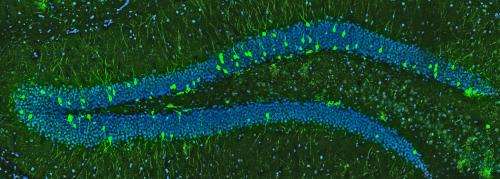
Cognitive decline in old age is linked to decreasing production of new neurons. Scientists from the German Cancer Research Center have discovered in mice that significantly more neurons are generated in the brains of older animals if a signaling molecule called Dickkopf-1 is turned off. In tests for spatial orientation and memory, mice in advanced adult age whose Dickkopf gene had been silenced reached an equal mental performance as young animals.
The hippocampus – a structure of the brain whose shape resembles that of a seahorse – is also called the "gateway" to memory. This is where information is stored and retrieved. Its performance relies on new neurons being continually formed in the hippocampus over the entire lifetime. "However, in old age, production of new neurons dramatically decreases. This is considered to be among the causes of declining memory and learning ability", Prof. Dr. Ana Martin-Villalba, a neuroscientist, explains.
Martin-Villalba, who heads a research department at the German Cancer Research Center (DKFZ), and her team are trying to find the molecular causes for this decrease in new neuron production (neurogenesis). Neural stem cells in the hippocampus are responsible for continuous supply of new neurons. Specific molecules in the immediate environment of these stem cells determine their fate: They may remain dormant, renew themselves, or differentiate into one of two types of specialized brain cells, astrocytes or neurons. One of these factors is the Wnt signaling molecule, which promotes the formation of young neurons. However, its molecular counterpart, called Dickkopf-1, can prevent this.
"We find considerably more Dickkopf-1 protein in the brains of older mice than in those of young animals. We therefore suspected this signaling molecule to be responsible for the fact that hardly any young neurons are generated any more in old age." The scientists tested their assumption in mice whose Dickkopf-1 gene is permanently silenced. Professor Christof Niehrs had developed these animals at DKFZ. The term "Dickkopf" (from German "dick" = thick, "Kopf" = head) also goes back to Niehrs, who had found in 1998 that this signaling molecule regulates head development during embryogenesis.
Martin-Villalba's team discovered that stem cells in the hippocampus of Dickkopf knockout mice renew themselves more often and generate significantly more young neurons. The difference was particularly obvious in two-year old mice: In the knockout mice of this age, the researchers counted 80 percent more young neurons than in control animals of the same age. Moreover, the newly formed cells in the adult Dickkopf-1 mutant mice matured into potent neurons with multiple branches. In contrast, neurons in control animals of the same age were found to be more rudimentary already.
Blocking Dickkopf improves spatial orientation and memory
Several years ago, Ana Martin-Villalba had shown that mice lose their spatial orientation when neurogenesis in the hippocampus is blocked. Now, is it possible that the young neurons in Dickkopf-deficient mice improve the animals' cognitive performance? The DKFZ researchers used standardized tests to study how the mice orient themselves in a maze. While in the control animals, the younger ones (3 months) performed much better in orienting themselves than the older ones (18 months), the Dickkopf-1-deficient mice showed no age-related decline in spatial orientation capabilities. Older Dickkopf-1 mutant mice also outperformed normal animals in tests determining spatial memory.
"Our result proves that Dickkopf-1 promotes age-related decline of specific cognitive abilities," says Ana Martin-Villalba. "Although we had expected silencing of Dickkopf-1 to improve spatial orientation and memory of adult mice, we were surprised and impressed that animals in advanced adult age actually reach the performance levels of young animals."
These results give rise to the question whether the function of Dickkopf-1 may be turned off using drugs. Antibodies blocking the Dickkopf protein are already being tested in clinical trials for treating a completely different condition. "It is fascinating to speculate that such a substance may also slow down age-related cognitive decline. But this is still a dream of the future, since we have only just started first experiments in mice to explore this question."
More information: Seib et al.: "Loss of Dickkopf-1 restores neurogenesis in old age and counteracts cognitive decline." dx.doi.org/10.1016/j.stem.2012.11.010


