Songbirds' brains coordinate singing with intricate timing, study reports
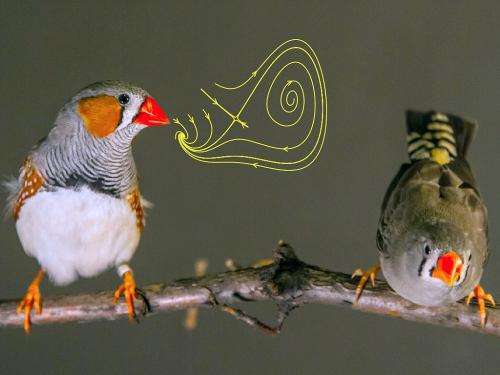
As a bird sings, some neurons in its brain prepare to make the next sounds while others are synchronized with the current notes—a coordination of physical actions and brain activity that is needed to produce complex movements, new research at the University of Chicago shows.
In an article in the current issue of Nature, neuroscientist Daniel Margoliash and colleagues show, for the first time, how the brain is organized to govern skilled performance—a finding that may lead to new ways of understanding human speech production.
The new study shows that birds' physical movements actually are made up of a multitude of smaller actions. "It is amazing that such small units of movements are encoded, and so precisely, at the level of the forebrain," said Margoliash, a professor of organismal biology and anatomy and psychology at UChicago.
"This work provides new insight into how the physics of producing vocal signals are represented in the brain to control vocalizations," said Howard Nusbaum, a professor of psychology at UChicago and an expert on speech.
By decoding the neural representation of communication, Nusbaum explained, the research may shed light on speech problems such as stuttering or aphasia (a disorder following a stroke). And it offers an unusual window into how the brain and body carry out other kinds of complex movement, from throwing a ball to doing a backflip.
"A big question in muscle control is how the motor system organizes the dynamics of movement," said Margoliash. Movements like reaching or grasping are difficult to study because they entail many variables, such as the angles of the shoulder, elbow, wrist and fingers; the forces of many muscles; and how these change over time" he said.
"With all this complexity, it has been difficult to determine which of the many variables that describe movements are the ones that are represented in the brain and used to control movements," he said.
It's difficult to find a natural framework with which to analyze the activity of single neurons. The bird study provided us a perfect opportunity," Margoliash said. Margoliash is a pioneer in the study of brain function in birds, with studies that include how learning occurs when a bird sleeps and recalls singing a song.
For the current study, he worked with Ana Amador, a post-doctoral researcher at UChicago, and University of Buenos Aires scholars Yonatan Sanz Perl and Gabriel Mindlin. The four are co-authors of the Nature paper "Elementary Gesture Dynamics are Encoded by Song Premotor Cortical Neurons."
For the study, the team studied zebra finches while the birds sang and while they slept (when songs were broadcast through a speaker). Researchers recorded the activity of single neurons through tiny wires connected to the birds' brains.
Mindlin, professor of physics at the University of Buenos Aires, and his students have created a mathematical model of the mechanics of the movement of the syrinx, the avian vocal organ. The team used that information to track the connections between brain responses and the physical actions needed to produce a song.
They reduced the description of a song to only two variables—the pressure pushing air through the syrinx and the tension of the vibrating membranes of the syrinx that are needed to produce the song. They also compared the timing predicted by the model with the timing of responses of the neurons in the bird's "song system."
The study revealed how activity at higher levels of the brain tracks basic motor functions. The team also avoided a problem scholars previously encountered. In the past, investigators did not know how to relate song with the variables of pressure and tension, and so they had an incomplete understanding of how neurons controlled song, Margoliash said. For example, a previous theory of song control contended that these complex movements are governed by a clock in the brain that runs independent of the song.
By looking at the physiological variables that the bird uses to control singing, the team was able to find something others had not noticed before: the precise timing between the firing of the neuron and the action connected with it.
"One fascinating observation we made really surprised us: that the forebrain neurons fire precisely at the time a sound transition is being produced," Margoliash explained. "But it takes far too much time for the activity in the forebrain to influence the bird's sound box in the periphery," Margoliash continued. The neurons that the team investigated are tracking and encoding particular moments in song but are not directly controlling them. "Lower levels of the brain are controlling the sound output, but the timing of these neurons suggest that they are helping to evaluate feedback from the produced sound."
Similar feedback plays an essential role in coordinating human speech, and in the skilled performance of athletes and musicians. Now, for the first time, there is a mathematical description that matches brain activity for highly skilled behavior, in the beautiful songs of birds.


