New technology may help doctors monitor concussions, aging, and neurological function
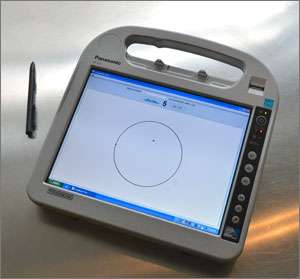
Doctors routinely track their patients' hand-eye coordination to monitor any neuromuscular deficits, particularly as patients age or when they are injured—but the tests they have been using to track this kind of information may be subjective and qualitative.
Researchers at the Wyss Institute for Biologically Inspired Engineering at Harvard University, the Beth Israel Deaconess Medical Center, and Hebrew SeniorLife, Boston (BIDMC), recently completed the first clinical study of a new rapid neuroassessment device they developed to quantitatively measure neuromuscular performance, as reported online in yesterday's Journal of Gerontology: Series A: Biological Sciences and Medical Sciences.
In the study, 150 healthy people from the Boston area aged 21 to 95 used a stylus to follow a moving target around a circle on a computer tablet. As every person performed this tracing task, proprietary computer methods developed at the Wyss Institute measured people's deviations from the circular path, which the researchers then analyzed as a function of age, sex, and handedness. Using this approach, a number can be obtained that can show differences in performance between various individuals or conditions. An older person performs quite differently on the tracing exercise, for example.
"This new tool may hold great potential to augment existing protocols in a doctor's neuromotor assessment toolbox," said Wyss Senior Staff Engineer Leia Stirling, Ph.D., who led the study. "It is portable, repeatable, quick to administer, and easy to perform."
Whereas current methods to assess a patient's neuromuscular function include subjective descriptions of a patient's reflexes and cognitive status, the tracing tool could add a slew of new information displayed as a "score". For example, doctors can record a "score" for "complexity," which relates to how well a person can adapt to changes, and "motion fluidity," which relates to how long the patient pauses during the task. Older subjects involved in the study had lower complexity and motion fluidity scores.
Wyss Core Faculty member Ary L. Goldberger, M.D., who is also the Director of the Margret & H. A. Rey Institute for Nonlinear Dynamics in Medicine at BIDMC, introduced the idea of studying complexity in the human body. "We have demonstrated in earlier studies that a loss of complexity is potentially associated with a range of human health issues from congestive heart failure and sleep apnea to aging," he said.
The team envisions a day when the technology – which they informally called "NeuroAssess"—might be used on the playing field and in doctor's offices worldwide. "One day it might sit next to the thermometer and pressure cuff in the doctor's office," Stirling said. "Just as your blood pressure is recorded during every visit, so could your neuromuscular score be tracked over time to determine progress through recovery and rehabilitation." The same technology could be used to assess off-target neurological side effects in human clinical trials.
Now that the baseline data have been collected from the healthy population of study subjects, the next goal is to determine NeuroAssess' potential to become a quantitative assessment tool for groups of people with neuromuscular pathologies, such as those who suffered concussions or have multiple sclerosis.
The team is currently conducting a study with athletes in the Boston area to determine the sensitivity of the technology in diagnosing concussions.
"The interdisciplinary team who masterminded this new technology represent the best of the Wyss Institute model, which makes it possible for scientists, engineers and clinicians who don't traditionally work together to sit down, dream up game-changing technologies, and more easily and quickly translate them into products for high value applications," said Wyss Founding Director Don Ingber, M.D., Ph.D.
More information: wyss.harvard.edu/viewpage/415/


