What heals traumatized kids? Answers are lacking
February 11, 2013 by Lindsey Tanner in Psychology & Psychiatry
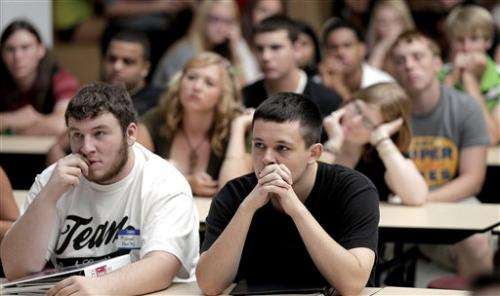
In this Wednesday, Aug. 17, 2011 file photo, students listen during an assembly on the first day of school at a temporary high school in a converted store in Joplin, Mo., nearly three months after an EF-5 tornado destroyed six schools and damaged four others along with killing 160 people and devastating a third of the city. According to research cited in a report by the federal Agency for Healthcare Research and Quality, about two-thirds of U.S. children and teens younger than 18 will experience at least one traumatic event, including shootings and other violence, car crashes and weather disasters. (AP Photo/Charlie Riedel)
Shootings and other traumatic events involving children are not rare events, but there's a startling lack of scientific evidence on the best ways to help young survivors and witnesses heal, a government-funded analysis found.
School-based counseling treatments showed the most promise, but there's no hard proof that anxiety drugs or other medication work and far more research is needed to provide solid answers, say the authors who reviewed 25 studies. Their report was sponsored by the federal Agency for Healthcare Research and Quality.
According to research cited in the report, about two-thirds of U.S. children and teens younger than 18 will experience at least one traumatic event, including shootings and other violence, car crashes and weather disasters. That includes survivors and witnesses of trauma. Most will not suffer any long-term psychological problems, but about 13 percent will develop symptoms of post-traumatic stress, including anxiety, behavior difficulties and other problems related to the event.
The report's conclusions don't mean that no treatment works. It's just that no one knows which treatments are best, or if certain ones work better for some children but not others.
"Our findings serve as a call to action," the researchers wrote in their analysis, published online Monday by the journal Pediatrics.
"This is a very important topic, just in light of recent events," said lead author Valerie Forman-Hoffman, a researcher at the University of North Carolina-Chapel Hill.
She has two young children and said the results suggest that it's likely one of them will experience some kind of trauma before reaching adulthood. "As a parent I want to know what works best," the researcher said.
Besides the December massacre at Sandy Hook Elementary School in Connecticut, other recent tragedies involving young survivors or witnesses include the fatal shooting last month of a 15-year-old Chicago girl gunned down in front of a group of friends; Superstorm Sandy in October; and the 2011 Joplin, Missouri, tornado, whose survivors include students whose high school was destroyed.
Some may do fine with no treatment; others will need some sort of counseling to help them cope.
Studying which treatments are most effective is difficult because so many things affect how a child or teen will fare emotionally after a traumatic event, said Dr. Denise Dowd, an emergency physician and research director at Children's Mercy Hospitals and Clinics in Kansas City, Missouri, who wrote a Pediatrics editorial.
One of the most important factors is how the child's parents handle the aftermath, Dowd said.
"If the parent is freaking out" and has difficulty controlling emotions, kids will have a tougher time dealing with trauma. Traumatized kids need to feel like they're in a safe and stable environment, and if their parents have trouble coping, "it's going to be very difficult for the kid," she said.
The researchers analyzed 25 studies of treatments that included anti-anxiety and depression drugs, school-based counseling, and various types of psychotherapy. The strongest evidence favored school-based treatments involving cognitive behavior therapy, which helps patients find ways to cope with disturbing thoughts and emotions, sometimes including talking repeatedly about their trauma.
This treatment worked better than nothing, but more research is needed comparing it with alternatives, the report says.
"We really don't have a gold standard treatment right now," said William Copeland, a psychologist and researcher at Duke University Medical Center who was not involved in the report. A lot of doctors and therapists may be "patching together a little bit of this and a little bit of that, and that might not add up to the most effective treatment for any given child," he said.
Copyright 2013 The Associated Press. All rights reserved. This material may not be published, broadcast, rewritten or redistributed.
-
Review: Few effective, evidence-based interventions for children exposed to traumatic events
Feb 11, 2013 |
not rated yet |
0
-
Children, teens at risk for lasting emotional impact from hurricane sandy
Nov 07, 2012 |
not rated yet |
0
-
UCSF child-trauma expert offers advice on how to talk to kids
Dec 17, 2012 |
not rated yet |
0
-
Psychological therapies improve life for children with post-traumatic stress disorder
Dec 11, 2012 |
not rated yet |
0
-
Researchers suggest diagnostic criteria for posttraumatic stress disorder are lacking
Dec 16, 2010 |
not rated yet |
0
-
Motion perception revisited: High Phi effect challenges established motion perception assumptions
Apr 23, 2013 |
3 / 5 (2) |
2
-
Anything you can do I can do better: Neuromolecular foundations of the superiority illusion (Update)
Apr 02, 2013 |
4.5 / 5 (11) |
5
-
The visual system as economist: Neural resource allocation in visual adaptation
Mar 30, 2013 |
5 / 5 (2) |
9
-
Separate lives: Neuronal and organismal lifespans decoupled
Mar 27, 2013 |
4.9 / 5 (8) |
0
-
Sizing things up: The evolutionary neurobiology of scale invariance
Feb 28, 2013 |
4.8 / 5 (10) |
14
-
How can there be villous adenoma in colon, if there are no villi there
12 hours ago
-
How can there be a term called "intestinal metaplasia" of stomach
May 21, 2013
-
Pressure-volume curve: Elastic Recoil Pressure don't make sense
May 18, 2013
-
If you became brain-dead, would you want them to pull the plug?
May 17, 2013
-
MRI bill question
May 15, 2013
-
Ratio of Hydrogen of Oxygen in Dessicated Animal Protein
May 13, 2013
- More from Physics Forums - Medical Sciences
More news stories
'Boys will be boys' in US, but not in Asia
A new study shows there is a gender gap when it comes to behavior and self-control in American young children – one that does not appear to exist in children in Asia.
Psychology & Psychiatry
3 hours ago |
not rated yet |
0
Brain can be trained in compassion, study shows
Until now, little was scientifically known about the human potential to cultivate compassion—the emotional state of caring for people who are suffering in a way that motivates altruistic behavior.
Psychology & Psychiatry
4 hours ago |
5 / 5 (1) |
2
|
Good marriage can buffer effects of dad's depression on young children
What effect does a father's depression have on his young son or daughter? When fathers report a high level of emotional intimacy in their marriage, their children benefit, said a University of Illinois study.
Psychology & Psychiatry
4 hours ago |
not rated yet |
0
American, Nepalese kids a world apart on social duties
(Medical Xpress)—Preschoolers universally recognize that one's choices are not always free – that our decisions may be constrained by social obligations to be nice to others or follow rules set by parents ...
Psychology & Psychiatry
12 hours ago |
not rated yet |
0
Ethicists' behavior not more moral, study finds
(Medical Xpress)—Do ethicists engage in better moral behavior than other professors? The answer is no. Nor are they more likely than nonethicists to act according to values they espouse, according to researchers from the ...
Psychology & Psychiatry
12 hours ago |
5 / 5 (1) |
0
Calorie information in fast food restaurants used by 40 percent of 9-18 year olds when making food choices
A new study published online today (Thursday) in the Journal of Public Health has found that of young people who visited fast food or chain restaurants in the U.S. in 2010, girls and youth who were obese were more likely ...
Having both migraines, depression may mean smaller brain
(HealthDay)—Migraines and depression can each cause a great deal of suffering, but new research indicates the combination of the two may be linked to something else entirely—a smaller brain.
Slowing the aging process—only with antibiotics
Swiss scientists reveal the mechanism responsible for aging hidden deep within mitochondria—and dramatically slow it down in worms by administering antibiotics to the young.
Researchers complete largest genetic sequencing study of human disease
Researchers from Queen Mary, University of London have led the largest sequencing study of human disease to date, investigating the genetic basis of six autoimmune diseases.
Novel approach for influenza vaccination shows promise in early animal testing
A new approach for immunizing against influenza elicited a more potent immune response and broader protection than the currently licensed seasonal influenza vaccines when tested in mice and ferrets. The vaccine ...
Systematic screening of med adherence will ID barriers
(HealthDay)—Implementation of systematic monitoring for medication adherence will allow for identification of barriers to adherence and tailoring of interventions, according to a viewpoint piece published ...