New drug shows promise in ability to fight rare type of breast cancer
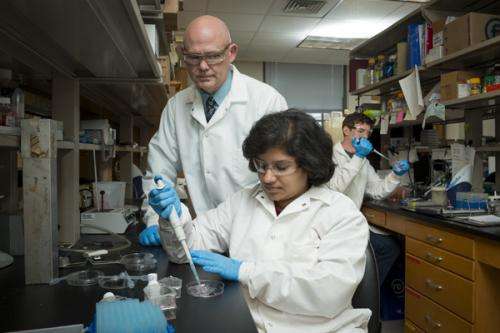
Researchers in the University of Delaware's Department of Biological Sciences are investigating a new drug that has shown positive results in early tests of its ability to fight a rare and aggressive form of breast cancer.
A small, pilot study of the drug found that inflammatory breast cancer (IBC) tumors in mice—which grew to four times their original size in a 10-day period if untreated—remained stable in size when treated with the drug. When a small amount of a traditional chemotherapy drug, which has limited effectiveness in IBC, was combined with the new drug, the number of tumor cells was cut in half.
"It's a nontoxic drug, it's inexpensive, and it's easy to administer," said Kenneth L. van Golen, associate professor of biological sciences and a senior research scientist with the Helen F. Graham Cancer Center at Christiana Care. "To me, it looks like a home run."
Van Golen specializes in IBC research, and the new drug was first brought to his attention by doctoral student Madhura Joglekar. She had read about a small pharmaceutical company in Texas that had developed it to treat gastrointestinal cancer. But she realized that it was designed to target those tumors in the same kind of way that might be effective with IBC tumors. Specifically, the novel drug targets the platelet-derived growth factor receptor.
IBC is relatively rare, uses a different pathway in which it spreads, or metastasizes, and is much more deadly than the common form of breast cancer. Receptors in the typical form of the disease are on the outside of the cell, but in IBC they are on the inside, making them harder to target for treatment.
"This new drug targets receptor molecules and we already knew that's a good approach for IBC," Joglekar said. She brought the studies to van Golen, who contacted manufacturer Arog Pharmaceuticals, and was given the go-ahead to work with the drug, which already is in clinical trials with gastrointestinal cancer patients.
In Joglekar's studies with mice, she and van Golen were especially encouraged by the way the drug seems to significantly increase the effectiveness of the usual chemotherapy. This compound effect, van Golen said, might mean that IBC patients could undergo less extensive chemotherapy, with resulting fewer side effects, than they do now.
Because IBC is highly aggressive, current treatments of surgery, chemotherapy and radiation are generally intensive and harsh. The disease is systemic, spreading rapidly through the lymphatic system, and is often misdiagnosed at first because it resembles an infection more than a traditional form of breast cancer.
That's another reason to be optimistic about the new drug, van Golen said: Because it appears to be so nontoxic, it could be given to a patient, along with an antibiotic, even before the diagnosis is certain, with no harm done if the condition turns out to be merely an infection. But if IBC were later diagnosed, the crucial early cancer treatment would have started without delay.
Joglekar presented the results of the research at an international IBC conference in December, where it received a great deal of positive notice, van Golen said. If preclinical studies continue to produce promising results, he estimated that the drug could be used in Phase 3 clinical trials (the final phase before a drug is usually approved for general use) in two to three years.
Meanwhile, Joglekar said she hopes to conduct longer-term studies on the drug's effects on IBC tumors and on the way it seems to sensitize cells in those tumors to chemotherapy, making that treatment more effective, and also to explore exactly how the drug works at the molecular level.
In addition to investigating its interaction with chemotherapy drugs, van Golen plans to study whether it could also augment the effects of radiation treatment.
"I think this drug is a real winner," he said. "We just need to learn more about how to use it."


