Immune cells cluster and communicate 'like bees,' researcher says
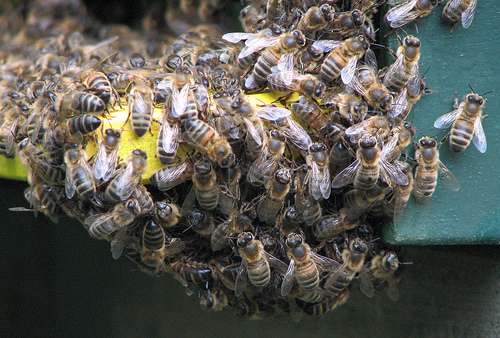
The immune system's T cells, while coordinating responses to diseases and vaccines, act like honey bees sharing information about the best honey sources. Credit: Adstream/Flickr CC
The immune system's T cells, while coordinating responses to diseases and vaccines, act like honey bees sharing information about the best honey sources, according to a new study by scientists at UC San Francisco.
"In the morning, each bee goes looking individually for a sugar source, then comes back to the hive and does a dance in front of the other bees describing the location of what it's found, which helps the hive decide collectively where the best source is," said senior scientist Matthew Krummel, PhD, a UCSF professor of pathology.
They don't bust the same moves as bees, but T cells gather together and communicate essential information to each other in a similar way, Krummel said, thereby helping to coordinate immune responses directed against invading pathogens. This discovery might lead to useful therapeutic interventions to fight disease, according to Krummel.
Results of the study were published online March 10 in Nature Immunology.
Krummel's lab team found that after individual T cells survey lymph nodes and sample foreign matter, such as vaccines, bacteria or viruses, they come together as a group during what he and his team call the "critical differentiation period." This occurs several hours to one day after exposure.
"They cluster together for the purpose of sharing information, transmitting what they've discovered about the new pathogen or vaccine, which in turn helps the immune system mount a coordinated response to the foreign matter," Krummel said.
The discovery is important, Krummel said, because it sheds light on an aspect of medicine that has long been obscure: how vaccines work. "We know that they are effective for years after a vaccination, but we don't know why. It seems that T-cell aggregation is a profound part of the reason."
Krummel's team found that the critical differentiation period is essential to the formation of what is known as a "memory pool," the mechanism by which the immune system recognizes a pathogen to which it had been exposed months or years previously.
"Without that long-term memory, vaccines would be useless," Krummel said. "The body wouldn't remember that it had been exposed to a particular pathogen, such as measles or diphtheria, and would not know how to successfully fight it off."
In experiments with a mouse model of human immune function, the scientists vaccinated mice for listeria, a common bacterium that causes food-borne illness, and then exposed the animals to the bacteria.
Mice in which the critical differentiation period was allowed to occur unimpeded remained healthy, protected from a potentially lethal infection. In mice in which T-cell differentiation was blocked, said Krummel, "it was as if the mice had never been vaccinated at all."
Krummel said the work also opens up new paths of research in immunology, which his laboratory is currently pursuing. "Now that we know that there is a nexus at which the cells are integrating their responses, we might be able to design cells that will join that nexus in order to get the cells to do things we want them to do – push immune response in a particular direction, or enhance it overall," he said.
Conversely, Krummel speculated that in case of autoimmune disorders, such as diabetes or lupus, "it might be possible to attenuate the immune response by blocking the formation of a memory pool."
"You can't eliminate insulin, which is what much of the immune response is reacting to in diabetes," he said. "But if you can tweak the immune cells in the right way, then although each cell would be responding to insulin, they would not be reacting as a group and thus may not become effective at killing the insulin-producing cells. That would severely weaken the autoimmune effect."
Krummel cautioned that while the mouse model of human immune response is "robust and very well-grounded," research will ultimately have to take place in humans, "which will be years away. We'll have to see what happens."
Journal reference:
Nature Immunology
Provided by
University of California, San Francisco
-
'Thin red line' around breast cancer
May 02, 2012 |
not rated yet |
0
-
'Dirty' wild mice may be more relevant immunology model
Sep 08, 2011 |
not rated yet |
0
-
New origin found for a critical immune response
Mar 01, 2009 |
not rated yet |
0
-
Moving towards a better treatment for autoimmune diabetes
Apr 09, 2012 |
not rated yet |
0
-
Signaling pathway reveals mechanism for B cell differentiation in immune response
Apr 22, 2011 |
not rated yet |
0
-
Motion perception revisited: High Phi effect challenges established motion perception assumptions
Apr 23, 2013 |
3 / 5 (2) |
2
-
Anything you can do I can do better: Neuromolecular foundations of the superiority illusion (Update)
Apr 02, 2013 |
4.5 / 5 (11) |
5
-
The visual system as economist: Neural resource allocation in visual adaptation
Mar 30, 2013 |
5 / 5 (2) |
9
-
Separate lives: Neuronal and organismal lifespans decoupled
Mar 27, 2013 |
4.9 / 5 (8) |
0
-
Sizing things up: The evolutionary neurobiology of scale invariance
Feb 28, 2013 |
4.8 / 5 (10) |
14
-
Differences of Classical Mechanics when learned with Calc vs algebra?
3 hours ago
-
what is the distance traveled
7 hours ago
-
Image of a Convex Lens Cut in Half Horizontally
11 hours ago
-
Ray tracing throught optical system of thick lenses
11 hours ago
-
Faraday's law on circular wire
12 hours ago
-
Specific Exergy vs Specific Flow Exergy
13 hours ago
- More from Physics Forums - Classical Physics
More news stories
New immune system discovered
(Medical Xpress)—A research team, led by Jeremy Barr, a biology post-doctoral fellow, unveils a new immune system that protects humans and animals from infection.
Immunology
May 20, 2013 |
4.8 / 5 (23) |
8
|
Vitamin D could provide new and effective treatments for asthma
(Medical Xpress)—Scientists at King's College London have discovered that Vitamin D has the potential to significantly reduce the symptoms of asthma. The study, led by Professor Catherine Hawrylowicz from ...
Immunology
May 20, 2013 |
5 / 5 (1) |
0
|
Immune protein could stop diabetes in its tracks
Melbourne researchers have identified an immune protein that has the potential to stop or reverse the development of type 1 diabetes in its early stages, before insulin-producing cells have been destroyed.
Immunology
May 20, 2013 |
5 / 5 (5) |
0
|
Stem-cell-based strategy boosts immune system in mice
Raising hopes for cell-based therapies, UC San Francisco researchers have created the first functioning human thymus tissue from embryonic stem cells in the laboratory. The researchers showed that, in mice, ...
Immunology
May 16, 2013 |
4.8 / 5 (5) |
0
|
Resistance to visceral leishmaniasis: New mechanisms involved
Researchers from CNRS, Université Toulouse III - Paul Sabatier and IRD have elucidated new molecular mechanisms involved in resistance to visceral leishmaniasis, a serious parasitic infection. They have shown that dectin-1 ...
Immunology
May 16, 2013 |
not rated yet |
0
Calorie information in fast food restaurants used by 40 percent of 9-18 year olds when making food choices
A new study published online today (Thursday) in the Journal of Public Health has found that of young people who visited fast food or chain restaurants in the U.S. in 2010, girls and youth who were obese were more likely ...
Having both migraines, depression may mean smaller brain
(HealthDay)—Migraines and depression can each cause a great deal of suffering, but new research indicates the combination of the two may be linked to something else entirely—a smaller brain.
Slowing the aging process—only with antibiotics
Swiss scientists reveal the mechanism responsible for aging hidden deep within mitochondria—and dramatically slow it down in worms by administering antibiotics to the young.
Brain can be trained in compassion, study shows
Until now, little was scientifically known about the human potential to cultivate compassion—the emotional state of caring for people who are suffering in a way that motivates altruistic behavior.
Researchers complete largest genetic sequencing study of human disease
Researchers from Queen Mary, University of London have led the largest sequencing study of human disease to date, investigating the genetic basis of six autoimmune diseases.
Novel approach for influenza vaccination shows promise in early animal testing
A new approach for immunizing against influenza elicited a more potent immune response and broader protection than the currently licensed seasonal influenza vaccines when tested in mice and ferrets. The vaccine ...